Facts
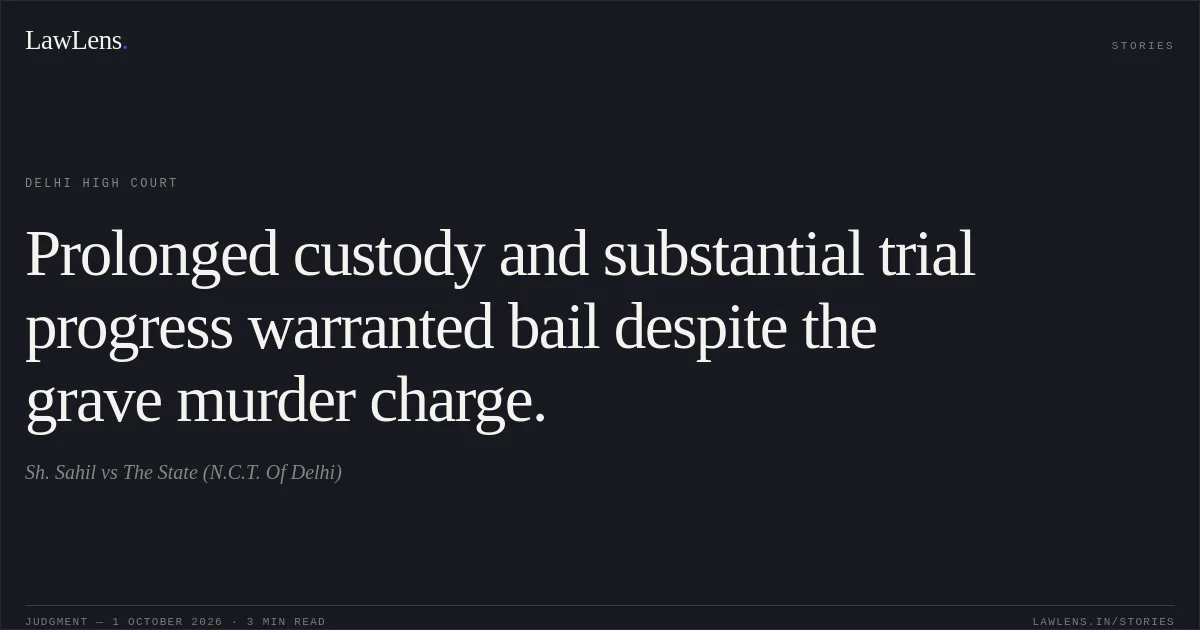
The applicants sought regular bail under Section 483 of the Bharatiya Nagarik Suraksha Sanhita, 2023 (BNSS), in a case arising from the death of Bunty @ Vicky, with charges under Sections 302, 201, 120B and 34 of the Indian Penal Code, 1860 (IPC).
Source reference: para. 1They had been in custody since 8 February 2023; the investigation was complete, the charge-sheet had been filed, and substantial trial evidence had been recorded.
Source reference: paras. 2, 9They relied on their prolonged custody, the evidence already recorded, and the grant of bail to co-accused Anshul Antil.
Source reference: para. 3The State relied, among other things, on an FSL report said to match the deceased’s DNA profile with clothing recovered at the applicants’ instance.
Source reference: para. 4A prosecution witness who was expected to testify about the alleged sale of the applicants’ mobile phones had been dropped because he was untraceable.
Source reference: paras. 7–8Issues
1. Whether the applicants should be granted regular bail, having regard to the seriousness of the charges, the evidence relied upon by the prosecution, and the applicable bail principles.
Source reference: paras. 4, 10–162. Whether prolonged custody, the stage of trial, and the release of a co-accused supported granting bail to the applicants.
Source reference: paras. 3, 9, 16Law Applied
Section 483 of the BNSS confers on the High Court and Court of Session the power to grant regular bail; the charges in this case were under Sections 302, 201, 120B and 34 of the IPC.
Source reference: para. 1Under State of Maharashtra v. Sitaram Popat Vetal, the court must give reasons for granting bail and consider the accusation’s nature and gravity, the supporting evidence, the risk of witness tampering or threats, and other relevant circumstances.
Source reference: para. 10Gurcharan Singh v. State (Delhi Admn.) identifies relevant considerations including the offence’s gravity, the accused’s position, risk of absconding or reoffending, witness tampering, and the history of the case and investigation.
Source reference: para. 11The general principle is “bail, not jail,” subject to risks such as flight, obstruction of justice, reoffending or witness intimidation (State of Rajasthan v. Balchand).
Source reference: para. 12The gravity of a Section 302 charge alone does not require refusal of bail (Prabhakar Tewari v. State of U.P.).
Source reference: para. 13Pre-trial detention is not punitive, and bail principally serves to secure the accused’s appearance at trial (Sanjay Chandra v. CBI).
Source reference: para. 14The Court also considered Zahur Haider Zaidi v. CBI, which treated custody duration and likely trial duration as relevant and noted that concerns about influencing witnesses may be addressed through bail cancellation if misconduct occurs.
Source reference: para. 15Reasoning
The Court considered the prosecution’s reliance on the DNA evidence from recovered clothing, as well as the applicants’ response relying on State of Rajasthan v. Hanuman, without determining the evidence’s ultimate merits at the bail stage.
Source reference: paras. 4–6, 22It weighed the seriousness of the charge against the applicants’ custody of more than three years and seven months, the substantial progress of the trial, the fact that a material witness had been dropped, and the release of co-accused Anshul Antil in circumstances relevant to these applications.
Source reference: paras. 3, 8–9Applying the principles governing bail and pre-trial detention, the Court found the totality of those circumstances sufficient to grant bail, subject to safeguards.
Source reference: paras. 10–16Holding
The Court allowed both applications and directed that Dheeraj Toor and Sahil be released on regular bail, each on a bond of ₹25,000 with one surety for the like amount, subject to the stated conditions, including restrictions on travel, contact with witnesses and involvement in criminal activity, and monthly reporting to the concerned SHO.
The Trial Court was requested to expedite the proceedings; the Court clarified that its observations were confined to the bail applications and would not affect the trial.
Source reference: paras. 21–22Acts & Sections Cited
6 provisions across 3 statutes referred to in this judgment. Each provision opens on LawLens.
Bharatiya Nagarik Suraksha Sanhita, 20231
Indian Penal Code, 18603
Code of Criminal Procedure, 19732
Original Court PDF
Sh. SahilvsThe State (N.C.T. Of Delhi)
Click to open original judgment
Original judgment, available to read, download and summarize on LawLens.in