Facts
The petitioners sought quashing of FIR Case Crime No. 231 of 2026, Police Station Raniganj, District Pratapgarh, registered under Sections 352, 351(3) and 324(4) of the Bharatiya Nyaya Sanhita, 2023 (“BNS”), corresponding broadly to Sections 504, 506 and 427 IPC, and sought protection from arrest and prosecution.
Source reference: p.1, para. 4The informant alleged that on 3 June 2026, while cultivating his land with a tractor, the petitioners abused him, threatened him and damaged the boundary wall of the property.
Source reference: p.1, para. 5The petitioners disputed the allegations, asserting that the informant and his associates had attempted to encroach upon their land and that the FIR was a retaliatory and fabricated proceeding.
Source reference: p.2, para. 6They further contended that the offence corresponding to Section 506 IPC was non-cognizable under the BNSS and that the police could not investigate without a Magistrate’s order under Section 174(2) BNSS.
Source reference: pp. 6–7, paras. 9–10The State relied upon the Uttar Pradesh notification dated 31 July 1989, issued under Section 10 of the Criminal Law (Amendment) Act, 1932, which made the offence under Section 506 IPC cognizable and non-bailable in Uttar Pradesh.
Source reference: pp. 7–8, paras. 11–12Issues
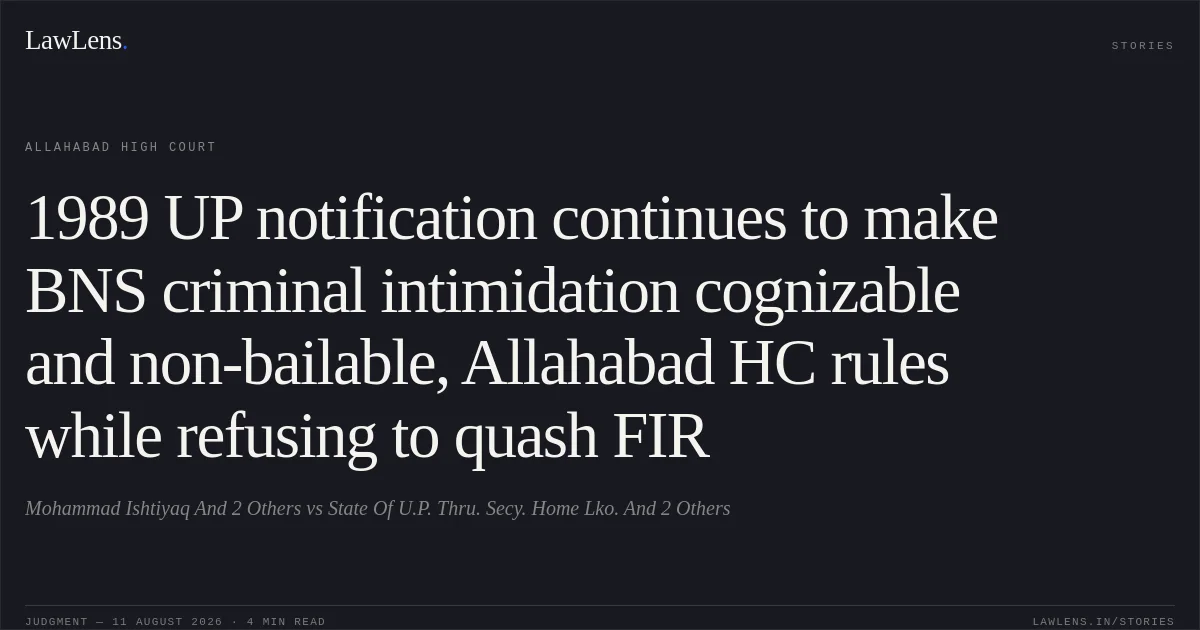
Whether the Uttar Pradesh notification dated 31 July 1989, making an offence corresponding to Section 506 IPC cognizable and non-bailable, survived the repeal of the Code of Criminal Procedure, 1973 and continued to apply to Section 351 BNS under the BNSS?
Source reference: pp. 6–7, paras. 9–10; pp. 20–21, para. 21Whether the FIR was liable to be quashed on the ground that the alleged offence under Section 351 BNS was non-cognizable and that investigation could not proceed without an order under Section 174(2) BNSS?
Source reference: pp. 6–7, paras. 9–10; pp. 20–21, paras. 21, 26Whether the petitioners were entitled to protection against arrest and whether the Investigating Officer was required to comply with the safeguards governing offences punishable with imprisonment up to seven years?
Source reference: pp. 21–23, paras. 22–27Law Applied
The Court applied Section 531(2)(b) of the BNSS, which saves notifications, orders and powers in force immediately before the commencement of the BNSS and treats them as issued under the corresponding provisions of the new Sanhita.
Source reference: pp. 3–5, para. 7; pp. 8–10, para. 12It also applied Section 8 of the General Clauses Act, 1897, under which references to repealed enactments are generally construed as references to the corresponding re-enacted provisions.
Source reference: pp. 9–10, para. 12Section 10 of the Criminal Law (Amendment) Act, 1932 authorises the State Government to declare specified offences, including the offence under Section 506 IPC, cognizable and non-bailable by notification.
Source reference: pp. 9–10, para. 12Relying on Mata Sevak Upadhyay v. State of U.P., Aires Rodrigues v. Vishwajeet P. Rane, and Vinay Kumar Pandey v. State of U.P., the Court held that the 31 July 1989 notification remained valid and applied to the corresponding BNS provision.
Source reference: pp. 10–20, paras. 12–21The Court further applied the principles in Arnesh Kumar v. State of Bihar and Md. Asfak Alam v. State of Jharkhand, requiring strict compliance with statutory safeguards and notice requirements before arrest in offences punishable with imprisonment up to seven years.
Source reference: pp. 21–23, paras. 22–25The principles governing interference with an FIR at the threshold under State of Haryana v. Bhajan Lal, Neeharika Infrastructure Pvt. Ltd. v. State of Maharashtra and Leelavati Devi v. State of U.P. were also applied.
Source reference: p. 23, para. 26Reasoning
The Court rejected the petitioners’ reliance on Raman Sahni, observing that that decision concerned the effect of the repeal of the CrPC on the Uttar Pradesh amendment relating to anticipatory bail, whereas the present case concerned a notification issued under the independent statutory authority of Section 10 of the Criminal Law (Amendment) Act, 1932.
Source reference: pp. 7–8, paras. 11–12The Court preferred the reasoning in Mata Sevak Upadhyay, which had upheld the validity of the 1989 notification, and treated the contrary view in Virendra Singh as not binding because it had neither considered nor distinguished the earlier Full Bench decision.
Source reference: pp. 14–18, paras. 13–16In light of Section 531(2)(b) BNSS, Section 8 of the General Clauses Act and the Supreme Court’s decision in Aires Rodrigues, the Court held that the notification was preserved and must be read as applying to the corresponding BNS provision.
Source reference: pp. 19–21, paras. 19–21Consequently, the offence under Section 351 BNS remained cognizable and non-bailable in Uttar Pradesh despite its classification in the First Schedule to the BNSS.
Source reference: pp. 19–21, paras. 19–21Since the FIR disclosed, at least prima facie, a cognizable offence, the Court found no ground for quashing it at the investigation stage under the principles governing such interference.
Source reference: p. 23, para. 26Nevertheless, because the alleged offences attracted punishment up to seven years, the Court directed the Investigating Officer to comply with the safeguards against unnecessary arrest and to issue notice under Sections 35 and 35(3) BNSS before taking coercive action.
Source reference: pp. 21–23, paras. 22–27Holding
The Court held that the Uttar Pradesh notification dated 31 July 1989 remained operative after the commencement of the BNSS and continued to render the offence corresponding to Section 506 IPC—namely, the relevant offence under Section 351 BNS—cognizable and non-bailable in Uttar Pradesh.
The challenge to the FIR on the ground of non-cognizability and absence of a Magistrate’s order was therefore rejected, and the prayer for quashing the FIR was dismissed.
Source reference: p. 23, para. 26The writ petition was dismissed at the admission stage, subject to the direction that the Investigating Officer must issue notice under Sections 35 and 35(3) BNSS before arrest or other coercive action and that the petitioners must cooperate with the investigation.
Source reference: p. 23, paras. 27–28Acts & Sections Cited
31 provisions across 6 statutes referred to in this judgment. Each provision opens on LawLens.
Bharatiya Nagarik Suraksha Sanhita, 20238
Bharatiya Nyaya Sanhita, 20233
Code of Criminal Procedure, 19735
Dowry Prohibition Act, 19611
General Clauses Act, 18972
Original Court PDF
Mohammad Ishtiyaq And 2 OthersvsState Of U.P. Thru. Secy. Home Lko. And 2 Others
Click to open original judgment
Original judgment, available to read, download and summarize on LawLens.in