01Facts
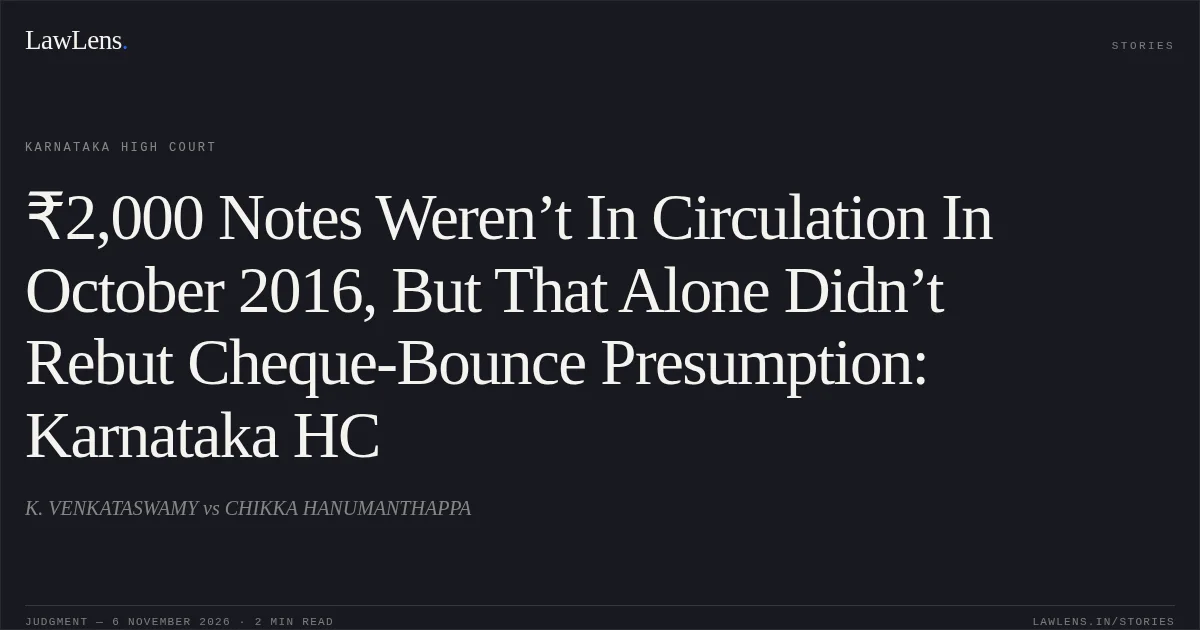
The complainant alleged that he lent the accused ₹2,50,000 in cash on 10 October 2016 and that the accused issued a cheque for repayment. The cheque was dishonoured for insufficiency of funds; the complainant issued a demand notice, which was served, but the accused did not pay or reply.
¶ 3–4The trial court convicted the accused under Section 138 of the Negotiable Instruments Act, 1881, and imposed a fine of ₹3,50,000; the appellate court confirmed the conviction and sentence.
¶ 6–9In revision, the accused challenged the concurrent findings, principally arguing that the complainant had not established financial capacity or the alleged loan.
¶ 1202Issues
i.1. Whether the concurrent findings of conviction and sentence were perverse, grossly erroneous, or otherwise liable to interference in revision.
¶ 13ii.2. Whether the accused rebutted the statutory presumptions under Sections 118 and 139 of the Negotiable Instruments Act by raising a credible defence concerning the cheque or the complainant’s financial capacity.
¶ 18–1903Law Applied
Section 138 of the Negotiable Instruments Act applies where a cheque is issued towards a legally enforceable debt or liability, dishonoured, followed by a timely written demand notice, and the drawer fails to pay within the prescribed period.
¶ 17Sections 118 and 139 raise rebuttable presumptions that the cheque was issued for consideration and towards discharge of a legally recoverable debt.
¶ 18The High Court’s revisional jurisdiction under Sections 397 and 401 Cr.P.C. is supervisory, not equivalent to appellate jurisdiction; interference with concurrent findings is warranted where they are perverse, grossly erroneous, unreasonable, untenable, based on irrelevant or no material, or reflect arbitrary or capricious exercise of discretion.
¶ 15–16The Court relied on Kuntegowda v. Thurubaiah, Criminal Appeal No. 3654 of 2026, 2026 SCC OnLine SC 1485, and the principles stated in State of Maharashtra v. Jagmohan Singh Kuldip Singh Anand, (2004) 7 SCC 659, and State of Kerala v. Puttumana Illath Jathavedan Namboodiri, (1999) 2 SCC 452.
¶ 15Provisions in the judgment · 7 · Linked ones open on LawLens
Code of Criminal Procedure, 1973 Section 397Section 401Section 200Section 313
Negotiable Instruments Act, 1881 Section 138Section 139Section 118
04Reasoning
The Court found that the cheque was dishonoured, the demand notice was served at the accused’s address, and the accused did not reply.
¶ 20–21The accused’s evidence concerning an alleged security cheque given to Devaraju was inconsistent and did not establish that defence; the Court also noted that the accused later relied on a stop-payment instruction.
¶ 22–23The challenge to the complainant’s capacity and the alleged cash denominations did not, in the Court’s view, rebut the statutory presumptions.
¶ 24–25The complainant testified to income from agriculture and livestock, and the accused had not elicited evidence in cross-examination sufficient to discredit that account; nor had the accused raised the financial-capacity defence in his own evidence.
¶ 24–25Finding no material showing that the lower courts had ignored relevant evidence or relied on irrelevant material, the High Court held that the threshold for revisional interference was not met.
¶ 2605Holding
The High Court answered the revisional question in the negative and dismissed the revision petition.
¶ 14, 26–27The trial court’s conviction and sentence, as confirmed by the appellate court, were left undisturbed.
¶ 14, 26–27Original Court PDF
K. VENKATASWAMYvsCHIKKA HANUMANTHAPPA
Click to open original judgment
Original judgment, available to read, download and summarize on LawLens.in