Facts
The petitioner-defendant agreed to sell the disputed land to the respondent-plaintiff on 3 July 1991 for ₹25,000, receiving ₹13,000 as advance, with the balance ₹12,000 payable at the time of execution of the sale deed.
Source reference: para. 1The plaintiff instituted a suit for specific performance, which was dismissed by the trial court on 18 August 1998 on the finding that the agreement was a device relating to a loan transaction.
Source reference: para. 2The first appellate court reversed that decision on 22 November 2003 and decreed specific performance, directing the plaintiff to deposit the balance consideration within one month and the defendant to execute the sale deed within two months.
Source reference: para. 3The defendant’s second appeal was not stayed and was ultimately dismissed on 23 September 2019.
Source reference: para. 4The plaintiff initiated execution proceedings only on 6 August 2012 and did not deposit the balance consideration within the period fixed by the appellate decree.
Source reference: para. 4The executing court allowed those applications on payment of ₹1,000 as costs and rejected the defendant’s application under Section 28. The revisional court affirmed that order on 6 April 2026, leading to the present petition under Article 227.
Source reference: paras. 4–5Issues
Whether the executing court could extend the time for depositing the balance sale consideration after more than twenty years from the decree for specific performance?
Source reference: para. 12; pp. 3–4Whether, in view of the plaintiff’s prolonged and unexplained failure to deposit the balance consideration, the defendant was entitled to rescission of the contract/decree under Section 28 of the Specific Relief Act, 1963?
Source reference: paras. 12, 30–33; pp. 3–5, 11–13Whether the pendency and subsequent dismissal of the second appeal, and the doctrine of merger, justified treating the period for compliance as commencing only from the High Court’s judgment dated 23 September 2019?
Source reference: paras. 23–29, 36–38; pp. 10–16Law Applied
Section 28(1) of the Specific Relief Act, 1963 empowers the court, in its discretion, either to rescind a specific-performance decree for non-payment within the prescribed period or to extend the time for payment; the court does not become functus officio after passing the decree and retains jurisdiction until execution of the sale deed.
Source reference: paras. 13–15, 19–20A decree for specific performance is in the nature of a preliminary decree, and non-compliance does not invariably result in automatic rescission, although a decree containing an express self-operative consequence may become inexecutable on default.
Source reference: paras. 15–18Under Chanda v. Rattni, Sardar Mohar Singh v. Mangilal, Bhupinder Kumar v. Angrej Singh, and Ramankutty Guptan v. Avara, extension of time may be granted even after expiry of the original period and even where the decree was passed by an appellate court.
Source reference: paras. 21–22However, under Ram Lal v. Jarnail Singh and Anand Narayan Shukla v. [respondent], the discretion must be exercised judiciously by considering the decree-holder’s bona fides, the cause and length of delay, the parties’ conduct, and equities created during the intervening period; willful negligence or conduct indicating absence of intention to perform may justify rescission.
Source reference: paras. 31–33The doctrine of merger makes the appellate decree the operative decree but does not, by itself, erase the decree-holder’s prior default or automatically restart the period for payment.
Source reference: paras. 36–37Reasoning
The High Court held that although Section 28 confers a broad discretionary power to extend time, that discretion had to be exercised in light of the plaintiff’s conduct and the equities between the parties.
Source reference: paras. 30–33The plaintiff did not deposit the balance consideration within one month of the appellate decree dated 22 November 2003, waited approximately nine years before initiating execution, and failed to pursue the extension application allegedly filed in 2012.
Source reference: paras. 23–27The second appeal neither stayed execution nor was actively contested by the plaintiff, and even after its dismissal on 23 September 2019, the plaintiff waited until 17 November 2025—approximately six years—to seek extension and condonation.
Source reference: paras. 24–29This conduct demonstrated willful negligence and an absence of prompt intention to complete the contract.
Source reference: paras. 30–33Although the decree merged into the High Court’s second-appeal judgment, the merger doctrine did not justify disregarding the earlier default or treating 2019 as the starting point for compliance.
Source reference: paras. 36–38A payment of merely ₹1,000 as costs was also insufficient to balance the equities arising from the delay of more than two decades.
Source reference: para. 39Holding
The High Court allowed the Article 227 petition and set aside both the executing court’s order dated 23 December 2025 and the revisional court’s order dated 6 April 2026.
It held that, on the facts, the plaintiff was not entitled to extension of time for depositing the balance sale consideration and that the defendant’s application under Section 28 ought not to have been rejected.
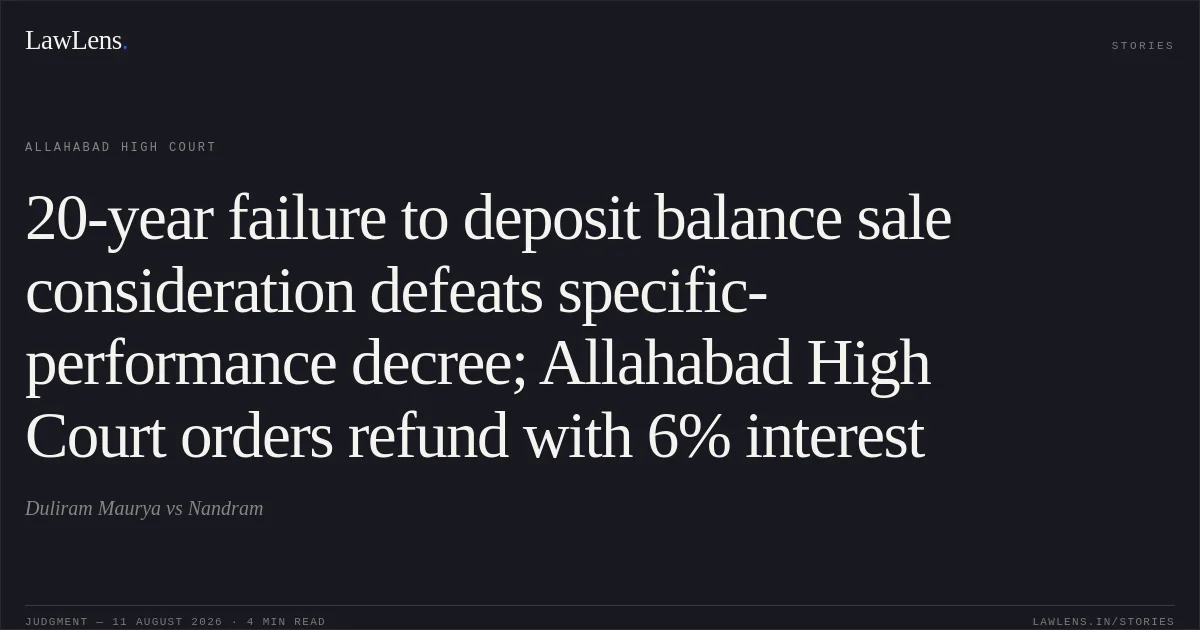
Source reference: paras. 39–41The defendant was directed to refund the ₹13,000 advance received under the agreement dated 3 July 1991, together with interest at 6% per annum from the date of receipt, within one month.
Source reference: para. 43Acts & Sections Cited
4 provisions across 3 statutes referred to in this judgment. Each provision opens on LawLens.
Specific Relief Act, 19631
Code of Civil Procedure, 19082
Limitation Act, 19631
Original Court PDF
Duliram MauryavsNandram
Click to open original judgment
Original judgment, available to read, download and summarize on LawLens.in