Facts
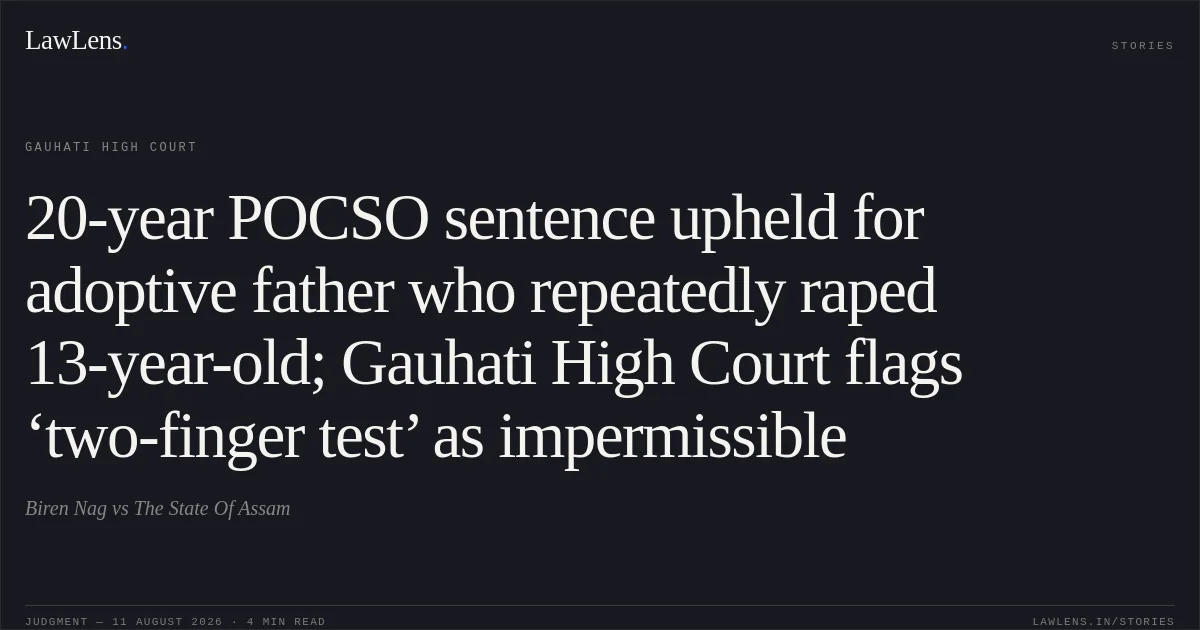
The appellant was tried for repeatedly raping his 13-year-old adopted daughter from April 2022.
Source reference: paras. 3, 10, 14, 19, 24; pp. 2–5, 7–8The victim initially disclosed the incidents to a village resident, PW-4, on 9 September 2022; villagers thereafter convened a meeting, where the appellant allegedly confessed, and PW-1 lodged the FIR on 10 September 2022.
Source reference: paras. 3, 10, 14, 19, 24; pp. 2–5, 7–8The prosecution case was that the victim had earlier informed her foster mother, who instructed her not to disclose the incidents.
Source reference: paras. 3, 10, 14, 19, 24; pp. 2–5, 7–8The appellant was charged under Sections 376 and 201 IPC read with Section 6 of the POCSO Act. His wife was separately charged under Section 201 IPC read with Sections 17 and 21 of the POCSO Act.
Source reference: paras. 5–6, 18; pp. 3, 7The victim was not cited as a prosecution witness in the charge-sheet but was examined by the Trial Court as Court Witness No. 1.
Source reference: paras. 5–6, 18; pp. 3, 7The Special Judge, POCSO, Karbi Anglong, convicted the appellant under Section 6 of the POCSO Act, relating to aggravated penetrative sexual assault under Section 5(n), and sentenced him to 20 years’ rigorous imprisonment with a fine of ₹10,000.
Source reference: para. 2, 6; pp. 2–3He was acquitted under Section 201 IPC, while his wife was acquitted of all charges.
Source reference: para. 2, 6; pp. 2–3Issues
Whether the testimony of the victim, examined as a Court Witness, together with her Section 164 Cr.P.C. statement and surrounding evidence, proved beyond reasonable doubt that the appellant had repeatedly raped her?
Source reference: paras. 19–24, 39–40; pp. 7–9, 15–16Whether the delay of approximately five months in lodging the FIR rendered the prosecution case doubtful?
Source reference: paras. 25–30; pp. 9–10Whether the medical evidence, including the two-finger examination, could corroborate or undermine the allegation of rape?
Source reference: paras. 16, 31–33; pp. 6, 10–11Whether the appellant’s explanation under Section 313 Cr.P.C.—that the victim falsely implicated him after being disciplined for refusing to attend school and messaging a boy—created a reasonable doubt?
Source reference: paras. 23, 35, 38–40; pp. 8, 11, 15–16Whether the alleged extra-judicial confession before the villagers could be relied upon as corroborative evidence?
Source reference: paras. 36–38; pp. 11–15Law Applied
The Court applied Section 6 of the POCSO Act, which prescribes punishment for aggravated penetrative sexual assault, including the circumstances covered by Section 5(n), where the offender repeatedly commits penetrative sexual assault on a child; Sections 376 and 201 IPC were also part of the charge, though the appellant was acquitted under Section 201 IPC.
Source reference: paras. 2, 5–6; pp. 2–3The Court relied on the principle that the credible and consistent testimony of a sexual-offence victim can, by itself, sustain a conviction, particularly where it is corroborated by surrounding circumstances and the victim’s prior statement.
Source reference: paras. 19–24, 39–40; pp. 7–9, 15–16On delay, it applied Apren Joseph v. State of Kerala, Deepak v. State of Haryana, State of Punjab v. Gurmit Singh, State of H.P. v. Gian Chand and State of U.P. v. Manoj Kumar Pandey, holding that delay in rape cases, especially where the accused is a relative or trusted family member, is not necessarily fatal if reasonably explained.
Source reference: paras. 25–30; pp. 9–10Regarding medical evidence, the Court relied on Lillu v. State of Haryana and State of Jharkhand v. Sainendra Kumar Rai to hold that the two-finger test lacks scientific basis, violates the survivor’s privacy and dignity, and that the condition of the hymen neither proves nor disproves sexual assault.
Source reference: paras. 31–33; pp. 10–11As to the extra-judicial confession, the Court applied the principles stated in Pritinder Singh v. State of Punjab and the authorities cited therein: such a confession is a weak form of evidence, but may support conviction if voluntary, truthful, credible and corroborated.
Source reference: paras. 36–37; pp. 11–15Reasoning
The Court found the victim’s evidence consistent, specific and materially corroborated by her Section 164 Cr.P.C. statement, her prompt disclosure to PW-4 and PW-1 once the abuse became unbearable, and the evidence that she had been living in a shelter home after the incident.
Source reference: paras. 19–21, 24, 30, 39–40; pp. 7–9, 10, 15–16The delay was held satisfactorily explained because the victim was a young adopted child, the alleged perpetrator was her foster father, and her foster mother had discouraged disclosure.
Source reference: paras. 24–30; pp. 8–10The Court held that the absence of injuries did not discredit the allegation.
Source reference: paras. 31–33; pp. 10–11Although it criticised the doctor’s use of the two-finger test as legally and medically impermissible, it clarified that hymenal findings cannot determine whether rape occurred; the victim’s trustworthy testimony remained the principal evidence.
Source reference: paras. 31–33; pp. 10–11The appellant’s Section 313 explanation was treated as an afterthought because the alleged mobile-phone messaging was not put to the victim or other witnesses in cross-examination, and no defence evidence was led to substantiate the proposed false-implication theory.
Source reference: paras. 35, 40; pp. 11, 15–16The Court also accepted PW-1’s unchallenged evidence that the appellant confessed before the villagers.
Source reference: paras. 36–38; pp. 11–15While recognising the inherent weakness of an extra-judicial confession, it found that the statement was supported by the victim’s evidence and other circumstances and therefore furnished additional corroboration.
Source reference: paras. 36–38; pp. 11–15The fact that the victim had been omitted from the charge-sheet did not render her evidence inadmissible; the Trial Court was entitled to examine her as a Court Witness, and her testimony remained materially unshaken in cross-examination.
Source reference: paras. 18, 40; pp. 7, 15–16Holding
The High Court answered the issues against the appellant.
It held that the prosecution proved beyond reasonable doubt that the appellant had repeatedly subjected his 13-year-old adopted daughter to penetrative sexual assault, constituting aggravated penetrative sexual assault under Sections 5(n) and 6 of the POCSO Act.
Source reference: paras. 34, 39–41; pp. 11, 15–16The delay in the FIR, absence of injuries, medical examination, omission of the victim from the charge-sheet, and the appellant’s Section 313 explanation did not create reasonable doubt.
Source reference: paras. 41–43; p. 16The appeal was dismissed and the conviction and sentence of 20 years’ rigorous imprisonment with a ₹10,000 fine were upheld; the Trial Court Record was directed to be returned.
Source reference: paras. 41–43; p. 16Acts & Sections Cited
8 provisions across 3 statutes referred to in this judgment. Each provision opens on LawLens.
Protection of Children from Sexual Offences Act, 20124
Indian Penal Code, 18602
Code of Criminal Procedure, 19732
Original Court PDF
Biren NagvsThe State Of Assam
Click to open original judgment
Original judgment, available to read, download and summarize on LawLens.in