Facts
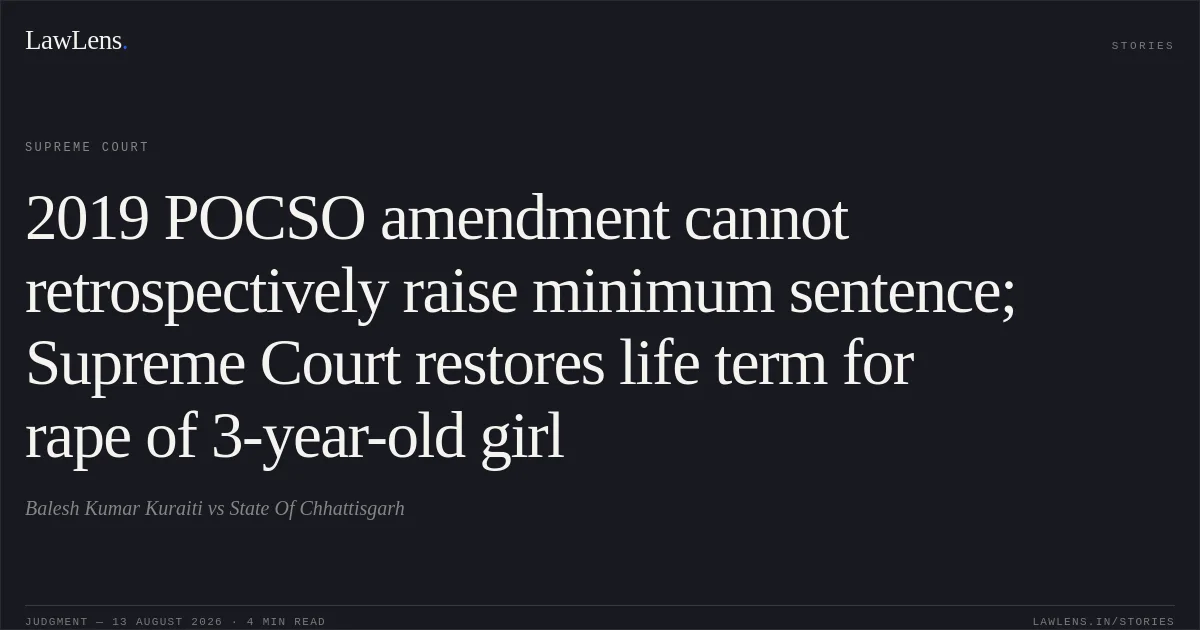
The appellant was convicted for aggravated penetrative sexual assault upon a three-year-old girl arising from an incident dated 17 February 2016. The Trial Court relied on the testimony of the victim, her parents, medical evidence showing facial and genital injuries, and forensic evidence detecting human sperm on the victim’s vaginal slide. It convicted the appellant under Section 376(2)(i) of the Indian Penal Code, 1860 (“IPC”) and Section 6 of the Protection of Children from Sexual Offences Act, 2012 (“POCSO Act”), sentencing him to imprisonment for life and fine of ₹10,000 for each offence, with the sentences to run concurrently
Source reference: paras. 3–9; pp. 2–6The High Court affirmed the conviction but reduced the sentence to 20 years’ rigorous imprisonment for both offences, relying upon the amended Section 6 of the POCSO Act and Section 42 of that Act. The Supreme Court granted leave limited to the question of sentence and did not reconsider the conviction
Source reference: paras. 10–11; pp. 6–7Issues
Whether the High Court was justified in applying the 2019 amendment to Section 6 of the POCSO Act, which enhanced the minimum punishment from ten years to twenty years, to an offence committed in 2016?
Source reference: paras. 11–19; pp. 7–10Whether, in view of Section 42 of the POCSO Act, the sentence under Section 376(2)(i) IPC or Section 6 of the POCSO Act constituted the greater punishment applicable to the appellant?
Source reference: paras. 20–26; pp. 11–15Whether the High Court’s reduction of the sentence from life imprisonment to 20 years’ rigorous imprisonment was legally sustainable in the absence of adequate sentencing reasons?
Source reference: paras. 27–29; pp. 15–16Law Applied
The Court applied Article 20(1) of the Constitution, which prohibits conviction or imposition of a greater penalty under a law enacted after the commission of the offence. Section 6 of the POCSO Act, as it stood in 2016, prescribed rigorous imprisonment of not less than ten years, extendable to imprisonment for life, whereas the 2019 amendment enhanced the minimum punishment to twenty years and defined life imprisonment as imprisonment for the remainder of the offender’s natural life; the amended provision could operate only prospectively.
Source reference: paras. 13–19; pp. 8–10Section 376(2)(i) IPC, as applicable to the offence, prescribed rigorous imprisonment of not less than ten years, extendable to life imprisonment, with life imprisonment expressly meaning imprisonment for the remainder of the offender’s natural life. Under Section 42 of the POCSO Act, where the same act constitutes offences under the POCSO Act and the IPC, the offender is liable to punishment under the enactment providing the greater punishment.
Source reference: paras. 20–23; pp. 11–13The Court relied on Satauram Mandavi v. State of Chhattisgarh, 2025 INSC 892, on the prohibition against imposing a sentence outside the statutory framework existing when the offence was committed; Swamy Shraddananda v. State of Karnataka, (2008) 13 SCC 767, and Union of India v. V. Sriharan, (2016) 7 SCC 1, on judicial determination of the actual period to be served within the broad category of life imprisonment; and Gyanendra Singh @ Raja Singh v. State of Uttar Pradesh, 2025 INSC 335, on imposing life imprisonment without necessarily stipulating that it must continue until the convict’s natural life.
Source reference: paras. 19, 24–25; pp. 10, 13–15Reasoning
The offence was committed in 2016, before the POCSO Amendment Act, 2019 came into force on 16 September 2019. Applying Article 20(1), the Court held that the High Court could not rely on the amended Section 6 to impose or justify the enhanced 20-year minimum sentence. The governing POCSO provision was therefore the unamended Section 6, under which life imprisonment was available but early-release benefits remained subject to the applicable statutory regime.
Source reference: paras. 16–19; pp. 9–10The Court further considered Section 42 because the appellant had been convicted under both Section 376(2)(i) IPC and Section 6 POCSO. Although Section 376(2)(i) contained an express reference to imprisonment for the remainder of natural life, the Court relied on the sentencing jurisprudence recognising that courts may impose life imprisonment without directing that incarceration must necessarily continue until natural death.
Source reference: paras. 23–26; pp. 13–15The High Court’s brief conclusion that 20 years’ rigorous imprisonment would suffice did not explain why the Trial Court’s life sentence, imposed after considering the victim’s age and the gravity of the offence, required reduction. The Supreme Court therefore found the High Court’s sentencing determination legally unsustainable.
Source reference: paras. 27–29; pp. 15–16Holding
The Court answered the principal issue in the negative and held that the High Court erred in applying the 2019 amendment to Section 6 of the POCSO Act to the appellant’s 2016 offence.
It set aside the High Court’s judgment insofar as it reduced the sentence and restored the Trial Court’s sentence: imprisonment for life and a fine of ₹10,000 for the offence under the unamended Section 6 of the POCSO Act, and imprisonment for life and a fine of ₹10,000 for the offence under Section 376(2)(i) IPC. The sentences were directed to run concurrently, without stipulation that imprisonment must continue for the appellant’s natural life, and were to include the period already undergone. The conviction, fines, and other directions relating to victim compensation were left undisturbed.
Source reference: paras. 29–30, 35; pp. 16–18Acts & Sections Cited
9 provisions across 2 statutes referred to in this judgment. Each provision opens on LawLens.
Indian Penal Code, 18604
Protection of Children from Sexual Offences Act, 20125
Original Court PDF
Balesh Kumar KuraitivsState Of Chhattisgarh
Click to open original judgment
Original judgment, available to read, download and summarize on LawLens.in