Facts
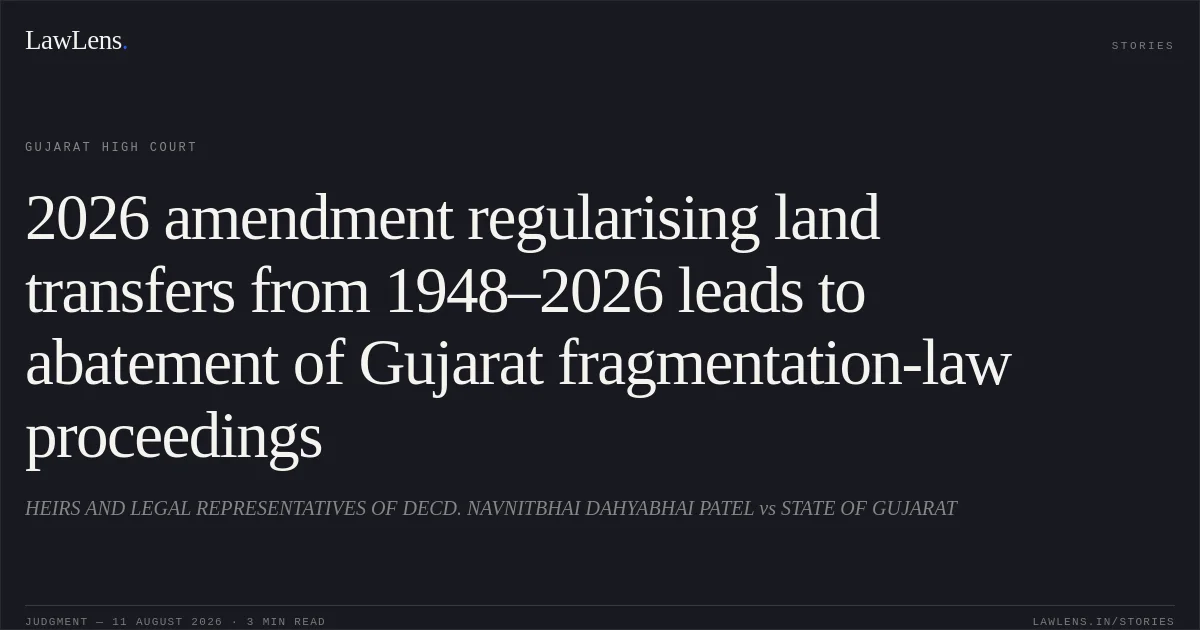
The petitioners invoked Articles 226 and 227 of the Constitution challenging the order dated 3 March 2016 passed by the Special Secretary, Revenue Department (SSRD), in Revision Application No. 3 of 2000, and the order dated 24 September 2009 passed by the Deputy Collector in proceedings concerning an alleged breach of the Gujarat Prevention of Fragmentation and Consolidation of Holdings Act, 1947 (“Fragmentation Act”).
Source reference: p.1The transaction in question arose from an agreement to sell dated 26 August 1963 and was stated to fall within the period covered by the subsequent statutory amendment.
Source reference: p.2During the hearing, the State relied on the Gujarat Ordinance No. 2 of 2026 and the Notification dated 14 July 2026, introducing Section 9(4), under which specified transfers or partitions made between 29 January 1948 and 31 March 2026 were deemed regularised and pending proceedings were required to abate.
Source reference: pp.2–3, 5The State sought remand to the competent authority to determine whether the transaction fell within the amended provision, while the petitioners contended that the proceedings should directly be declared abated.
Source reference: p.2Issues
Whether the transfer in question, having occurred within the period specified in Section 9(4) of the Fragmentation Act, stood deemed regularised and the pending proceedings abated?
Source reference: pp.2–3, 5–6Whether the matter should be remanded to the competent authority for reconsideration in light of the 2026 amendment, or whether the High Court could directly declare the proceedings abated?
Source reference: pp.2, 5–6Law Applied
The Court applied Articles 226 and 227 of the Constitution in examining the legality of the impugned revenue orders.
Source reference: p.1It relied on the Gujarat Prevention of Fragmentation and Consolidation of Holdings Act, 1947, as amended by Gujarat Ordinance No. 2 of 2026 and the Notification dated 14 July 2026.
Source reference: p.3Section 9(4) provides that a transfer or partition contrary to the Act, made on or after 29 January 1948 but on or before 31 March 2026, shall be deemed regularised without penalty or premium, and that all pending proceedings before any officer or authority relating to such transfer or partition shall abate.
Source reference: pp.3, 5The Court also relied on Peter Augustine v. K.V. Xavier, 2025 INSC 771, for the principle that remand is not routine and should not be ordered where it would serve no useful purpose or merely prolong litigation and create multiplicity of proceedings.
Source reference: p.6Reasoning
The Court found that the transaction was a bona fide transaction and that the original landowners had already received the consideration, with no subsisting dispute regarding payment.
Source reference: p.6Since the agreement to sell was executed on 26 August 1963, the transaction fell within the temporal scope of Section 9(4), namely, between 29 January 1948 and 31 March 2026.
Source reference: pp.2, 6The statutory consequence was automatic deemed regularisation and abatement of pending proceedings.
Source reference: p.6Applying Peter Augustine, the Court held that remand would serve no useful purpose because the amended provision had already resolved the legal consequence applicable to the transaction; remand would instead result in unnecessary delay and multiplicity of proceedings.
Source reference: p.6The Court therefore declined the State’s request for remand and directly applied Section 9(4) to the pending proceedings.
Source reference: p.6Holding
The petition was allowed.
The Court held that, by virtue of Section 9(4) of the Fragmentation Act, the transaction stood deemed regularised and the proceedings initiated against the petitioners abated.
Source reference: p.7Consequently, the orders dated 24 September 2009 and 3 March 2016 were quashed and set aside.
Source reference: p.7Acts & Sections Cited
3 provisions across 1 statute referred to in this judgment. Each provision opens on LawLens.
Original Court PDF
HEIRS AND LEGAL REPRESENTATIVES OF DECD. NAVNITBHAI DAHYABHAI PATELvsSTATE OF GUJARAT
Click to open original judgment
Original judgment, available to read, download and summarize on LawLens.in