Facts
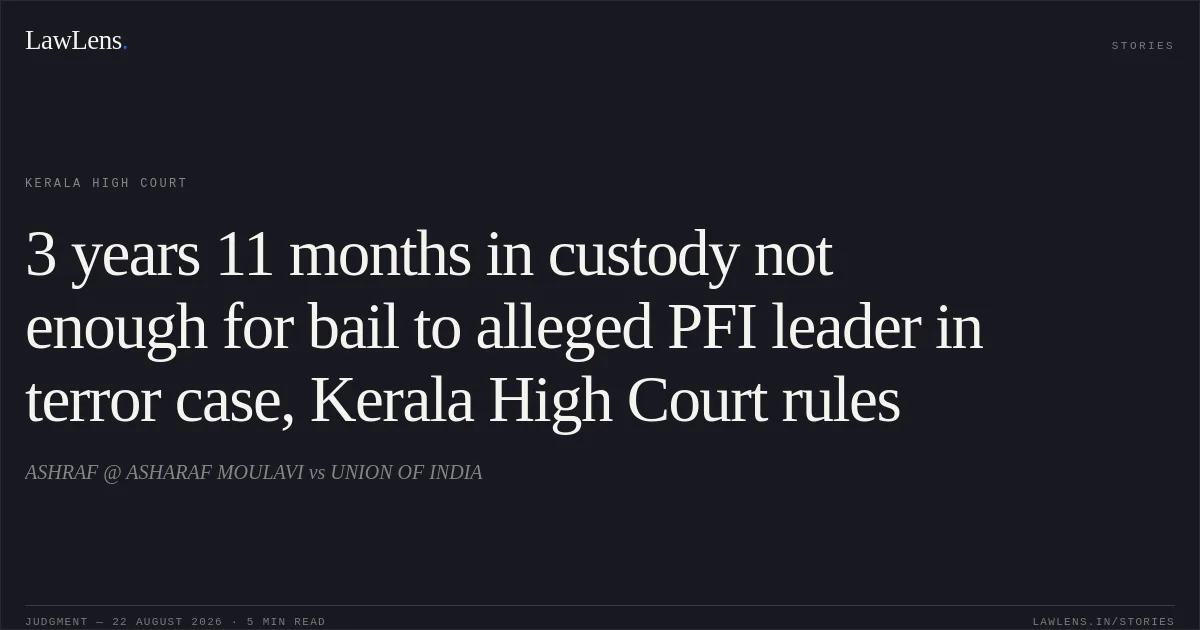
The appellant, Ashraf @ Ashraf Moulavi, was Accused No. 2 in S.C. No. 2 of 2023 before the Special Court for NIA Cases, Ernakulam.
Source reference: paras. 2–15The prosecution alleged that the Popular Front of India (PFI) had entered into a larger conspiracy to radicalise cadres, conduct arms training, identify and target leaders of other communities, and commit terrorist acts.
Source reference: paras. 2–15The appellant was alleged to be a senior PFI leader who promoted the “India 2047” agenda, encouraged recruitment to ISIS/Daesh, organised arms training, maintained links with other accused, and participated in the conspiracy leading to the murder of S.K. Srinivasan at Palakkad on 16.04.2022.
Source reference: paras. 2–15He was arrested on 22.09.2022 and was charged with offences under Sections 120B, 153A and 302 read with Section 120B of the IPC and Sections 13, 18, 18A, 18B, 20, 38 and 39 of the UA(P) Act.
Source reference: paras. 14, 81, 155His first bail application was dismissed by the Special Court and the High Court, and the Supreme Court dismissed his appeal insofar as he was concerned.
Source reference: paras. 15–16, 57–59The appellant’s second bail application was dismissed on 20.02.2026, principally on the ground that the statutory bar under the proviso to Section 43-D(5) of the UA(P) Act applied.
Source reference: paras. 17–18Issues
Whether the appellant’s arrest was rendered illegal under Article 22(1) of the Constitution and Section 43-B(1) of the UA(P) Act because written grounds of arrest were not supplied to him at the time of arrest.
Source reference: paras. 23–46Whether the materials in the case diary and final report disclosed reasonable grounds for believing that the accusations against the appellant were prima facie true, thereby attracting the bar under the proviso to Section 43-D(5) of the UA(P) Act.
Source reference: paras. 47–67Whether the appellant was entitled to bail on the principle of parity because certain co-accused involved in the Srinivasan murder were granted bail.
Source reference: paras. 68–88Whether the appellant’s prolonged incarceration and the anticipated delay in completing the trial justified release on bail under Articles 21 and 22 of the Constitution, notwithstanding Section 43-D(5) of the UA(P) Act.
Source reference: paras. 89–164Law Applied
The Court applied Article 22(1) of the Constitution, Section 43-B(1) of the UA(P) Act and the principles governing communication of grounds of arrest in Pankaj Bansal v. Union of India, Prabir Purkayastha v. State (NCT of Delhi), Ram Kishor Arora v. Directorate of Enforcement, Vihaan Kumar v. State of Haryana and Mihir Rajesh Shah v. State of Maharashtra.
Source reference: paras. 23–46It applied the proviso to Section 43-D(5) of the UA(P) Act, under which bail must be refused where the Court finds reasonable grounds for believing that the accusation is prima facie true, and relied on National Investigation Agency v. Zahoor Ahmad Shah Watali for the limited, broad-probability assessment at the bail stage.
Source reference: paras. 60–63, 135–136Sections 15, 16, 18, 18-A, 18-B, 20, 38 and 39 of the UA(P) Act were applied to the alleged terrorist act, conspiracy, terrorist training, recruitment, membership and support of a terrorist organisation.
Source reference: paras. 50–56On parity, the Court relied on Ramesh Bhavan Rathod v. Vishanbhai Hirabhai Makwana and Tarun Kumar v. Enforcement Directorate, holding that parity depends on the accused’s specific role and cannot perpetuate an erroneous or unjustified bail order.
Source reference: paras. 69–70, 83–88On prolonged incarceration, the Court applied Union of India v. K.A. Najeeb, Shaheen Welfare Association v. Union of India, Javed Gulam Nabi Shaikh v. State of Maharashtra and subsequent decisions, recognising that constitutional courts may grant bail despite Section 43-D(5) where incarceration is unduly prolonged and a timely trial is not realistically possible.
Source reference: paras. 90–99, 114–145Reasoning
The Court rejected the challenge to the arrest because the appellant was arrested on 22.09.2022, before Pankaj Bansal directed, “henceforth,” the routine supply of written grounds of arrest.
Source reference: para. 46On the law applicable at the time, informing the appellant of the grounds orally, in a language understood by him, was held sufficient; the absence of written grounds therefore did not invalidate the arrest.
Source reference: para. 46The Court further held that the earlier High Court finding that the accusation against the appellant was prima facie true had attained finality after the Supreme Court dismissed his appeal.
Source reference: paras. 64–67The prosecution materials—including witness statements, the seized pen drive and mobile phone, lists of Hindu and RSS leaders, alleged records concerning weapons and financial transactions, ISIS-related material, WhatsApp communications, and evidence concerning arms training—were sufficient at the bail stage to establish a prima facie case under Chapters IV and VI of the UA(P) Act.
Source reference: paras. 64–67, 81.1–81.2, 149–150Parity was unavailable because the co-accused granted bail were alleged to be members of a “Defence Team,” whereas the appellant was alleged to be a senior leader and “kingpin” who organised training and participated in the larger conspiracy; the roles were therefore materially different.
Source reference: paras. 87–88Although the appellant had undergone approximately three years and eleven months of custody and the prosecution case involved 71 accused, about 1,001 witnesses, 1,688 documents, 692 material objects and extensive forensic material, the Court held that prolonged incarceration did not automatically justify bail.
Source reference: paras. 151–163Given that the alleged offences carried punishment up to life imprisonment or death, the custody undergone had not exceeded a substantial part of the possible sentence.
Source reference: paras. 151–163The Court also noted that the earlier delay was substantially connected with proceedings before the Supreme Court and that steps had been taken to establish additional NIA Special Courts for expeditious trial.
Source reference: paras. 151–163Holding
The Court held that the appellant’s arrest was not illegal for want of written grounds of arrest; that the prosecution materials disclosed a prima facie case attracting the embargo under Section 43-D(5) of the UA(P) Act; that parity with the co-accused was unavailable because of the appellant’s distinct and higher alleged role; and that his period of incarceration and the present stage of the proceedings did not establish an Article 21 violation warranting bail.
The criminal appeal was accordingly dismissed, and the Special Court’s order dated 20.02.2026 rejecting bail was left undisturbed.
Source reference: para. 164Acts & Sections Cited
77 provisions across 11 statutes referred to in this judgment. Each provision opens on LawLens.
Unlawful Activities (Prevention) Act, 1967
Code of Criminal Procedure, 19738
National Investigation Agency Act, 20084
Indian Penal Code, 1860
Arms Act, 19591
Prevention of Money-Laundering Act, 20026
Bharatiya Nagarik Suraksha Sanhita, 20235
Bharatiya Nyaya Sanhita, 20232
Narcotic Drugs and Psychotropic Substances Act, 19856
Explosive Substances Act, 19081
Original Court PDF
ASHRAF @ ASHARAF MOULAVIvsUNION OF INDIA
Click to open original judgment
Original judgment, available to read, download and summarize on LawLens.in