Facts
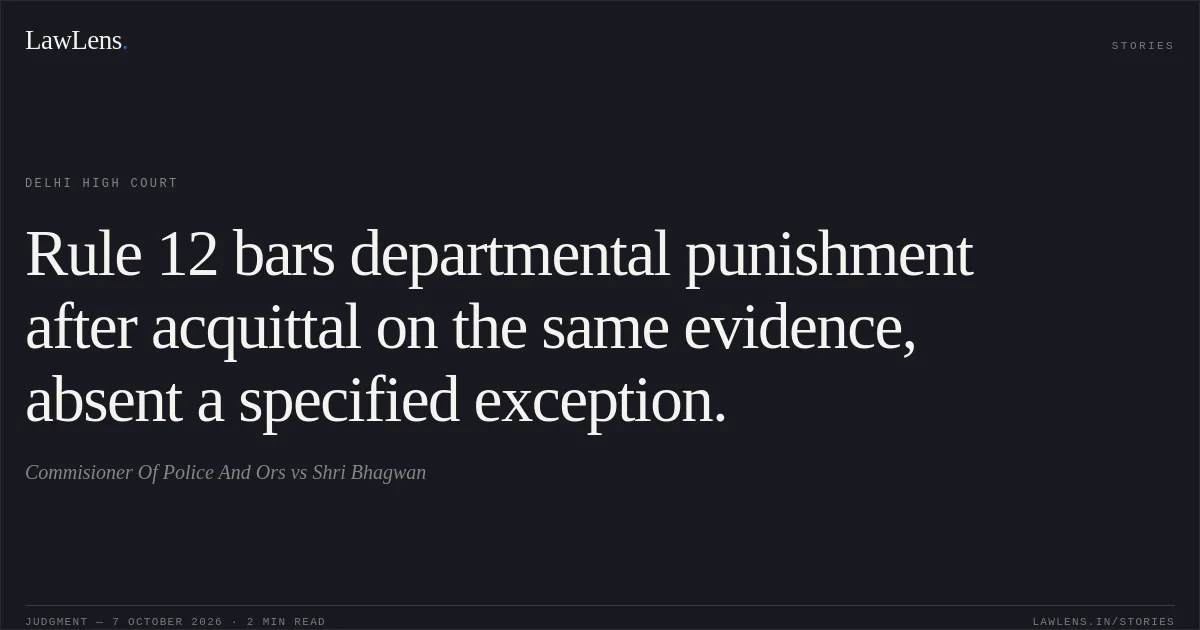
The respondent, a Delhi Police constable, faced departmental proceedings and criminal prosecution arising from the same alleged assault.
Source reference: p.5–8The departmental inquiry found the charge proved, relying principally on the medical record’s notation of “assault by Shri Bhagwan”; the Disciplinary Authority imposed two years’ permanent forfeiture of approved service with proportionate reduction in pay
Source reference: p.5–8In the criminal case, the material witnesses did not identify the respondent as an assailant, and the Metropolitan Magistrate acquitted him, finding the prosecution had failed to connect him to the offence
Source reference: p.9–12The Central Administrative Tribunal set aside the departmental punishment under Rule 12 of the Delhi Police (Punishment and Appeal) Rules, 1980 (“DPPAR”); the Delhi Police challenged that decision
Source reference: p.12–13Issues
1. Whether Rule 12 of the DPPAR barred departmental punishment where the respondent was acquitted in criminal proceedings based on the same allegations and evidence
Source reference: p.1–2, 22–232. Whether the acquittal fell within an exception under clauses (a) to (e) of Rule 12, particularly because witnesses had turned hostile or the acquittal was allegedly on technical grounds
Source reference: p.12–13, 16–20Law Applied
Rule 12 of the DPPAR bars departmental punishment of a police officer, on the same charge or a different charge founded on evidence cited in the criminal case, following acquittal, unless one of its specified exceptions applies: acquittal on technical grounds; a finding or opinion that prosecution witnesses were won over; a judicial finding that an offence occurred and suspicion rests on the officer; evidence disclosing unconnected facts justifying a different charge; or availability of additional evidence.
Source reference: p.1Under Delhi Police v. Krishan Kumar, acquittal on technical grounds means acquittal for failure to meet a mandatory technical requirement, not an acquittal following assessment of evidence, even where described as one on benefit of doubt.
Source reference: p.13–14, 21Under Govt. of NCT of Delhi v. Satyapal Singh Yadav and Govt. of NCT of Delhi v. Vishambar Dayal, a witness turning hostile does not, without a positive finding or opinion that the witness was won over, satisfy clause (b).
Source reference: p.16–21The Court also relied on Delhi Police v. Ram Kishore Tyagi in reaffirming that departmental proceedings are barred unless a Rule 12 exception applies.
Source reference: p.21Reasoning
The criminal and departmental proceedings concerned the same allegations and evidence, so Rule 12 governed.
Source reference: p.22–23The criminal court’s acquittal followed its assessment of the evidence and was based on the absence of evidence connecting the respondent to the assault, not on a technical defect.
Source reference: p.9–12, 22–23Nor did the criminal judgment or the Disciplinary Authority find that the witnesses had been won over; hostility alone could not establish clause (b).
Source reference: p.16–20The record disclosed no other Rule 12 exception, including additional or unconnected evidence.
Source reference: p.22–23Accordingly, the departmental punishment could not stand.
Source reference: p.22–23Holding
The Court held that none of the exceptions in Rule 12 applied and affirmed the Tribunal’s decision setting aside the departmental punishment.
The writ petition was dismissed.
Source reference: p.23Acts & Sections Cited
13 provisions across 3 statutes referred to in this judgment. Each provision opens on LawLens.
Code of Criminal Procedure, 19734
Indian Penal Code, 18606
Arms Act, 19593
Original Court PDF
Commisioner Of Police And OrsvsShri Bhagwan
Click to open original judgment
Original judgment, available to read, download and summarize on LawLens.in