Facts
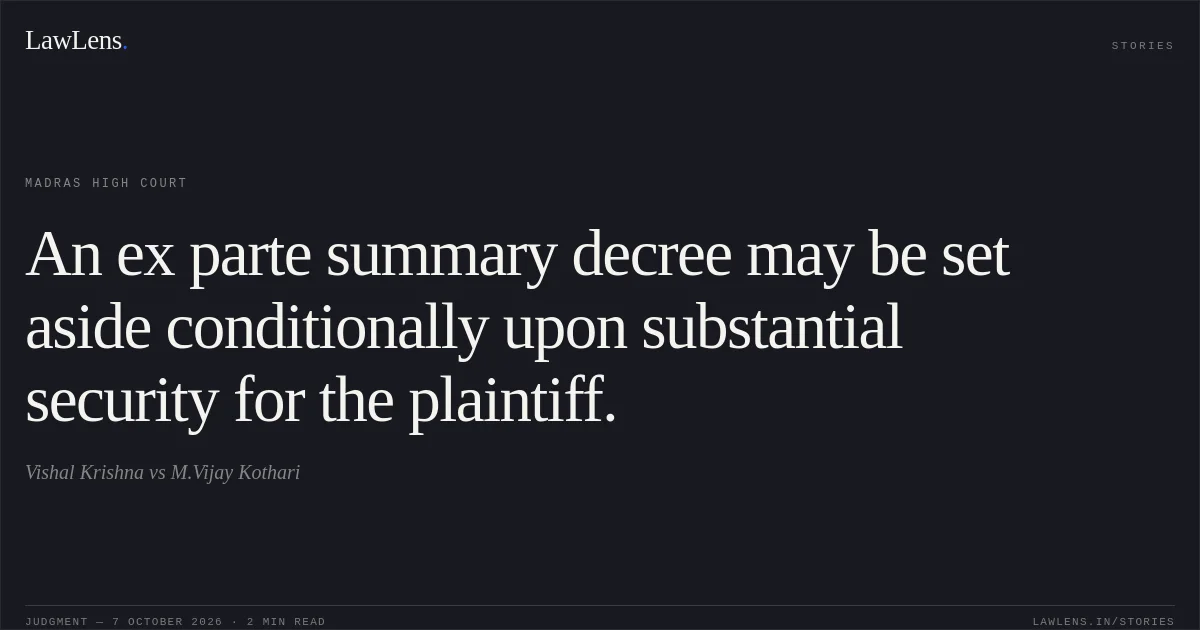
The respondent obtained an ex parte decree in a summary suit under Order XXXVII CPC on 17 December 2019.
Source reference: p. 2, paras. 1–5The petitioner said he learned of the suit and decree only on 23 December 2020.
Source reference: p. 2, paras. 1–5He applied under Order XXXVII Rule 4 CPC to set aside the decree, relying on the Supreme Court’s COVID-19 limitation exclusions, but did not file an accompanying application to condone delay.
Source reference: p. 2, paras. 1–5The Trial Court dismissed the application, finding that the COVID-19 orders did not assist him and that the failure to seek condonation was fatal.
Source reference: p. 2, paras. 1–5The petitioner challenged that dismissal under Article 227, also contending that the suit itself was time-barred.
Source reference: p. 2, paras. 1–5Issues
Whether the Trial Court’s dismissal of the petitioner’s Order XXXVII Rule 4 application disclosed an illegality or infirmity warranting interference under Article 227.
Source reference: p. 3, para. 4Whether the petitioner should nevertheless be permitted to contest the summary suit on the merits, subject to conditions, given his defence that the suit was time-barred.
Source reference: pp. 3–4, paras. 4–6Law Applied
Order XXXVII Rules 1 and 2 CPC provide for the summary procedure invoked in the suit; Order XXXVII Rule 4 was the provision under which the petitioner sought to set aside the ex parte decree.
Source reference: p. 2, para. 3Article 227 of the Constitution was invoked to challenge the Trial Court’s order.
Source reference: no citationThe Court referred to the Supreme Court’s COVID-19 limitation orders, which excluded the period from 15 March 2020 to 28 February 2022, but upheld the Trial Court’s conclusion that those orders did not cure the petitioner’s failure to file an application for condonation of delay.
Source reference: p. 2, para. 3The Court nonetheless considered whether an opportunity to contest the suit could be granted on suitable terms.
Source reference: pp. 3–4, paras. 5–6Reasoning
The Court found no illegality or infirmity in the Trial Court’s dismissal of the Rule 4 application and did not disturb its conclusions on delay or the COVID-19 limitation orders.
Source reference: p. 3, paras. 3–4However, considering the petitioner’s specific defence that the suit was time-barred, the Court concluded that he could be given an opportunity to contest the suit if the respondent’s interests were substantially secured.
Source reference: pp. 3–4, paras. 5–6It therefore made relief conditional on a deposit of ₹50 lakh, being the principal amount claimed as borrowed.
Source reference: pp. 3–4, paras. 5–6Holding
The revision petition was disposed of with conditional relief.
If the petitioner deposits ₹50 lakh to the credit of the suit within eight weeks of receiving the order, either in one payment or two equal instalments, the ex parte decree will stand set aside and conditional leave to defend will operate.
Source reference: p. 4, para. 6The petitioner was directed to file his written statement without waiting for the deposit; the Trial Court was to prepare the case for trial and dispose of it by 2 April 2027.
Source reference: p. 4, para. 6The deposit is to be invested in an interest-bearing deposit for the benefit of the successful party.
Source reference: p. 4, para. 6If the condition is not met, the Trial Court’s order stands confirmed and the respondent may execute the decree.
Source reference: p. 6, para. 7Original Court PDF
Vishal KrishnavsM.Vijay Kothari
Click to open original judgment
Original judgment, available to read, download and summarize on LawLens.in