01Facts
MMTC and PAMP entered into a Share Purchase and Shareholders Agreement (SPSHA) to establish MPIPL as a gold and silver refinery.
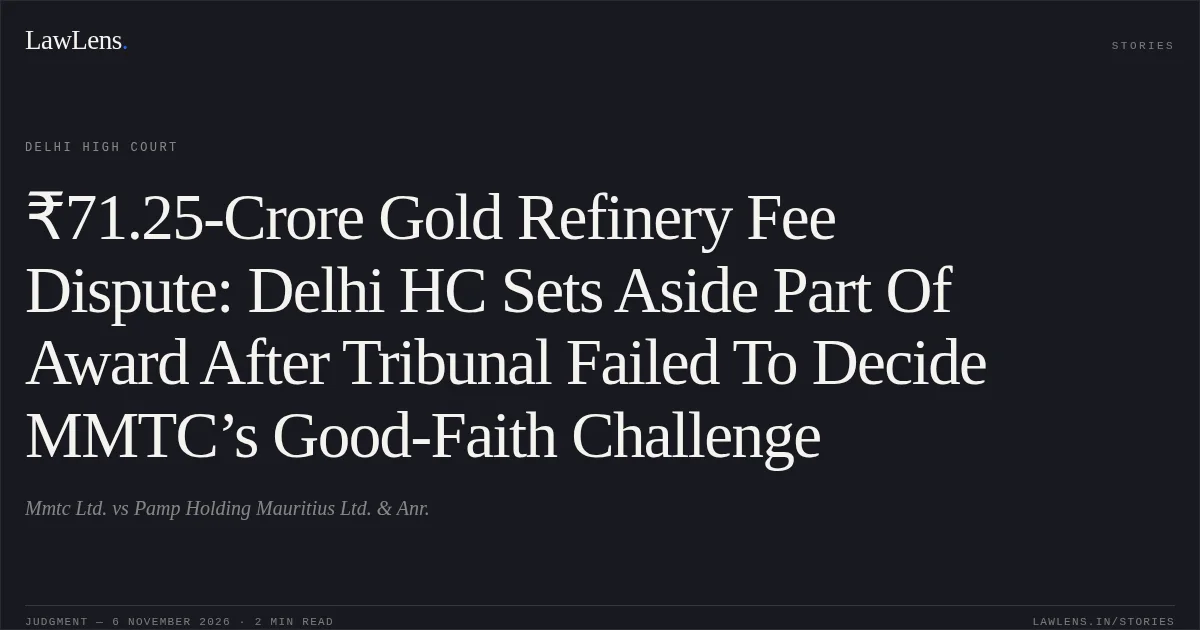
¶ 7–17, 19–25MMTC alleged that PAMP’s group companies charged MPIPL approximately ₹71.25 crore for dore sourcing and process know-how that PAMP was obliged to assist with under the SPSHA, and that the transactions breached the agreement’s good-faith requirement.
¶ 7–17, 19–25The Arbitral Tribunal dismissed MMTC’s claims, finding that the SPSHA did not require the services to be free of charge, the agreements were on arm’s-length terms, and MMTC could not seek restitution on MPIPL’s behalf.
¶ 7–17, 19–25MMTC challenged the award under Section 34 of the Arbitration and Conciliation Act, 1996
¶ 7–17, 19–2502Issues
i.1. Whether the Tribunal’s failure to adjudicate MMTC’s allegation that the transactions breached the SPSHA’s good-faith obligation constituted a ground to set aside the award under Section 34
¶ 58, 64–69ii.2. Whether that non-adjudication caused material prejudice sufficient to warrant interference with the award in an international commercial arbitration
¶ 70–7903Law Applied
Section 34(2)(b)(ii) permits setting aside an award that conflicts with the public policy of India, which is confined to the grounds in Explanation 1; Explanation 2 bars review of the merits when assessing contravention of the fundamental policy of Indian law.
¶ 41–50Patent illegality under Section 34(2A) is unavailable for international commercial arbitrations.
¶ 41–50Under Section 34(2)(a)(iv), an award may be challenged where the tribunal fails to decide a matter submitted to it; failure to address every issue is not sufficient by itself, and the omission must cause real or actual prejudice.
¶ 70–72The Court also considered Sections 34(2)(a)(iii) and 34(2)(b)(ii), and relied on the Division Bench decision in Ssangyong Engineering & Construction Co. Ltd. v. NHAI (2026:DHC:6687-DB), which distinguishes non-adjudication of a material issue from an erroneous decision on that issue.
¶ 70–72Article 34.1 of the SPSHA required covered transactions to be conducted in good faith and, where their terms were not otherwise agreed, on an arm’s-length basis.
¶ 59Provisions in the judgment · 12 · Linked ones open on LawLens
Arbitration and Conciliation Act, 1996 10 provisions
Section 2Section 18Section 28Section 31Section 33Section 34Section 48Section 75Section 81Section 68Indian Contract Act, 1872 Section 23
India International Arbitration Centre Act, 2019 Section 24
04Reasoning
The Tribunal found that the agreements were on arm’s-length terms but did not independently determine MMTC’s material allegation that PHML had used its majority control to procure the agreements in breach of Article 34’s good-faith requirement.
¶ 64–68The Court held that this was not merely a challenge to the correctness of the Tribunal’s reasoning: the good-faith allegation was a distinct contractual issue, supported by pleaded circumstances including the DSA’s execution without MMTC’s prior knowledge and objections to the licence fees.
¶ 64–68Because the Tribunal’s failure to decide that issue could affect the outcome, it caused material prejudice and fell within the permissible grounds for Section 34 interference.
¶ 73–7905Holding
The Court partly allowed the petition and set aside the award insofar as it dismissed MMTC’s surviving claims for breach of the SPSHA and related monetary relief, and insofar as it awarded costs and expenses on the basis of that dismissal.
¶ 80–82The award concerning prayers (a), (b), and (c), which MMTC had not pursued before the Tribunal, remained undisturbed.
¶ 81–83The parties were left free to pursue available contractual or other legal remedies concerning the surviving dispute.
¶ 81–83Original Court PDF
Mmtc Ltd.vsPamp Holding Mauritius Ltd. & Anr.
Click to open original judgment
Original judgment, available to read, download and summarize on LawLens.in