01Facts
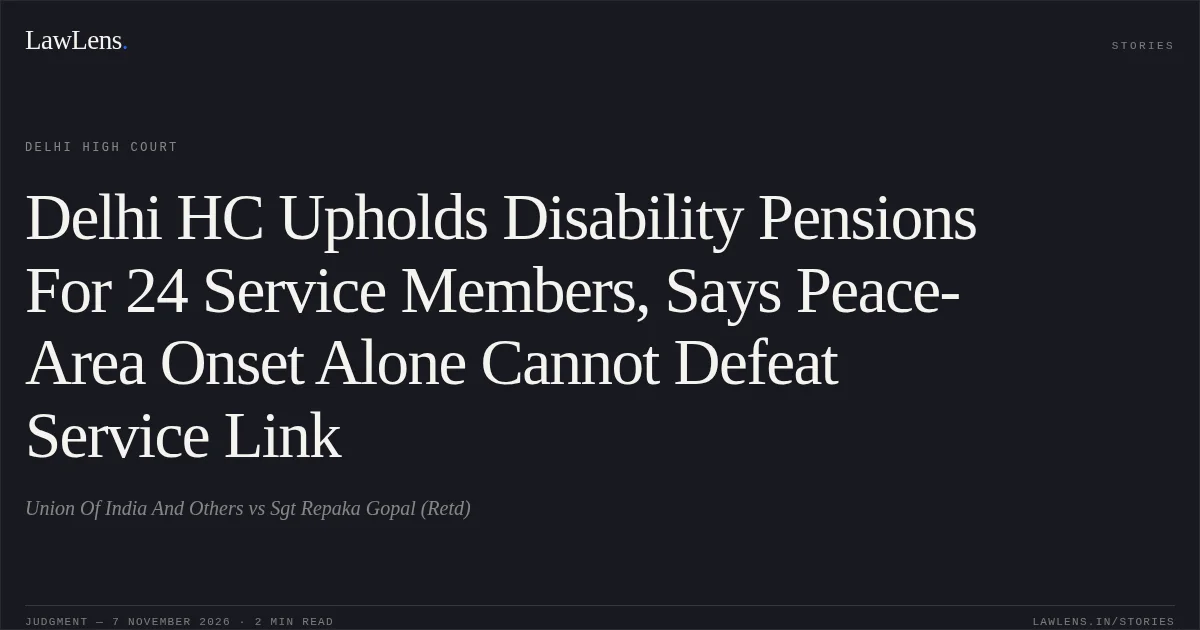
The Union of India filed a batch of writ petitions challenging Armed Forces Tribunal judgments granting disability pension to the respondents, whose disabilities included hypertension, diabetes, seizure disorders and cardiac conditions.
pp. 8–11The Release Medical Boards had generally found the disabilities neither attributable to nor aggravated by service, relying on factors such as onset in a peace area, lifestyle or metabolic causes, or the absence of a close association with service conditions.
pp. 8–11The respondents submitted that the Tribunal’s decisions followed binding Supreme Court and Delhi High Court authorities.
pp. 8–11The Union did not dispute that those authorities covered the issues raised in the petitions.
pp. 8–1102Issues
i.1. Whether the fact that a disability arose in a peace area is, by itself, sufficient to conclude that it was neither attributable to nor aggravated by military service
p. 11ii.2. Whether, in the absence of a record of pre-existing disease at entry into service, a disability arising during service is presumed attributable to or aggravated by service, and who bears the burden of rebutting that presumption
pp. 11–12iii.3. Whether the Tribunal’s disability-pension awards disclosed any legal infirmity warranting interference under the writ jurisdiction
p. 1203Law Applied
The Court applied the principles in Dharamvir Singh v. Union of India, (2013) 7 SCC 316, and Union of India v. Rajbir Singh, 2015 SCC OnLine SC 119: the mere fact that a disability arose in a peace area does not establish that it was neither attributable to nor aggravated by military service; where no pre-existing disease is recorded on entry into service, the individual is presumed to have been in sound physical and mental health, and a disability arising during service is presumed attributable to or aggravated by service.
p. 11The employer bears the burden of rebutting that presumption, and the Medical Board must give reasons for its conclusion.
p. 11The Court also relied on Union of India v. Ex Sub Gawas Anil Madso, 2025 SCC OnLine Del 2018, as upheld in Union of India v. Col. NC Isaac (Retd.), 2026 SCC OnLine SC 1895
p. 1104Reasoning
The Court noted that the Union accepted that the respondents’ cases were covered by the cited authorities.
pp. 11–12It held that the Tribunal had applied the governing principles and that the Medical Boards’ reliance on peace-area onset or similar general observations did not, without more, displace the applicable presumption or establish that the disabilities were unrelated to service.
pp. 11–12Finding no infirmity in the Tribunal’s judgments, the Court saw no basis to interfere
pp. 11–1205Holding
The Court dismissed all the writ petitions as devoid of merit and upheld the Tribunal’s judgments.
p. 12It directed the Union to implement those judgments within four months, except the judgment challenged in W.P.(C) 5718/2026, which had already been implemented.
p. 12All petitions were disposed of along with the pending applications
p. 12Original Court PDF
Union Of India & Ors.vsMaj Gen Surender Mohan Vsm Retd
Click to open original judgment
Original judgment, available to read, download and summarize on LawLens.in