01Facts
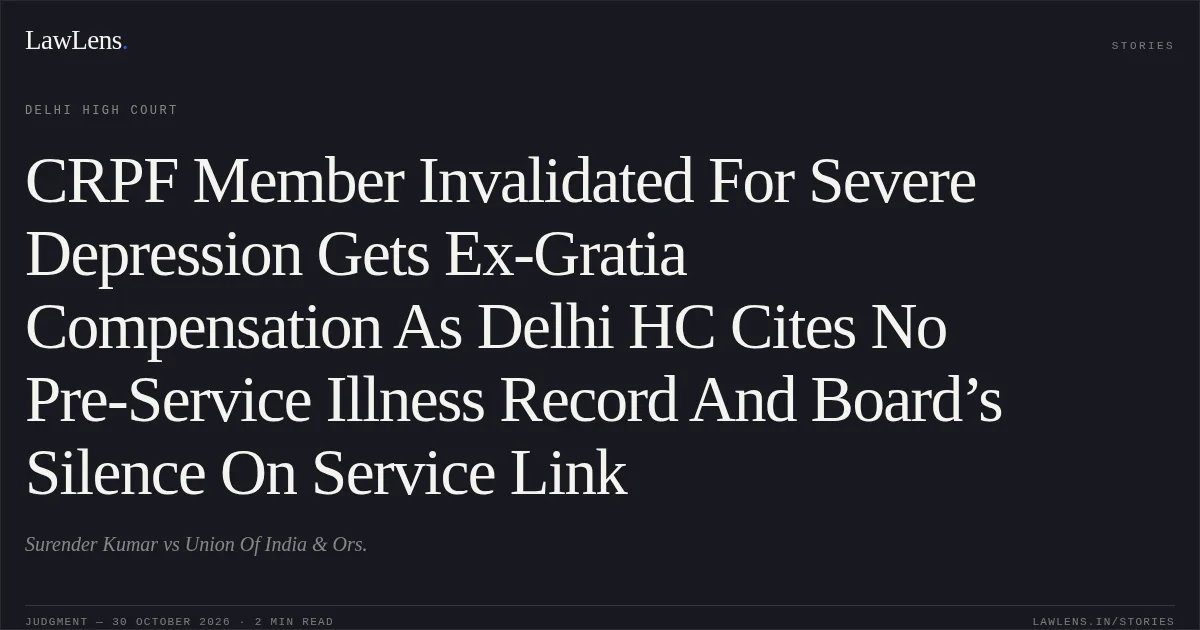
The petitioner was enrolled in the CRPF in 2009 after being declared medically fit, with no record of any pre-existing illness or disability.
p. 4 · ¶ 8An Invalidation Medical Board (IMB) later assessed him as suffering from Severe Depressive Disorder with Deliberate Self Harm, assessed his disability at 70%, and recommended invalidation.
p. 2, 4 · ¶ 2, 8He was invalidated from service on 23 January 2025 but was not granted disability pension or ex-gratia compensation, the respondents relying on the IMB’s finding that the disability was not attributable to or aggravated by service.
p. 2, 4 · ¶ 3, 8He sought ex-gratia compensation under the Office Memorandums dated 21 April 2011 and 7 June 2017.
p. 1 · ¶ 102Issues
i.1. Whether, in the absence of an IMB finding that the petitioner’s disability was attributable to or aggravated by CRPF service, he could nevertheless receive ex-gratia compensation under the applicable Office Memorandums.
p. 4 · ¶ 903Law Applied
The Office Memorandum dated 21 April 2011 provides for ex-gratia compensation to eligible CAPF personnel invalidated from service because of a disability attributable to or aggravated by service; the amount was revised by the Office Memorandum dated 7 June 2017.
p. 5 · ¶ 9The Court applied the principles concerning the burden of proof and reasonable benefit of doubt reflected in Rules 5, 9 and 14 of the Entitlement Rules for Casualty Pensionary Awards, 1982, and the corresponding beneficial provisions of the Entitlement Rules, 2008.
pp. 5–8 · ¶ 10–11Relying on Dharamvir Singh v. Union of India, (2013) 7 SCC 316, and Union of India v. Col. N.C. Isaac (Retd.), 2026 SCC OnLine SC 1895, the Court stated that the employer bears the burden of establishing that a disability is not attributable to service, and that the claimant may receive the benefit of reasonable doubt.
pp. 5–8 · ¶ 10–11It also relied on Manvir Singh v. Union of India, 2024 SCC OnLine Del 9195, concerning the treatment of a disability arising during service where the Medical Board gives no reasons on attributability or aggravation.
p. 9 · ¶ 1204Reasoning
The IMB recorded that the petitioner’s condition had developed during service and recommended invalidation, but its proceedings contained no finding or reasons on whether the disability was attributable to or aggravated by service.
p. 9 · ¶ 13Since the record contained no indication of illness at enrolment, and the respondents had not established that the disability was unrelated to service, the Court applied the burden-of-proof and benefit-of-doubt principles to treat the disability as resulting from service conditions. It therefore held that the attributability/aggravation requirement in the 2011 Office Memorandum was satisfied.
p. 9 · ¶ 1305Holding
The Court held that the petitioner was entitled to ex-gratia compensation under the Office Memorandums dated 21 April 2011 and 7 June 2017, allowed the writ petition, and directed payment within three months.
pp. 9–10 · ¶ 13–15If payment was not made within that period, the amount would carry interest at 12% per annum until actual payment.
pp. 9–10 · ¶ 13–15Original Court PDF
Surender KumarvsUnion Of India & Ors.
Click to open original judgment
Original judgment, available to read, download and summarize on LawLens.in