01Facts
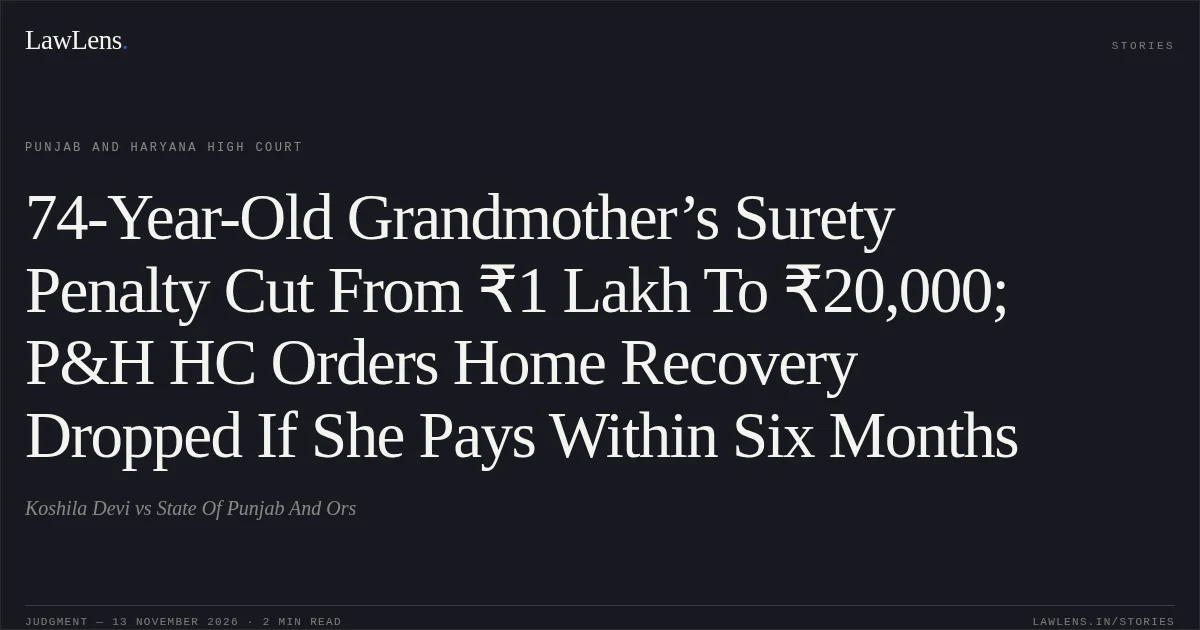
The petitioner, a 74-year-old widowed woman, stood surety for her grandson, Chetan Kainth, in a criminal case. After he failed to appear and was declared a proclaimed offender, proceedings under Section 446 Cr.P.C. were initiated against her.
pp. 1–3The Sessions Judge imposed a penalty of ₹1,00,000 and issued recovery warrants through the Collector. The petitioner sought modification, relying on her age, financial hardship, efforts to secure her grandson’s appearance, and the absence of any allegation that she had connived in or facilitated his abscondence.
pp. 1–3The State opposed the petition, arguing that she had failed to fulfil her obligations as surety.
p. 302Issues
i.1. Whether the penalty imposed on the petitioner under Section 446 Cr.P.C. should be modified in the circumstances of the case
pp. 3–4ii.2. Whether coercive recovery against the petitioner’s residential house should be permitted, and whether time should be allowed to deposit any modified penalty
pp. 3–403Law Applied
Section 446 Cr.P.C. governs forfeiture of bonds and proceedings against sureties. Although forfeiture entails liability, the court has discretion to remit or modify the penalty in light of the circumstances of the case.
pp. 3–4Relying on Mohammad Kunju v. State of Karnataka, the Court stated that where there is no material indicating that a surety connived with the accused or knew of the accused’s intention to abscond, the penalty should not be unduly harsh or excessive.
pp. 3–4Provisions in the judgment · 4 · Linked ones open on LawLens
Indian Penal Code, 1860 Section 341Section 379Section 34
Code of Criminal Procedure, 1973 Section 446
04Reasoning
The Court accepted that the petitioner had stood surety and that the accused’s failure to appear led to forfeiture of the bond. However, it found no material showing that she had connived with him or facilitated his abscondence, and noted her stated efforts to secure his presence.
pp. 3–4Taking account of her age, widowed status, and pleaded financial incapacity, the Court considered a reduced penalty with time to pay sufficient to serve the ends of justice, while protecting her sole residence from coercive recovery.
pp. 3–405Holding
The Court modified the Sessions Judge’s order by reducing the penalty from ₹1,00,000 to ₹20,000, payable within six months.
p. 4If paid within that period, the recovery warrant was to be recalled and any attachment or coercive proceedings against the petitioner’s residential house released or dropped.
p. 4If she failed to pay, the Trial Court could proceed in accordance with law. The petition was disposed of subject to these directions.
p. 4Original Court PDF
Koshila DevivsState Of Punjab And Ors
Click to open original judgment
Original judgment, available to read, download and summarize on LawLens.in