01Facts
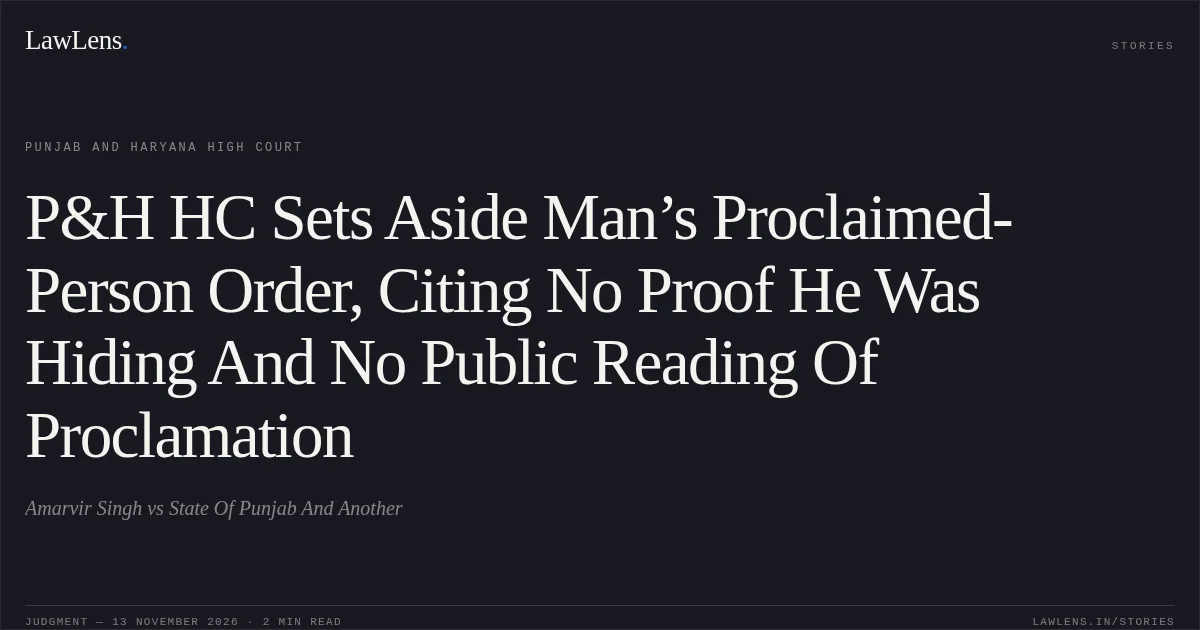
The petitioner invoked Section 528 of the BNSS, 2023, to challenge the order declaring him a proclaimed person in an FIR alleging offences under Sections 406 and 420 IPC.
p. 1After two unsuccessful attempts to execute arrest warrants, the Trial Court initiated proclamation proceedings under Section 82 CrPC. The executing official reported that the petitioner’s house was locked, and that copies of the proclamation had been affixed at the house, a local dharamshala and the Court notice board; the petitioner was subsequently declared a proclaimed person.
pp. 1–3The petitioner challenged that order on the grounds that the statutory procedure had not been properly followed.
pp. 1, 3–402Issues
i.Whether the Trial Court had sufficient material to conclude that the petitioner was absconding or concealing himself to evade arrest, and whether it made adequate efforts to secure his presence before issuing a proclamation.
p. 3ii.Whether the proclamation complied with Section 82 CrPC when it was not publicly read at a conspicuous place in the town or village where the petitioner ordinarily resided.
pp. 3–403Law Applied
Section 82 CrPC requires the Court to have reason to believe, based on available evidence and material, that a person has absconded or is concealing himself to avoid execution of an arrest warrant; the Court must consider prior efforts to secure the person’s presence and record specific satisfaction [*Pardeep Kumar v. State of Haryana*, CRM-M-41656-2023, decided 23 August 2023].
p. 3The proclamation procedure also requires public reading at a conspicuous place in the town or village where the person ordinarily resides; omission of that step renders the proclamation and subsequent proceedings a nullity [*Rahul Dureja v. State of Punjab*, 2022(1) Law Herald 219; see also *Harvinder Singh v. State of Haryana*, 2021(1) RCR (Criminal) 493; *Mahender Kumar v. HDFC Ltd.*, 2024(1) Law Herald 859; *Ramandeep Singh Sangha v. State of Punjab*, 2024(1) Law Herald 291; *Sukhjinder Singh v. State of Punjab*, 2024(2) RCR (Criminal) 5].
p. 4Provisions in the judgment · 6 · Linked ones open on LawLens
Bharatiya Nagarik Suraksha Sanhita, 2023 Section 528
Indian Penal Code, 1860 Section 406Section 420
Bharatiya Nyaya Sanhita, 2023 Section 316Section 318
Code of Criminal Procedure, 1973 Section 82
04Reasoning
The Court found that the police report showed only that the petitioner was not found at his residence and his whereabouts were unknown; the record did not provide cogent material supporting the Trial Court’s conclusion that he was intentionally absconding or concealing himself.
p. 3The Court also considered it significant that warrants had been issued on only two dates and held that the prosecution should have been directed to provide a fresh address rather than proceeding directly to declare the petitioner proclaimed.
p. 3Further, the executing official’s statement described affixing copies of the proclamation but did not establish that it had been publicly read at a conspicuous place in the relevant town or village, as required by Section 82 CrPC. The Court therefore held that the statutory procedure had not been followed.
pp. 3–405Holding
The Court accepted the petition and set aside the Trial Court’s order dated 30 September 2025 declaring the petitioner a proclaimed person, holding that the Section 82 CrPC proceedings were procedurally defective.
p. 4Any pending miscellaneous applications were also disposed of.
p. 4Original Court PDF
Amarvir SinghvsState Of Punjab And Another
Click to open original judgment
Original judgment, available to read, download and summarize on LawLens.in