01Facts
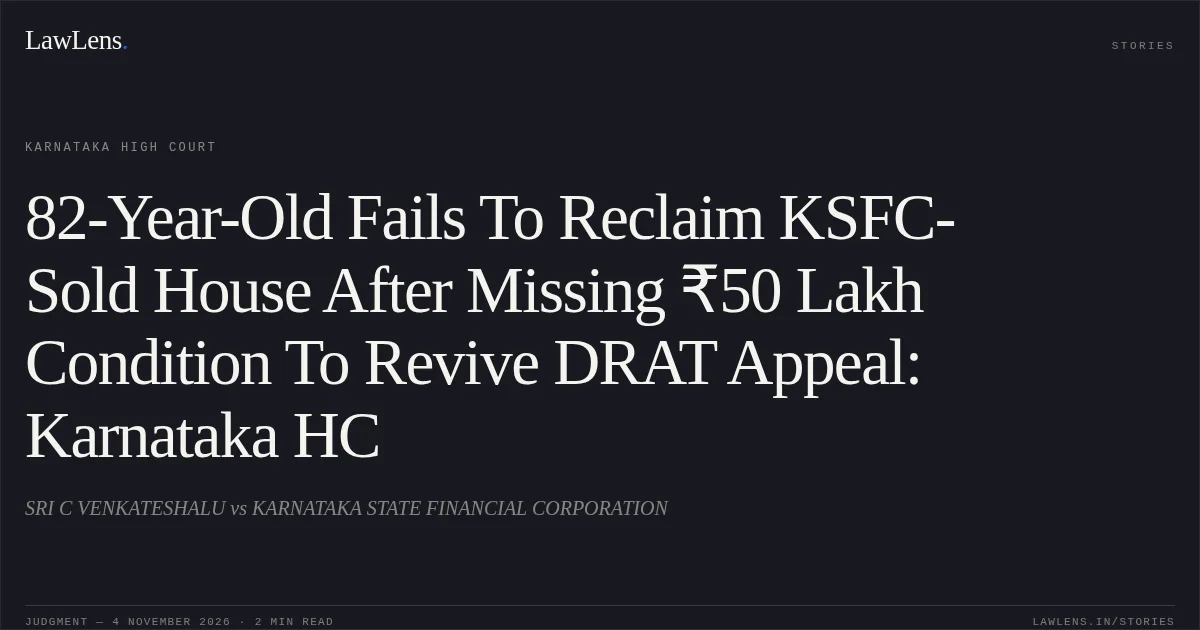
The appellant borrowed ₹25 lakh from KSFC in 1997 and defaulted. KSFC initiated recovery proceedings and enforcement action under the SARFAESI Act, taking possession of the subject property. The appellant disputed that the property secured his own loan, asserting that he had mortgaged it as guarantor for another transaction.
¶ 3–5In 2012, the DRT set aside a sale notice but declined to grant possession; the appellant’s appeal to the DRAT was dismissed, and his restoration application was also rejected. Although the High Court later set aside the restoration order subject to a ₹50 lakh deposit, the appellant did not make the deposit.
¶ 10, 13–14KSFC sold the property to respondent No. 2 by a sale deed dated 30 August 2013.
¶ 12The appellant’s 2023 writ petition seeking possession, invalidation of the sale deed and damages was dismissed by the Single Judge; he appealed.
¶ 1, 15–16The judgment refers to the sale deed date as 30 August 2018 in para. 18, although para. 12 gives the date as 30 August 2013.
¶ 12, 1802Issues
i.1. Whether the appellant could obtain possession and challenge the sale deed through the writ petition after the DRT’s decision on possession had attained finality.
¶ 14, 16, 20ii.2. Whether the writ petition was liable to be rejected for delay, given when the appellant’s cause of action arose.
¶ 17–1903Law Applied
The Court considered the State Financial Corporations Act, 1951, including KSFC’s recovery proceedings under Section 31(1), and the SARFAESI Act, including enforcement under Sections 13(2) and 13(4) and the borrower’s remedy under Section 17.
¶ 6, 9–10It applied the principles that a final decision in the statutory challenge to enforcement cannot be reopened through a later writ petition seeking inconsistent relief, and that delay may bar writ relief where the petitioner does not act within a reasonable time after the cause of action arises.
¶ 14, 17–20No judicial precedent is identified as the basis for the decision.
Provisions in the judgment · 4 · Linked ones open on LawLens
State Financial Corporations Act, 1951 Section 31
KARNATAKA HIGH COURT ACT, 1961 Section 4
Securitisation and Reconstruction of Financial Assets and Enforcement of Security Interest Act, 2002 Section 13Section 17
04Reasoning
The appellant’s challenge to KSFC’s enforcement had been pursued before the DRT and DRAT. Because he failed to satisfy the condition for restoration of his DRAT appeal, the DRT’s refusal to grant possession became final; the appellant could not use the later writ petition to obtain that relief or invalidate the resulting sale.
¶ 14, 16, 20The Court also rejected the argument that the cause of action arose only when KSFC’s separate recovery litigation concluded. It held that the relevant cause arose when the appellant was dispossessed in 2011, and that the challenge to the sale arose when the sale deed was executed; KSFC’s pursuit of its own appeals did not postpone those dates.
¶ 18–1905Holding
The Court held that the appellant’s requested relief was barred both by the finality of the SARFAESI proceedings and by delay.
¶ 20–21It dismissed the writ appeal and left the Single Judge’s rejection of the writ petition undisturbed.
¶ 20–21Original Court PDF
SRI C VENKATESHALUvsKARNATAKA STATE FINANCIAL CORPORATION
Click to open original judgment
Original judgment, available to read, download and summarize on LawLens.in