Facts
The petitioner was appointed as a Conductor in the respondent-Corporation on 6 November 1984 and was subsequently directed to work as a Booking Clerk by order dated 8 March 1987.
Source reference: para. 2He claimed that, despite submitting representations for promotion, his junior, respondent No. 3 Hanuman Prasad Sharma, who was appointed as a Conductor on 13 June 1985, was promoted as Ticket Checker with effect from 26 February 1993 and later promoted as TS Second.
Source reference: para. 2The petitioner filed the present writ petition under Article 226 seeking, inter alia, quashing of his alleged voluntary retirement, restoration of service-related benefits, promotion from the date on which his junior was promoted, and grant of annual increments.
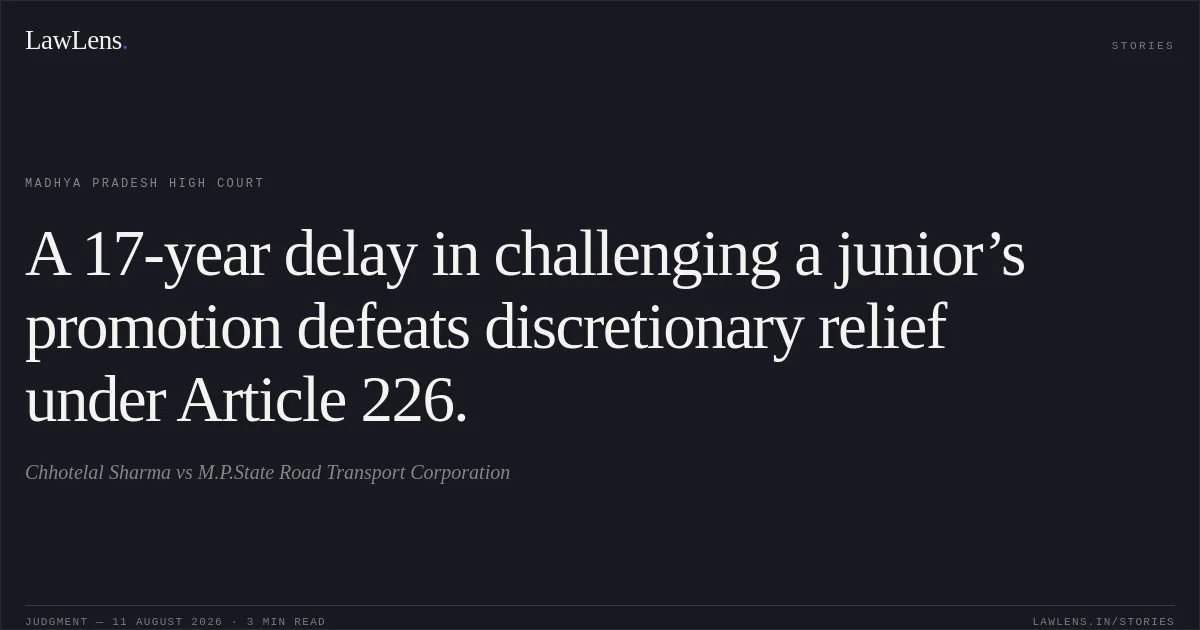
Source reference: para. 1The petition was instituted on 10 December 2010, approximately 17 years after the alleged promotion of respondent No. 3.
Source reference: paras. 3, 5Issues
Whether the petitioner’s challenge to the promotion of his junior and his claim for consequential promotion and service benefits could be entertained after an unexplained delay of approximately 17 years.
Source reference: paras. 3, 5–6Whether the petitioner’s repeated representations constituted a sufficient explanation for the delay and laches in invoking the writ jurisdiction of the High Court.
Source reference: para. 12Whether, in light of the delay and laches, the petitioner was entitled to relief concerning his alleged voluntary retirement, promotion, increments, and consequential benefits.
Source reference: paras. 1, 5–6, 13Law Applied
The Court applied the equitable and discretionary nature of jurisdiction under Article 226 of the Constitution, holding that a stale claim ordinarily cannot be entertained where the petitioner has failed to approach the Court within a reasonable time and has not satisfactorily explained the delay.
Source reference: paras. 5–7Relying on State of Orissa v. Mamata Mohanty, (2011) 3 SCC 436, the Court reiterated that a litigant cannot awaken after prolonged inaction and seek benefit from relief granted to a diligent litigant.
Source reference: para. 8Relying on Focus Energy Ltd. v. Government of India, I.L.R. (2011) M.P. 53, and the authorities cited therein, the Court held that delay and laches are relevant considerations, that equity favours the vigilant rather than the indolent, and that public law jurisdiction should not ordinarily be used to reopen stale claims, particularly where third-party rights may have crystallised.
Source reference: para. 9Under Karnataka Power Corpn. Ltd. v. K. Thangappan, (2006) 4 SCC 322, the High Court may refuse relief where negligence or omission, coupled with lapse of time and attendant circumstances, causes prejudice to the opposite party.
Source reference: para. 10The Court also relied on Ashok Kumar v. District Magistrate, Basti, (2012) 3 SCC 311, for the principle that a person who has slept over his rights is not entitled to discretionary relief.
Source reference: para. 11Repeated representations and their non-consideration do not, by themselves, constitute a valid explanation for delay.
Source reference: para. 12Reasoning
The Court found that respondent No. 3 had been promoted in 1993, whereas the petitioner approached the High Court only on 10 December 2010, after nearly 17 years.
Source reference: paras. 3, 5The petitioner neither challenged the promotion contemporaneously nor provided a satisfactory explanation for the prolonged delay; the petition merely stated, in one line, that there was no delay in filing it.
Source reference: para. 6Applying the principles governing laches under Article 226, the Court held that the petitioner’s prolonged inaction disentitled him to discretionary relief.
Source reference: no citationHis assertion that he had submitted repeated representations did not cure the delay, since such representations could not revive an otherwise stale claim.
Source reference: para. 12Consequently, the Court declined to examine the petitioner’s claims for retrospective promotion and consequential service benefits on their merits.
Source reference: para. 13Holding
The Court held that the writ petition was barred by inordinate and unexplained delay and laches.
No case for interference under Article 226 was made out, and the petitioner was not entitled to relief in respect of the alleged voluntary retirement, retrospective promotion, annual increments, or consequential benefits.
Source reference: para. 13The writ petition was accordingly dismissed.
Source reference: para. 13Original Court PDF
Chhotelal SharmavsM.P.State Road Transport Corporation
Click to open original judgment
Original judgment, available to read, download and summarize on LawLens.in