Facts
The appellant, allegedly aged five years at the time, claimed that she was struck by a Tata 407 bearing registration no. HR-46-4354 on 4 May 1997 while crossing a road, allegedly due to the rash and negligent driving of respondent no. 1. She claimed grievous injuries, including amputation of four toes of the right foot and three toes of the left foot, and treatment at Deen Dayal Upadhyay Hospital.
Source reference: paras. 2–4; pp. 1–2The claim petition under Section 166 of the Motor Vehicles Act, 1988, seeking ₹20,00,000 in compensation, was filed only on 19 February 2014, approximately 17 years after the accident.
Source reference: para. 4; p. 2The appellant examined herself, a doctor, and an alleged eyewitness. The vehicle owner and an officer of the insurer were examined for the respondents.
Source reference: paras. 7, 17–23; pp. 2–8The Motor Accident Claims Tribunal dismissed the claim, holding it to be a grossly delayed and “dead claim” and finding the evidence insufficient to establish the accident and negligence.
Source reference: paras. 8–16; pp. 3–5Issues
Whether a claim petition filed approximately 17 years after the accident, despite the absence of a prescribed limitation period under Section 166 of the Motor Vehicles Act at the relevant time, could be treated as a stale or “dead claim”?
Source reference: paras. 27–31; pp. 9–15Whether the appellant, who was a minor when the accident occurred, was entitled to invoke the benefit of Sections 6 and 8 of the Limitation Act, 1963?
Source reference: paras. 32–37; pp. 15–22Whether the appellant established, on the touchstone of preponderance of probabilities, that her injuries were caused by the rash and negligent driving of the offending vehicle?
Source reference: paras. 24–26, 38–40; pp. 6–9, 21–23Law Applied
The Court applied Section 166 of the Motor Vehicles Act, 1988, noting that the six-month limitation period under Section 166(3) had been deleted with effect from 14 November 1994, although the absence of a statutory limitation period did not permit claims to be filed after an unreasonable period.
Source reference: paras. 27–30; pp. 9–10Relying on M/s Purohit & Co. v. Khatoonbee, (2017) 4 SCC 783, the Court held that a claim must be brought within a reasonable time and that an excessively delayed claim may be treated as stale or “dead”; reasonableness depends on the facts, and a 28-year delay was held prima facie unreasonable.
Source reference: paras. 31.1–1.2; pp. 10–13The Court also relied on Corporation Bank v. Navin J. Shah, (2000) 2 SCC 628, Haryana State Coop. Land Development Bank v. Neelam, (2005) 5 SCC 91, Suman v. Shyamveer Singh, 2021 SCC OnLine Del 2848, and Meena Singhal v. Chaman Lal, 2026 SCC OnLine Del 1328, which recognise that statutory silence regarding limitation does not authorise adjudication of claims after an unreasonable delay.
Source reference: paras. 16, 31; pp. 4–5, 10–15Sections 6 and 8 of the Limitation Act were applied to minors: Section 6 permits institution of proceedings after cessation of disability, while Section 8 restricts the extension to three years after the disability ceases.
Source reference: para. 32; p. 15Finally, the Court applied the requirement under Section 166 that the claimant prove that the injury resulted from the rash and negligent driving of the offending vehicle, on a preponderance of probabilities.
Source reference: para. 39; p. 23Reasoning
The Court held that the absence of a limitation period in Section 166 did not eliminate the requirement that a claim be brought within a reasonable time.
Source reference: paras. 27–31; pp. 9–15Although a minor may ordinarily obtain the benefit of Section 6, read with the restriction in Section 8 of the Limitation Act, the appellant’s own case that she was five years old in 1997 meant that she attained majority around 2010; therefore, a claim filed in 2014 would fall outside the three-year restriction under Section 8.
Source reference: paras. 34–36; pp. 20–21Conversely, if the appellant’s school record showing a 1994 birth date were accepted, the claim might technically fall within the limitation period, but it created a serious inconsistency because she would have been only about two years and seven months old at the time of the accident, making her asserted recollection of the vehicle number inherently doubtful.
Source reference: paras. 35–37; pp. 21–22Independently of limitation, the evidence did not establish negligence: the appellant admitted that she remembered little about the accident; her parents, who were the natural guardians and were allegedly involved in the treatment and police investigation, were not examined; the alleged eyewitness admitted that he had not seen the vehicle hit her; the driver denied the accident; and no insurance policy or reliable contemporaneous documentary evidence was produced.
Source reference: paras. 19–26, 38; pp. 6–9, 21–22The 17-year delay further impaired the reliability and availability of evidence and rendered the claim stale under the principles in Purohit.
Source reference: para. 38; pp. 22–23Holding
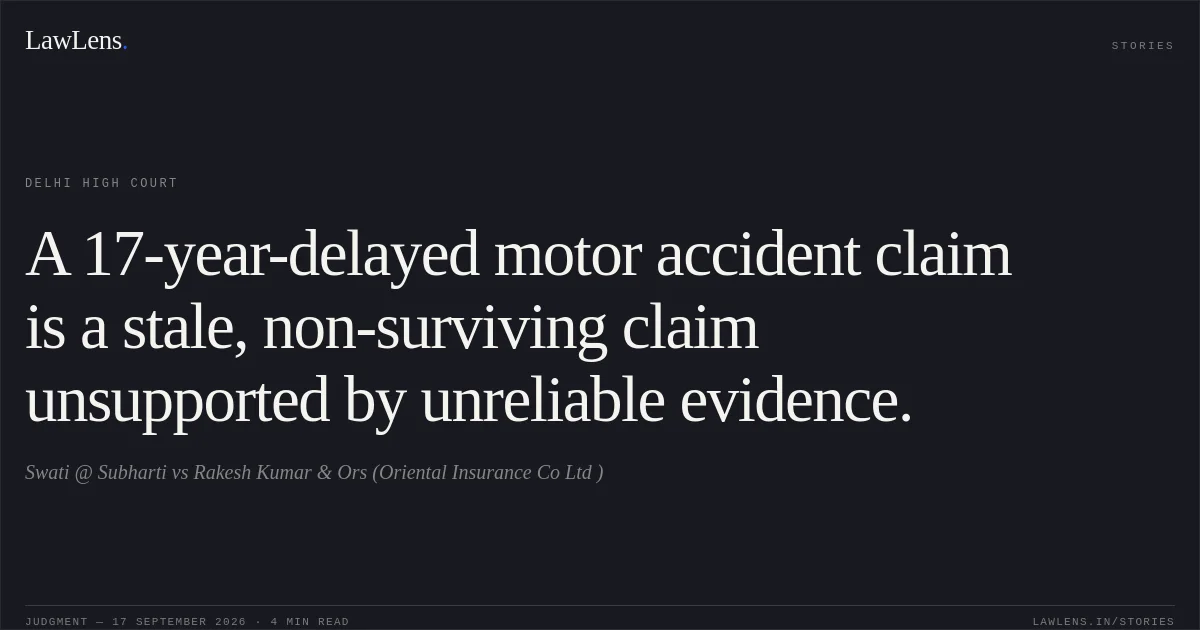
The Court answered the issues against the appellant. It held that the 17-year delay rendered the claim unreasonable and stale, and that the appellant could not successfully rely on the minor’s disability provisions to sustain it.
In any event, she failed to prove, even on a preponderance of probabilities, that her injuries resulted from the rash and negligent driving of the alleged offending vehicle.
Source reference: paras. 39–40; p. 23The appeal was accordingly dismissed, and all pending applications were rendered infructuous.
Source reference: paras. 41–42; p. 23Acts & Sections Cited
5 provisions across 2 statutes referred to in this judgment. Each provision opens on LawLens.
Motor Vehicles Act, 19881
Limitation Act, 19634
Original Court PDF
Swati @ SubhartivsRakesh Kumar & Ors (Oriental Insurance Co Ltd )
Click to open original judgment
Original judgment, available to read, download and summarize on LawLens.in