Facts
On 2 January 2012, the appellant was injured when a KSRTC bus collided with the car in which he was travelling.
Source reference: pp. 2–5, 7The Tribunal found the bus driver negligent and awarded the appellant ₹1,82,400 in compensation.
Source reference: pp. 2–5, 7The appellant, who claimed to be a 27-year-old interior designer, appealed under Section 173(1) of the Motor Vehicles Act, 1988, seeking enhancement.
Source reference: pp. 2–5, 7His injuries included a right femur fracture, fractures of three ribs, and a metacarpal fracture; the medical evidence also described a bent fixator nail, restricted right-hip movement, and shortening of the right leg.
Source reference: pp. 2–5, 7Issues
Whether the Tribunal’s assessment of compensation required modification, including as to income, loss of earning capacity, and compensation under the relevant heads.
Source reference: p. 5Law Applied
The claim was brought under Section 166 of the Motor Vehicles Act, 1988, and the appeal under Section 173(1).
Source reference: pp. 2, 5–7Compensation for personal injuries is to be assessed on the evidence and circumstances of the case, including the claimant’s income, age, functional loss of earning capacity, treatment and recovery period, and the effect of the injuries on future amenities and medical needs.
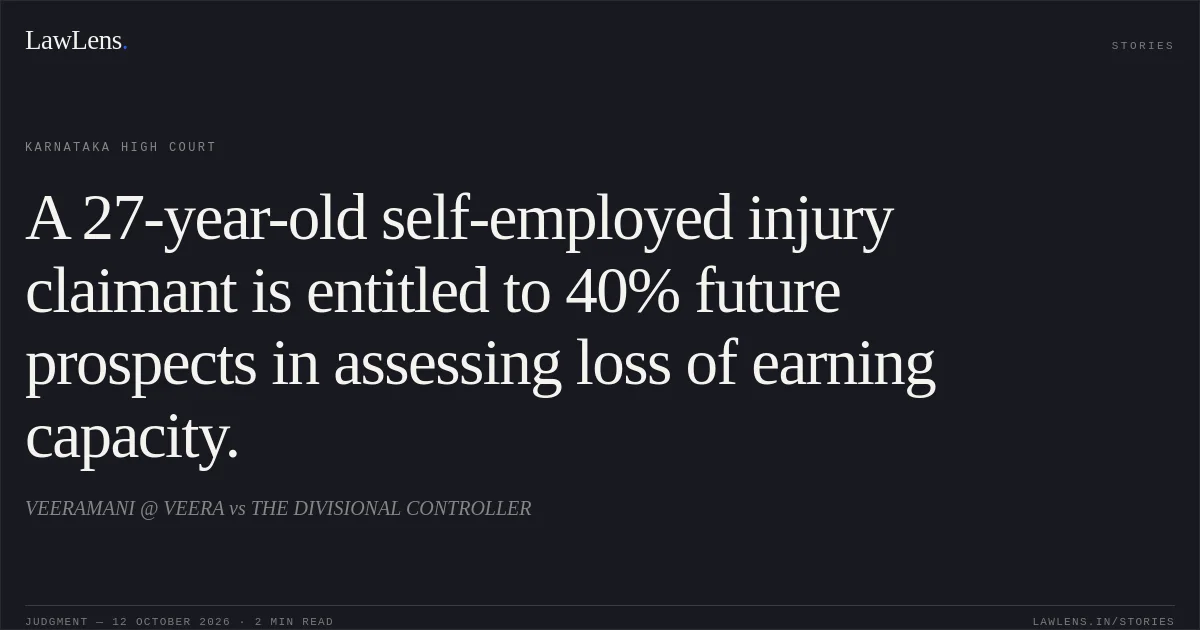
Source reference: pp. 2, 5–7Where claimed income is not proved, the court may adopt a notional income; the Court applied ₹7,000 per month for 2012 and added 40% towards future prospects for a self-employed claimant.
Source reference: pp. 2, 5–7No precedent is identified in the judgment.
Source reference: pp. 2, 5–7Reasoning
The claimant did not substantiate his asserted monthly income of ₹8,000, so the Court replaced the Tribunal’s ₹4,000 figure with the applicable notional income of ₹7,000.
Source reference: pp. 5–7Given the femur fracture and multiple other fractures, it increased the assessed loss of earning capacity from 15% to 20%; applying the multiplier of 17 and adding 40% future prospects, it calculated future loss of income at ₹3,99,840.
Source reference: pp. 5–7The Court also considered the 30-day inpatient treatment, medical bills, three-month recovery period, and evidence of lasting physical limitations when enhancing compensation for pain and suffering, medical and incidental expenses, loss of income during treatment, loss of amenities, and future medical expenses.
Source reference: pp. 5–7Holding
The Court answered the issue in the affirmative and partly allowed the appeal.
It modified the Tribunal’s award and reassessed compensation at ₹6,15,840, in place of ₹1,82,400, with interest at 6% per annum from the date of the claim petition until deposit, excluding the delayed period of 1,665 days.
Source reference: pp. 7–8The respondent was directed to deposit the amount within eight weeks, after which the compensation and interest were to be released to the claimant electronically.
Source reference: pp. 7–8Acts & Sections Cited
2 provisions across 1 statute referred to in this judgment. Each provision opens on LawLens.
Motor Vehicles Act, 19882
Original Court PDF
VEERAMANI @ VEERAvsTHE DIVISIONAL CONTROLLER
Click to open original judgment
Original judgment, available to read, download and summarize on LawLens.in


