Facts
The appellant, Sonu, sustained grievous injuries in a motor accident on 28 September 2020 when, while riding his motorcycle, he was hit by an auto-rickshaw.
Source reference: p.1, para. 2He suffered certified permanent visual disability of 60%.
Source reference: p.1, para. 2The Motor Accident Claims Tribunal awarded compensation of approximately ₹21,02,327 with interest at 9% per annum.
Source reference: p.1, para. 1The appellant challenged the award, contending that his functional disability should have been assessed at 100%, his income should have been calculated according to the minimum wages of a skilled worker, and additional compensation should have been granted towards attendant charges.
Source reference: p.1, paras. 3–6The Insurance Company opposed the enhancement and alleged that the appellant was not wearing a helmet and had consumed alcohol, but it had not filed a cross-appeal.
Source reference: p.2, para. 7Issues
Whether the appellant’s 60% permanent visual disability warranted assessment of functional disability at 100%, or at a higher percentage than the 40% assessed by the Tribunal?
Source reference: pp. 2–5, paras. 3–4, 13–14Whether the appellant’s income ought to have been assessed on the basis of minimum wages applicable to a skilled worker or driver, rather than those applicable to an unskilled worker?
Source reference: pp. 3–5, paras. 5, 9–10, 15–16Whether the compensation under the heads of conveyance, special diet and attendant charges required enhancement?
Source reference: pp. 5–7, paras. 17–20Whether the allegations regarding non-use of a helmet and intoxication justified reduction or denial of compensation?
Source reference: pp. 4–5, paras. 7, 11–12Law Applied
The Court applied the principles governing assessment of functional disability and loss of future earning capacity under the Motor Vehicles Act, particularly those stated in Raj Kumar v. Ajay Kumar, (2011) 1 SCC 343, under which physical disability must be translated into functional disability by considering its effect on the claimant’s actual earning capacity; where loss of future earning capacity is assessed at or above 50%, only nominal compensation may ordinarily be appropriate under overlapping non-pecuniary heads to avoid duplication.
Source reference: pp. 5–6, para. 18The Court relied on Gurudev Singh v. Reliance General Insurance Co. Ltd. & Ors., Civil Appeal No. 3399/2023, where 100% functional disability was upheld for a professional heavy-vehicle driver with visual impairment.
Source reference: pp. 2–3, para. 8(i)It also considered Jakir Hussein v. Sabir, (2015) 7 SCC 252, concerning 100% functional disability and compensation for pain, suffering and loss of amenities, and Sumer v. National Insurance Co. Ltd., 2023 SCC OnLine Del 5533, where substantial disability suffered by a driver justified 100% functional disability and consolidated attendant compensation of ₹2,00,000.
Source reference: pp. 3–4, paras. 8(ii)–8(iii)The Court further applied the principle that income cannot be assessed on the basis of asserted employment or wages without supporting evidence, but may be determined using the applicable minimum-wage category established by the record.
Source reference: pp. 4–5, paras. 9–10, 15–16Reasoning
The Court declined to assess functional disability at 100% because the appellant had not established that he was a professional driver or that he was actually employed as a private driver; a driving licence alone did not prove professional driving employment.
Source reference: p.5, paras. 13–14Accordingly, Gurudev Singh was distinguishable, as that case involved a professional heavy-goods-vehicle driver.
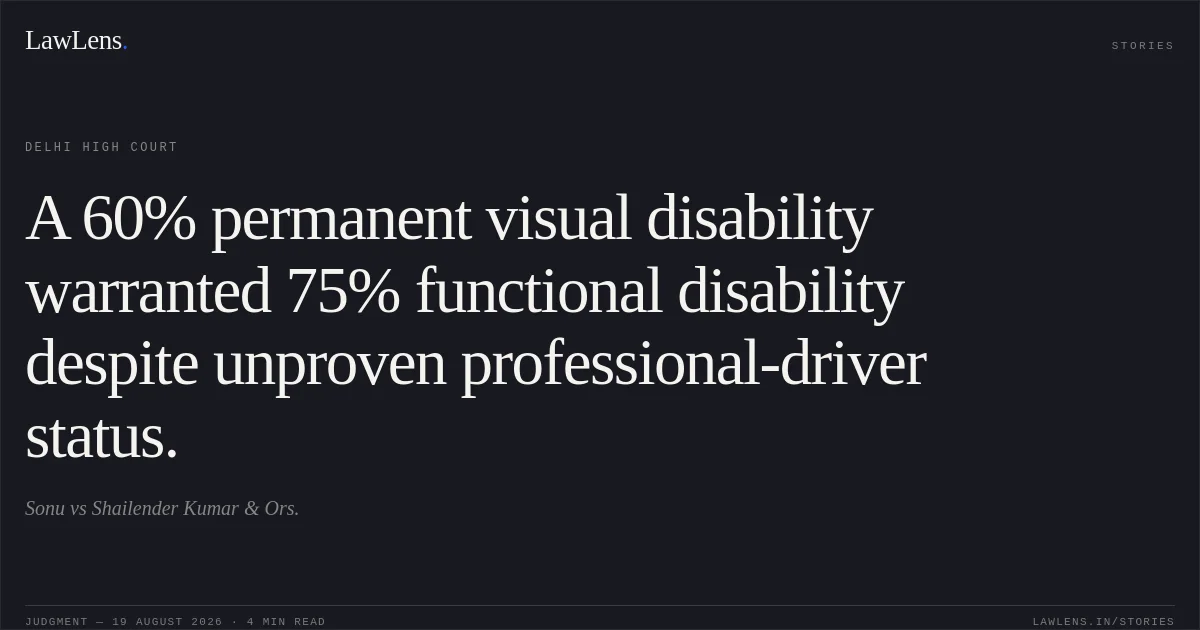
Source reference: p.5, para. 14Nevertheless, the Court held that 60% permanent visual disability would substantially impede the appellant’s ability to work or secure suitable employment and increased functional disability from 40% to 75%.
Source reference: p.5, para. 14Since the claimed income of ₹30,000 per month was unsupported, the Court rejected the skilled-worker claim, but, based on evidence that the appellant had passed Class 10, adopted the minimum wages of a matriculate at ₹18,563 per month.
Source reference: pp. 5–6, paras. 15–16Applying the revised income, 40% future prospects, 75% functional disability and multiplier of 16, the Court recalculated the loss of future earning capacity at ₹37,42,301.
Source reference: p.7, para. 22In view of the serious visual disability, conveyance and special-diet expenses were enhanced to ₹1,50,000 and attendant charges were fixed at ₹2,00,000, following Sumer.
Source reference: pp. 6–7, paras. 19–20The allegations of intoxication and absence of a helmet were not accepted as grounds for reduction: the evidence indicated that the auto driver was intoxicated, no breath test had been conducted on the appellant, and the Insurance Company had not filed a cross-appeal.
Source reference: pp. 4–5, paras. 11–12Holding
The appeal was allowed and the appellant’s functional disability was assessed at 75%, while his monthly income was fixed at ₹18,563 based on matriculate minimum wages.
Compensation for conveyance and special diet was enhanced to ₹1,50,000, and ₹2,00,000 was awarded towards attendant charges.
Source reference: pp. 6–7, paras. 19–20The total compensation was revised to ₹45,04,521, resulting in an enhancement of ₹24,02,240, with interest at 9% per annum.
Source reference: p.7, para. 22; p.8, para. 23The enhanced amount was directed to be deposited before the Tribunal within four weeks; ₹2,00,000 was to be released to the appellant within two weeks thereafter, while the balance was to be placed in staggered fixed deposits.
Source reference: p.8, para. 24The appeal and pending applications were disposed of accordingly.
Source reference: p.8, paras. 26–27Original Court PDF
SonuvsShailender Kumar & Ors.
Click to open original judgment
Original judgment, available to read, download and summarize on LawLens.in