Facts
On 03 June 2022, following a dispute in which mud splashed on accused Ramesh, Ramesh, Ram Babu and Rahul allegedly went to the complainant’s house and assaulted her and her family members with a sword and wooden sticks, causing injuries.
Source reference: para. 3The police registered a case under Sections 323, 324, 294 and 506 of the Indian Penal Code and filed a charge-sheet.
Source reference: para. 4The JMFC, Rajgarh, convicted the accused in RCT No. 416/2022 by judgment dated 13 March 2026 and imposed sentences under Sections 323(2), 324(1) and 325(1) IPC.
Source reference: para. 5The accused preferred an appeal, but the First Additional Sessions Judge, Rajgarh, dismissed it on 09 July 2026 solely on the ground of a 62-day delay, without examining the merits.
Source reference: para. 6The accused consequently filed the present revision under Sections 438 and 442 of the BNSS, 2023.
Source reference: para. 7Issues
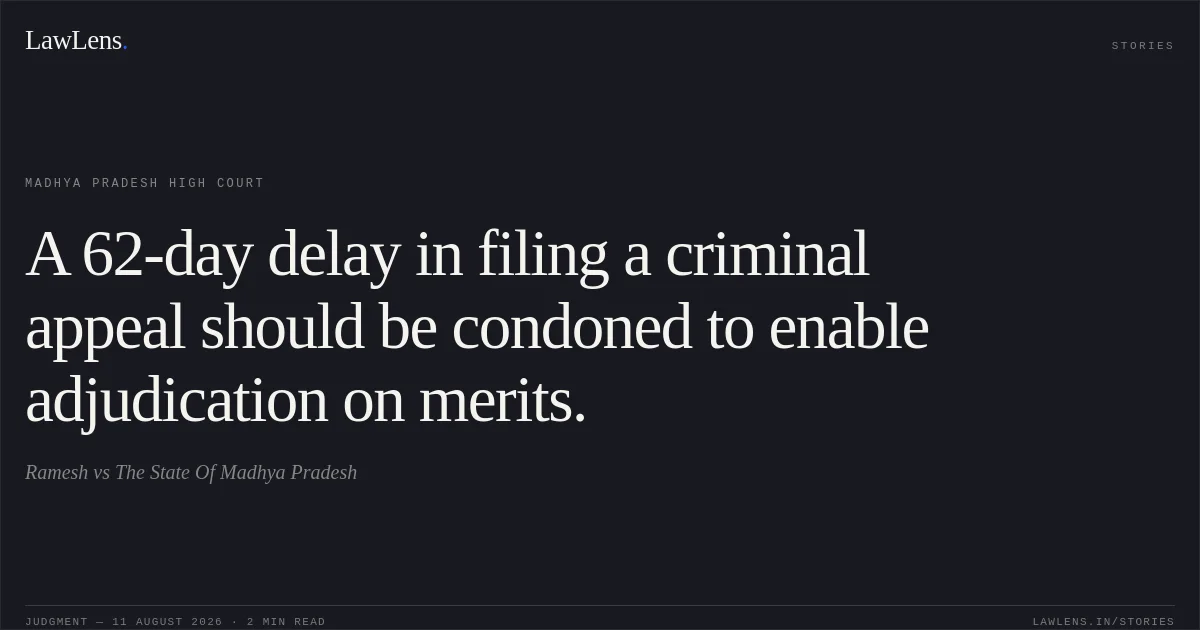
Whether the appellate court was justified in dismissing the criminal appeal solely on account of a 62-day delay without adjudicating the appeal on its merits?
Source reference: paras. 8–15Whether the High Court, in exercise of revisional jurisdiction, should condone the delay and direct consideration of the appeal on merits?
Source reference: paras. 15–20Law Applied
The Court exercised revisional jurisdiction under Sections 438 and 442 of the Bharatiya Nagarik Suraksha Sanhita, 2023.
Source reference: para. 16It applied the principle that limitation provisions are intended to prevent dilatory conduct and provide finality to litigation, not to destroy substantive rights, as stated in N. Balakrishnan v. M. Krishnamurthy, (1998) 7 SCC 123.
Source reference: para. 16It further relied on State of M.P. v. Pradeep Kumar, (2000) 7 SCC 372, which holds that an inadvertent lapse should not ordinarily permanently shut the doors of justice and that courts should determine whether a genuine grievance can be heard.
Source reference: para. 17The governing principle applied was that procedural rules, including limitation, should be construed liberally where refusal to condone a short and non-inordinate delay would defeat adjudication on merits, particularly in a criminal appeal involving personal liberty.
Source reference: para. 18Reasoning
The High Court found that the appellate court had dismissed the appeal merely because of a 62-day delay and had failed to consider the appellants’ substantive challenge to their conviction.
Source reference: para. 14Applying the principles in N. Balakrishnan and State of M.P. v. Pradeep Kumar, the Court held that 62 days could not be regarded as an inordinate delay and that an unintentional procedural lapse should not result in the denial of a statutory appellate remedy.
Source reference: para. 18The appellate court’s mechanical approach, particularly despite earlier directions issued by the High Court in CRR No. 2545/2026, amounted to material irregularity, failure to exercise jurisdiction and patent illegality warranting revisional interference.
Source reference: para. 19Holding
The revision petition was allowed.
The order dated 09 July 2026 passed by the First Additional Sessions Judge, Rajgarh, in Appeal No. CRA/147/2026 was set aside.
Source reference: para. 21The 62-day delay in filing the appeal was condoned, and the subordinate appellate court was directed to decide the appeal on its merits.
Source reference: para. 21A copy of the order was directed to be sent for immediate compliance.
Source reference: para. 22Acts & Sections Cited
6 provisions across 2 statutes referred to in this judgment. Each provision opens on LawLens.
Bharatiya Nagarik Suraksha Sanhita, 20231
Indian Penal Code, 18605
Original Court PDF
RameshvsThe State Of Madhya Pradesh
Click to open original judgment
Original judgment, available to read, download and summarize on LawLens.in