Facts
The Temple sued for possession of its property, arrears of rent and future mesne profits, alleging rent default and unauthorised subletting by its lessee, the first defendant.
Source reference: para. 3(i)–(iii)The defendants relied on a registered lease deed executed in 1987 in favour of the first defendant’s father, said to grant a 99-year lease for a lump sum and permit subletting and construction.
Source reference: paras. 3(iv)–(viii), 11The trial court dismissed the suit; the First Appellate Court reversed that decision and granted relief to the Temple.
Source reference: para. 3(xi)Defendants 3 to 5 appealed to the High Court.
Source reference: para. 4Issues
1. Whether the First Appellate Court erred in holding that the registered 99-year lease deed was invalid under Section 36 of the Indian Trusts Act, 1882, despite finding that it had been executed by the then trustee.
Source reference: para. 6(a)2. Whether the Temple had issued a valid notice under Section 106 of the Transfer of Property Act, 1882, terminating the tenancy.
Source reference: para. 6(b)Law Applied
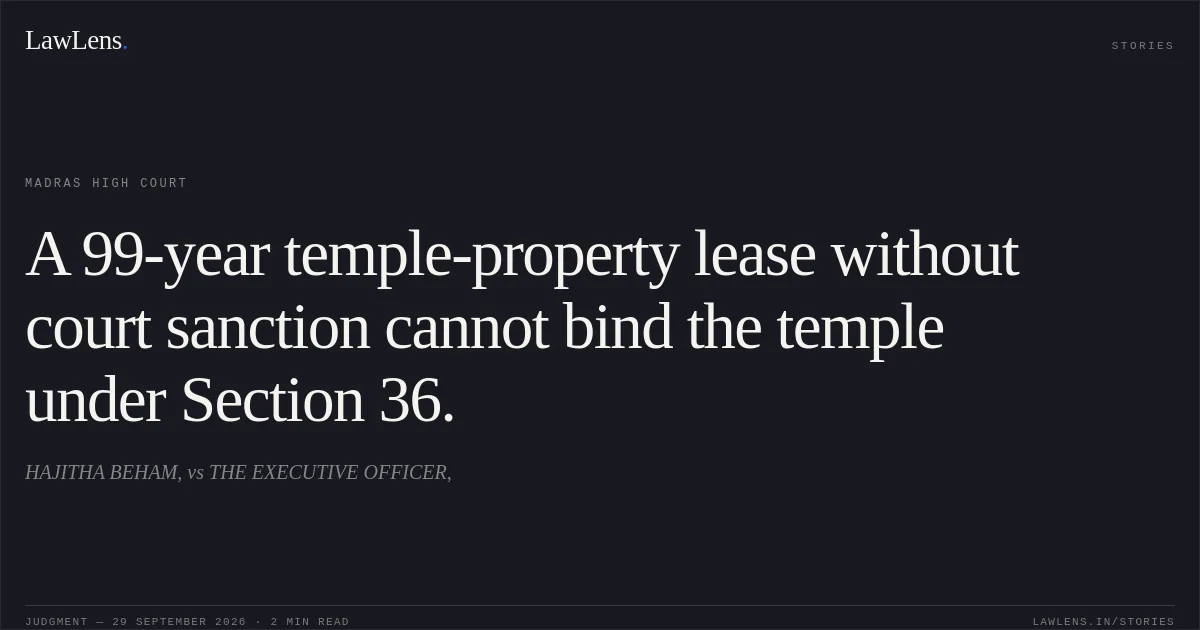
Section 36 of the Indian Trusts Act, 1882, as set out in the judgment, requires permission of the principal Civil Court of original jurisdiction for a lease of trust property exceeding 21 years; a lease granted beyond that period without sanction does not bind the trust and may be challenged by its beneficiary.
Source reference: paras. 12–13Section 106 of the Transfer of Property Act, 1882, governs termination of leases by written notice.
Source reference: paras. 14, 16The Court also applied the principle that, once the lessee’s tenancy is validly terminated, no separate notice to a sub-lessee is required, and the sub-lessee cannot claim a better right than the lessee.
Source reference: para. 15Reasoning
The Court found that Ex. B1 purported to grant a 99-year lease of Temple property, with rights to sublet and deal with the superstructure, but had been executed without the court permission contemplated by Section 36; the defendants therefore could not rely on it to defeat the Temple’s claim to possession.
Source reference: paras. 11–13, 18The Court further held that the Temple’s written notice dated 20 December 2000 terminated the first defendant’s tenancy with effect from 31 January 2001, met Section 106’s requirements, and preceded the suit. Because the second defendant claimed through the first defendant, a separate notice to the sub-lessee was unnecessary.
Source reference: paras. 15–17Holding
The Court answered the substantial questions against the appellants, holding that Ex. B1 did not defeat the Temple’s claim to possession and that the tenancy had been validly terminated.
The Second Appeal was dismissed, with no order as to costs; the connected miscellaneous petition was closed.
Source reference: para. 19Acts & Sections Cited
3 provisions across 3 statutes referred to in this judgment. Each provision opens on LawLens.
Code of Civil Procedure, 19081
Indian Trust Act, 18821
Transfer of Property Act, 18821
Original Court PDF
HAJITHA BEHAM,vsTHE EXECUTIVE OFFICER,
Click to open original judgment
Original judgment, available to read, download and summarize on LawLens.in