Facts
The husband appealed the Family Court’s dismissal of his petition for divorce under Sections 13(1)(i-a) and 13(1)(i-b) of the Hindu Marriage Act, 1955, alleging cruelty and desertion.
Source reference: para. 2–6He claimed that his wife had lived separately for over 23 years, neglected family responsibilities, and subjected him to criminal and domestic-violence proceedings.
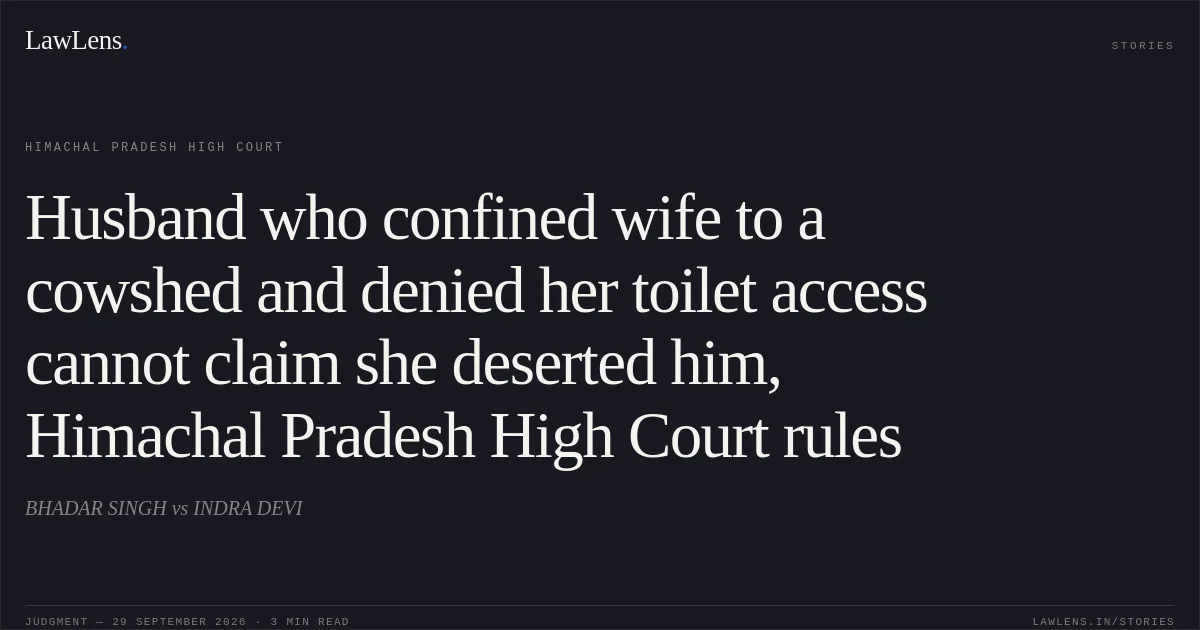
Source reference: para. 2–6The wife denied the allegations and asserted that the husband had subjected her to violence, excluded her from the main house, and forced her to live in an adjoining room without basic facilities.
Source reference: para. 2–6She relied on compromise deeds executed before police authorities and an order granting her relief under the Protection of Women from Domestic Violence Act, 2005.
Source reference: para. 2–6The Family Court found the grounds unproved and dismissed the petition; the husband appealed.
Source reference: para. 2–6Issues
Whether the wife had treated the husband with cruelty so as to entitle him to a divorce under Section 13(1)(i-a) of the Act.
Source reference: para. 5, 11–20Whether the wife had deserted the husband for the statutory period, without reasonable cause and with the requisite intention to end cohabitation, under Section 13(1)(i-b) of the Act.
Source reference: para. 5, 21–24Law Applied
Sections 13(1)(i-a) and 13(1)(i-b) of the Hindu Marriage Act provide, respectively, for divorce on proof of cruelty and desertion for a continuous period of at least two years immediately preceding the petition; the party seeking relief bears the burden of proving the ground.
Source reference: para. 11, 21–22Cruelty must be established by specific, clear and reliable evidence, and cannot rest on vague or generalized allegations; resort to legal proceedings does not by itself constitute cruelty unless shown to be false, frivolous or malicious.
Source reference: para. 12, 17–18Under Bipin Chander Jaisinghbhai Shah v. Prabhawati, desertion requires both factum of separation and animus deserendi, as well as absence of consent and of conduct by the petitioner that gave the other spouse reasonable cause to leave; Lachman Utamchand Kirpalani v. Meena was also relied on regarding desertion and constructive desertion.
Source reference: para. 22–23Section 23(1)(a) bars a party from taking advantage of their own wrong.
Source reference: para. 24The Court also treated clear admissions as substantive evidence, relying on Bharat Singh v. Bhagirathi and Nagindas Ramdas v. Dalpatram Ichharam.
Source reference: para. 14The Court also referred to Ravi Kumar v. Julmi Devi and Suman Singh v. Sanjay Singh on assessing cruelty in the circumstances and requiring cogent proof.
Source reference: para. 18Reasoning
The husband’s allegations of neglect and misconduct were general and lacked specific particulars or independent corroboration.
Source reference: para. 12–16His admitted signatures on the 2012 and 2014 compromise deeds supported the wife’s account of prior complaints and the husband’s undertakings to treat her properly and permit her use of the toilet and washroom.
Source reference: para. 12–16The evidence showed that the parties remained within the same premises, while the wife lived in an adjoining room or cowshed without basic sanitary facilities; the Court considered this evidence inconsistent with the husband’s claim that she had voluntarily abandoned the marriage.
Source reference: para. 12–16, 24The criminal case had been withdrawn after compromise, with no finding that the complaint was false, and the domestic-violence proceedings had resulted in orders granting the wife relief and restraining the husband from committing domestic violence or dispossessing her.
Source reference: para. 17–20The Court therefore found no basis to treat her resort to legal remedies as cruelty.
Source reference: para. 17–20It concluded that the wife had reasonable cause to live separately and that the husband’s conduct precluded him from relying on desertion.
Source reference: para. 23–24Holding
The Court held that the husband had failed to prove either cruelty or desertion by the wife.
It found no infirmity, perversity or illegality in the Family Court’s decision and dismissed the appeal, affirming the judgment and decree dated 8 August 2019.
Source reference: para. 25–26Any pending applications were disposed of, and the lower-court record was ordered to be returned.
Source reference: para. 25–26Acts & Sections Cited
6 provisions across 4 statutes referred to in this judgment. Each provision opens on LawLens.
Hindu Marriage Act, 19552
Indian Penal Code, 18601
Protection of Women from Domestic Violence Act, 20052
Code of Criminal Procedure, 19731
Original Court PDF
BHADAR SINGHvsINDRA DEVI
Click to open original judgment
Original judgment, available to read, download and summarize on LawLens.in