Facts
Dal Chand was shot and killed at about 2:00 a.m. on 8 July 1985. His son, Prem Kumar (PW-1), alleged that Udai Bhan Singh fired the shot, while Tej Singh and Mehtab Singh accompanied him.
Source reference: para. 1The prosecution relied principally on PW-1’s account and PW-2 Shankar’s evidence that he saw the accused fleeing. The post-mortem doctor found a firearm injury but testified that blackening, scorching, and tattooing were absent.
Source reference: para. 1Dal Chand’s wife and daughter, who were said to have been sleeping nearby, were not examined.
Source reference: para. 1The trial court convicted Udai Bhan under Section 302 IPC and Tej Singh and Mehtab Singh under Section 302 read with Section 34 IPC. The appeals of Tej Singh and Mehtab Singh had abated; Udai Bhan’s appeal alone remained for decision.
Source reference: para. 2Issues
Whether the medical evidence materially contradicted PW-1’s account of a close-range shot so as to make the prosecution case doubtful
Source reference: para. 18, paras. 21–27Whether the non-examination of the deceased’s wife and daughter, and the delayed recording of PW-2’s statement, undermined the prosecution evidence
Source reference: para. 18, paras. 28–35Whether, considering the evidence as a whole, the prosecution proved Udai Bhan’s guilt beyond reasonable doubt
Source reference: paras. 36–38Law Applied
Under Section 302 IPC, the prosecution must prove the accused’s guilt beyond reasonable doubt.
Source reference: no citationMedical evidence is ordinarily corroborative, but where it makes ocular evidence improbable or completely rules out the account given, the ocular evidence may be disbelieved (Solanki Chimanbhai Ukabhai v. State of Gujarat, (1983) 2 SCC 174; Abdul Sayeed v. State of M.P., (2010) 10 SCC 259).
Source reference: paras. 21–27A material witness’s unexplained non-examination may support an adverse inference under Section 114, Illustration (g), of the Evidence Act, particularly where that witness could have supplied a gap in the prosecution case (Habeeb Mohd. v. State of Hyderabad, (1953) 2 SCC 231; Takhaji Hiraji v. Thakore Kubersing Chamansing, (2001) 6 SCC).
Source reference: paras. 28–33The court also relied on Ram Narain Singh v. State of Punjab, (1975) 4 SCC 497, and Mani Ram v. State of U.P., 1994 Supp (2) SCC 289, concerning material conflict between ocular and medical evidence, and Rohtash Kumar v. State of Haryana, (2013) 14 SCC 434, on withholding eyewitnesses.
Source reference: paras. 21–33Reasoning
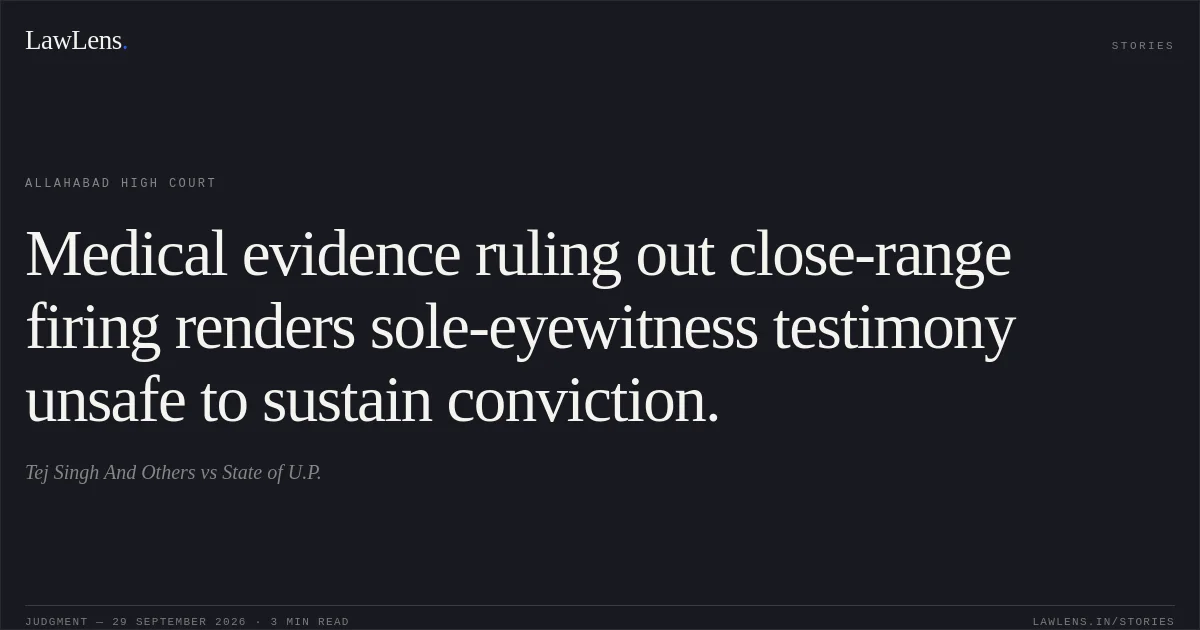
PW-1 described the shot as fired from close range, but the doctor found no blackening, scorching, or tattooing. The court treated this as a material conflict that made the sole direct account doubtful.
Source reference: paras. 21–27It further considered the unexplained absence of the deceased’s wife and daughter, who were said to have been sleeping beside him, significant to the prosecution’s proof of the occurrence.
Source reference: paras. 28–33PW-2’s presence on the road at 2:00 a.m. was regarded as unnatural and uncorroborated; his statement was recorded five days after the incident without explanation.
Source reference: para. 35The court also noted the parties’ land dispute and the prosecution’s explanation that rain prevented an immediate trip to the police station, despite the account that the family was sleeping in an open enclosure. Taken together, these matters raised reasonable doubt about the prosecution case.
Source reference: paras. 13, 34, 36Holding
The High Court held that the prosecution had not proved Udai Bhan Singh’s guilt beyond reasonable doubt and allowed his appeal.
It set aside the trial court’s judgment and acquitted him of the charges. As he was on bail, he was not required to surrender; his bail bonds were cancelled and his sureties discharged.
Source reference: paras. 36–39Acts & Sections Cited
4 provisions across 2 statutes referred to in this judgment. Each provision opens on LawLens.
Indian Penal Code, 18602
Code of Criminal Procedure, 19732
Original Court PDF
Tej Singh And OthersvsState of U.P.
Click to open original judgment
Original judgment, available to read, download and summarize on LawLens.in