Facts
Smt. Sukari and Smt. Satyawati brought a partition suit concerning agricultural land.
Source reference: pp. 1–3, paras. 1–3The trial court decreed partition, but the first appellate court reversed that decree.
Source reference: pp. 1–3, paras. 1–3In the plaintiffs’ second appeal, Sukari died and was deleted from the cause title. Defendant No. 5, Sonai, had also died, but her legal representatives were not brought on record.
Source reference: pp. 1–3, paras. 1–3The High Court allowed the second appeal and restored the trial court’s partition decree. Defendant Nos. 2 and 3 then sought recall of that judgment, contending that the appeal had abated against Sonai and the decree had been passed without her legal representatives.
Source reference: pp. 1–3, paras. 1–3Issues
Whether the second appeal, arising from a partition suit, abated as a whole because the legal representatives of deceased defendant No. 5 were not brought on record.
Source reference: pp. 3–4, para. 7Whether the applicants were entitled to recall of the High Court’s judgment and decree on that ground.
Source reference: p. 3, para. 3; p. 4, para. 8Law Applied
Order XXII Rules 4 and 11 of the Code of Civil Procedure, 1908, govern substitution of a deceased defendant’s legal representatives in an appeal.
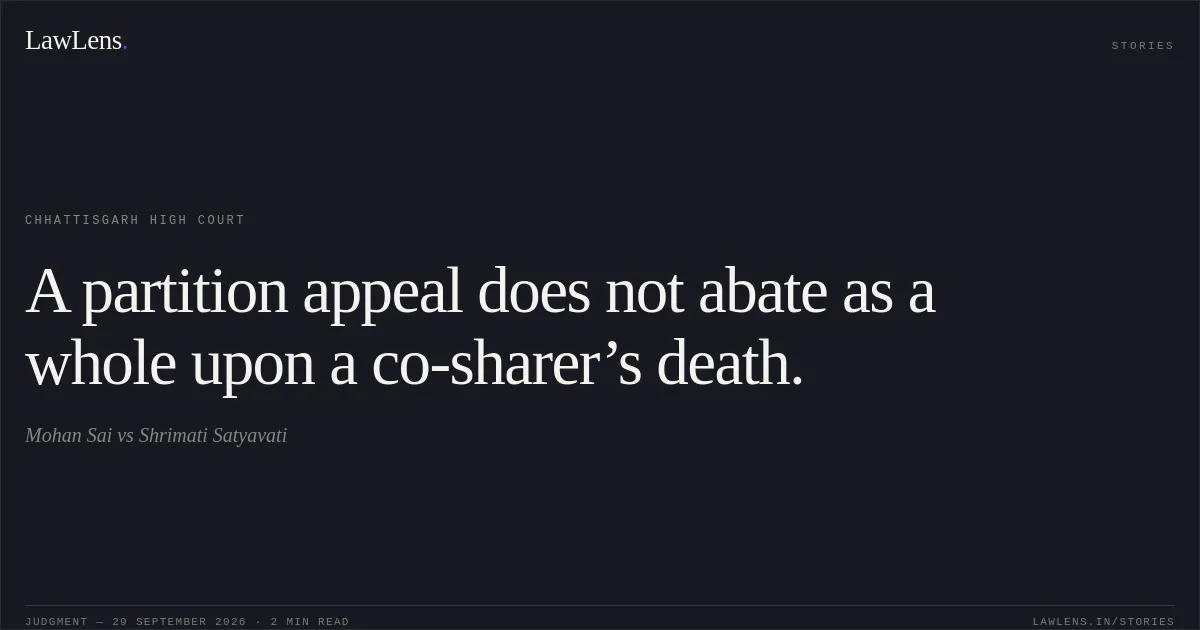
Source reference: pp. 3–4, para. 7The court applied the principle stated in Morasa Anjalah v. Kondragunte Venkateswarlu (Died) and Others, 1992 SCC OnLine AP 20, that an administration or partition suit does not abate as a whole merely because the legal representatives of a deceased co-sharer or co-owner have not been brought on record; each party is in the position of a plaintiff, and the deceased co-sharer’s heirs are necessary parties who may be brought on record under Order I Rule 10 CPC.
Source reference: pp. 3–4, para. 7The applicants also relied on Gurnam Singh (Dead) Through Legal Representatives and Others v. Gurbachan Kaur (Dead) by Legal Representatives, (2017) 13 SCC 414.
Source reference: p. 3, para. 3Reasoning
The court accepted that Sonai had died and her legal representatives had not been substituted.
Source reference: pp. 3–4, para. 7However, because the underlying proceeding was a partition suit, the omission did not cause the appeal to abate as a whole: each co-sharer stood in the position of a plaintiff, and the heirs of a deceased co-sharer remained necessary parties who could be brought on record under Order I Rule 10 CPC.
Source reference: pp. 3–4, para. 7The applicants’ abatement-based challenge therefore did not warrant recall of the partition decree.
Source reference: pp. 3–4, para. 7Holding
The court held that the appeal did not abate as a whole due to the failure to bring Sonai’s legal representatives on record.
It dismissed the MCC as not surviving for further adjudication and vacated any subsisting interim order.
Source reference: p. 4, para. 8Acts & Sections Cited
1 provisions across 1 statute referred to in this judgment. Each provision opens on LawLens.
Code of Civil Procedure, 19081
Original Court PDF
Mohan SaivsShrimati Satyavati
Click to open original judgment
Original judgment, available to read, download and summarize on LawLens.in