Facts
The petitioner was named in the complaint concerning a group assault and property damage on 3 December 2019, but the investigating officer omitted him from the charge sheet for want of sufficient material.
Source reference: pp. 3–5, 20–21After charges were framed against 13 accused, the prosecution examined 13 witnesses; 11 were treated as hostile. It then sought to arraign the petitioner under Section 319 CrPC, relying principally on the testimony of PW-9, the complainant, and PWs-12 and 13.
Source reference: pp. 4–5, 26The Sessions Court allowed the application, finding that their testimony and the complaint disclosed the petitioner’s presence and instigation of the assault.
Source reference: pp. 21–27The petitioner challenged that order under Section 482 CrPC.
Source reference: pp. 1–2Issues
Whether the evidence adduced at trial satisfied the threshold for summoning the petitioner as an additional accused under Section 319 CrPC.
Source reference: pp. 28–31, 51Whether the Sessions Court’s order allowing the application warranted interference under Section 482 CrPC.
Source reference: pp. 28, 51–52Law Applied
Section 319 CrPC empowers a court, during an inquiry or trial, to proceed against a person not already before it when evidence adduced before the court indicates that the person committed an offence triable with the existing accused.
Source reference: no citationUnder Hardeep Singh v. State of Punjab, the power is extraordinary and must be exercised sparingly: the evidence must be stronger than that required to frame a charge, though it need not establish guilt; the court must be satisfied that, if unrebutted, it may lead to conviction.
Source reference: pp. 29–31, 35–38The power may extend to a person named in the FIR but not charge-sheeted, but must rest on trial evidence; investigative material may be used for corroboration, not as a substitute for evidence before the court.
Source reference: pp. 39–41, 45–48The court also relied on Shankar v. State of Uttar Pradesh, Shiv Baran v. State of Uttar Pradesh, Omi v. State of Madhya Pradesh and Neeraj Kumar v. State of Uttar Pradesh in applying these principles.
Source reference: pp. 28–51Reasoning
The High Court held that the trial court had recited the evidence but had not adequately analysed whether it met Section 319’s heightened threshold.
Source reference: pp. 27–28Although PW-9 had named the petitioner in the complaint, his further statement to the police did not name him; PWs-12 and 13 had not attributed acts to the petitioner in their investigative statements.
Source reference: pp. 19–20, 25–27The High Court considered the trial testimony insufficient: PW-12 principally spoke to the petitioner’s presence, while PW-13’s account was assessed alongside the prior omissions and the evidence of the other witnesses, most of whom did not support the prosecution.
Source reference: pp. 19–20, 26–27In the High Court’s view, the trial court had treated these statements and the complaint as sufficient without explaining how they constituted strong and cogent evidence warranting the extraordinary power under Section 319.
Source reference: pp. 27–28, 51Holding
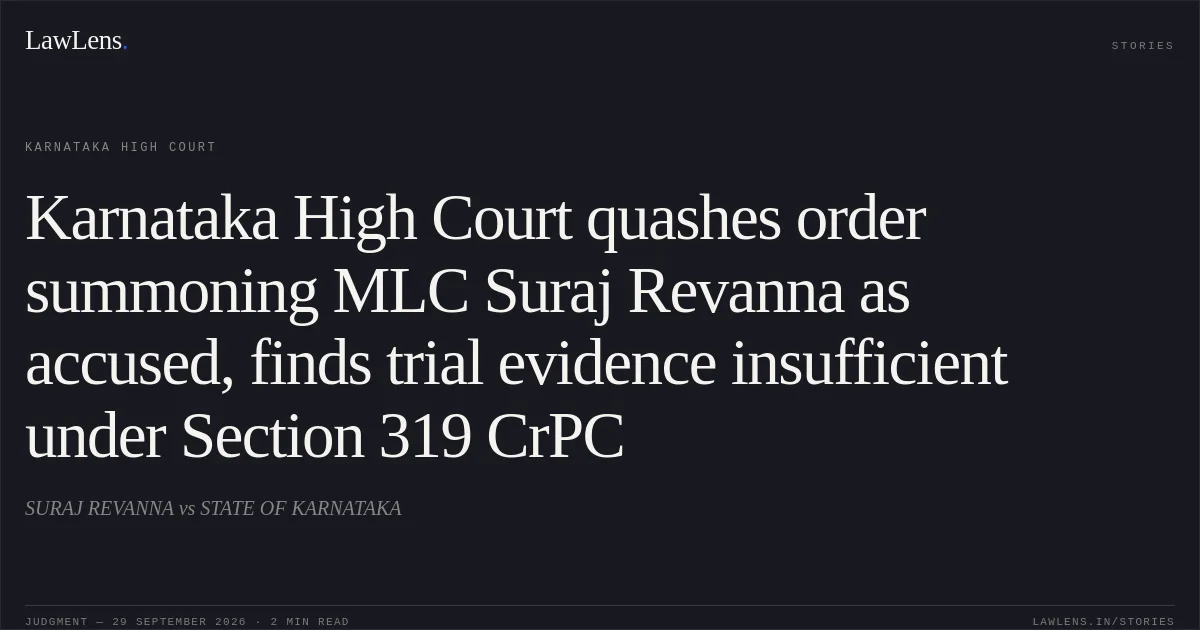
The High Court answered the issue in the petitioner’s favour, allowed the criminal petition and quashed the Sessions Court’s order dated 7 February 2025.
Consequently, the petitioner could not be arraigned as an additional accused in S.C. No. 194 of 2022.
Source reference: p. 52Acts & Sections Cited
16 provisions across 2 statutes referred to in this judgment. Each provision opens on LawLens.
Code of Criminal Procedure, 19734
Original Court PDF
SURAJ REVANNAvsSTATE OF KARNATAKA
Click to open original judgment
Original judgment, available to read, download and summarize on LawLens.in