Facts
The Tirunelveli Diocesan Council’s term expired on 12 April 2024, but elections for the 2024–2027 triennium were not held.
Source reference: para. 11On 22 May 2025, the CSI Synod appointed an Administrative Committee to manage the Diocese and conduct the elections.
Source reference: paras. 27–28Three writ petitions challenged the Synod’s communication and sought, among other reliefs, the appointment of a former Judge to conduct the elections.
Source reference: paras. 2–4, 31By a common order dated 28 October 2025, the Single Judge appointed a Judge Administrator.
Source reference: paras. 2–4, 31The Synod and others appealed.
Source reference: paras. 5–10The batch also included connected applications and a contempt petition alleging breach of an interim order.
Source reference: paras. 5–10Issues
Whether the Synod’s communication appointing an Administrative Committee to administer the Diocese and conduct elections was amenable to review under Article 226, given its internal character and the absence of an asserted public-law element.
Source reference: paras. 41, 51–52, 85Whether the Synod had authority under the CSI Constitution to intervene in the Diocese’s administration and appoint the Committee pending elections.
Source reference: paras. 42, 47–50Whether the Single Judge’s appointment of a Judge Administrator should be sustained.
Source reference: paras. 31, 42, 50–52Law Applied
Article 226 permits judicial review of a private body’s action where the body discharges a public duty or function and the challenged action has a public-law element; a body’s performance of some public function does not make every decision reviewable (*St. Mary’s Education Society v. Rajendra Prasad Bhargava*).
Source reference: paras. 77–79A voluntarily undertaken service is not, without more, a public duty, and a private body’s actions are not ordinarily subject to writ review absent the necessary public function or duty (*Ramakrishna Mission v. Kago Kunya*; *G. Bassi Reddy v. International Crops Research Institute*).
Source reference: paras. 81–83Under Chapter IX, clauses 15–17 of the CSI Constitution, the Synod has specified powers concerning diocesan administration, including taking steps where a Diocesan Council cannot or will not perform its functions, subject to the conditions stated in the Constitution.
Source reference: paras. 47–49The Court also considered the Full Bench decision in *D. Bright Joseph v. Church of South India* and the Supreme Court’s order dismissing the challenge to that decision while keeping the question of law open.
Source reference: paras. 69–72, 83–86Reasoning
The Court treated the challenged communication as an internal Synod-to-Diocese measure intended to address the administrative vacuum and facilitate overdue elections, rather than an action involving a public duty or public-law element.
Source reference: paras. 41, 45, 51–52It held that the Synod’s constitutional provisions empowered it to assist or intervene in diocesan administration in the circumstances, and that any defect in the authority or procedure for issuing the communication could be cured by ratification within the Church.
Source reference: paras. 47–50The Court therefore found that the Single Judge should not have displaced the internal arrangement by appointing a Judge Administrator.
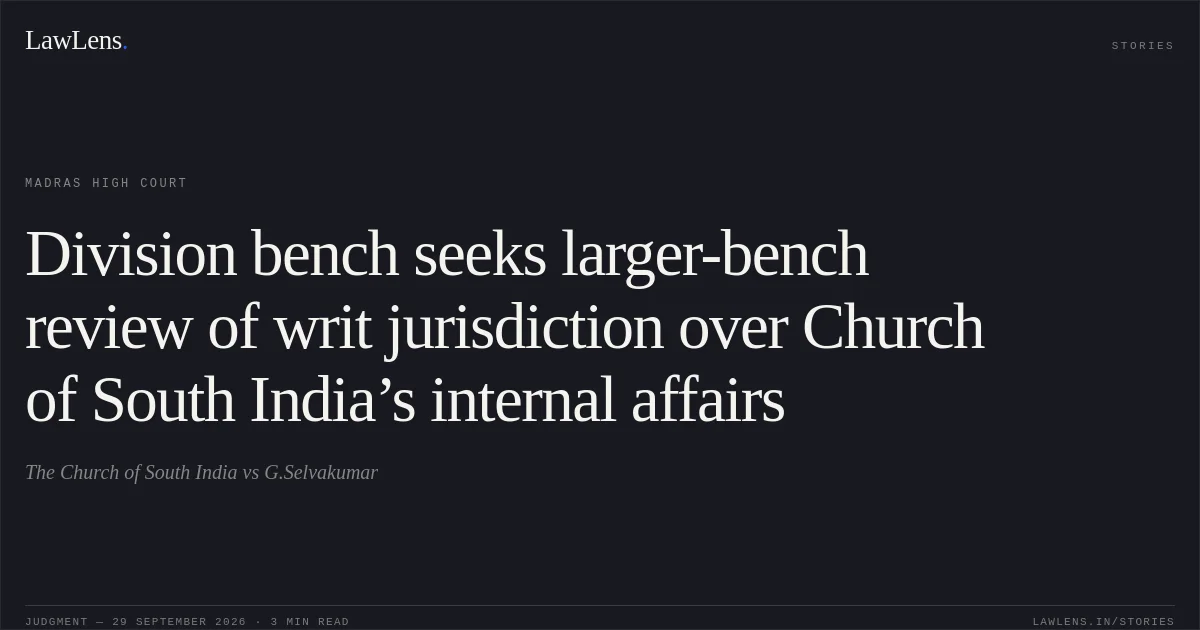
Source reference: paras. 42, 50–52Although it questioned the Full Bench’s reasoning in *D. Bright Joseph*, it did not purport to overrule that decision; instead, it directed that the judgment be placed before the Chief Justice for consideration of a Larger Bench reference.
Source reference: paras. 76, 83–86Holding
The Division Bench allowed the four writ appeals, set aside the Single Judge’s common order, and dismissed the three writ petitions.
The Administrative Committee appointed by the Synod was thus left in place to administer the Diocese pending elections.
Source reference: paras. 57, 67The connected applications and contempt petition were dismissed, with no order as to costs.
Source reference: paras. 54, 57, 59–64, 65The Registry was directed to place the judgment before the Chief Justice for consideration of a Larger Bench to revisit the question concerning writ review of internal CSI communications.
Source reference: para. 86Acts & Sections Cited
1 provisions across 1 statute referred to in this judgment. Each provision opens on LawLens.
Contempt of Courts Act, 19711
Original Court PDF
The Church of South IndiavsG.Selvakumar
Click to open original judgment
Original judgment, available to read, download and summarize on LawLens.in