Facts
The deceased workman, Md. Azam, claimed that he had worked for the petitioner jute mill since 1980 and that, after recovering from illness, he reported for duty on 3 July 2007 with a fitness certificate but was offered work only on “half pay” and on a voucher basis.
Source reference: paras. 3–5, 11–16, 18The management maintained that he was a casual badli worker who had been absent since 2006, and that it had sent him a notice on 14 August 2007 directing him to report for duty.
Source reference: paras. 3–5, 11–16, 18The workman raised an industrial dispute in 2011, alleging refusal of employment from July 2007.
Source reference: paras. 3–5, 11–16, 18The Industrial Tribunal held the termination by refusal of employment unjustified and awarded the workman’s legal heirs full back wages and consequential benefits from 3 July 2007 until his death on 26 November 2020, together with compensation.
Source reference: paras. 1–2The employer challenged that award by writ petition.
Source reference: para. 1Issues
1. Whether the Tribunal’s finding that the workman’s service was terminated by refusal of employment from July 2007 was sustainable on the evidence.
Source reference: paras. 21–242. Whether the workman’s failure to report for duty, despite receiving the management’s notice, established abandonment of service and displaced the Tribunal’s award of back wages and other relief.
Source reference: paras. 23–29Law Applied
The Court applied the principle that a finding or award must be supported by a proper appreciation of the evidence on record; it treated the evidence of a direction to report for duty, received by the workman, followed by his failure to join, as relevant to determining whether employment had been refused or service abandoned.
Source reference: paras. 23–27The petitioner cited Nagar Parishad Bilaspur v. Bone Ram and Another, (2005) II LLJ 123, concerning prolonged unexplained absence and abandonment, while the respondents cited Raghubir Singh v. General Manager, Haryana Roadways, 2014-IV-LLJ-171 (SC).
Source reference: paras. 19–20The judgment does not expressly set out or apply a statutory provision, or explain its adoption of either cited precedent.
Source reference: paras. 19–20Reasoning
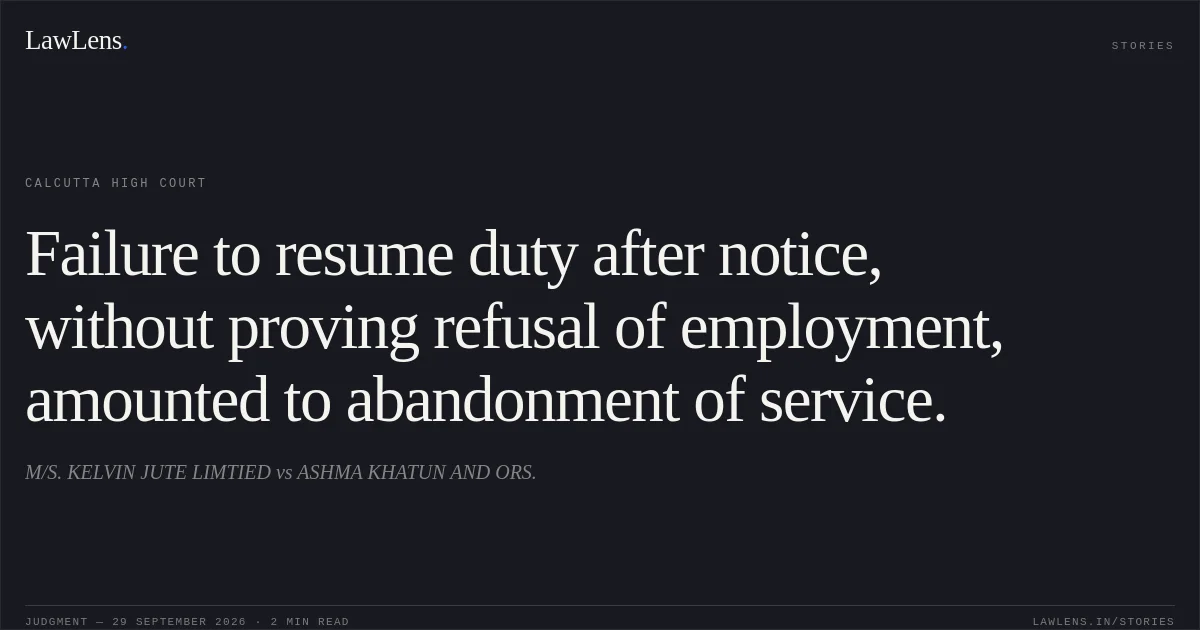
The Court found that the management’s letter dated 14 August 2007 and its acknowledgement card showed that the workman had been asked to report for duty and had received the notice.
Source reference: paras. 9–12, 22–27It considered his claim that he was offered only half pay unsupported by evidence, noting that he did not join and therefore could not substantiate that claim through the salary or voucher records.
Source reference: paras. 9–12, 22–27The Court also relied on the delay of nearly five years before the workman raised the dispute and found no evidence establishing that he was a permanent employee.
Source reference: paras. 9–12, 22–27On those facts, it concluded that refusal of employment had not been proved and that the workman had abandoned service; the Tribunal’s contrary award was therefore perverse and erroneous.
Source reference: paras. 9–12, 22–27Holding
The Court allowed the writ petition and quashed and set aside the Tribunal’s award dated 28 November 2022.
It directed that the deceased workman’s legal heirs be paid the benefits or dues to which he was entitled as a badli worker for the period from 1980 to 2007, within three months.
Source reference: para. 29No back wages or consequential benefits for the period after 2007 were upheld.
Source reference: paras. 27–30Acts & Sections Cited
1 provisions across 1 statute referred to in this judgment. Linked provisions open on LawLens.
the Act (alias, unresolved)1
Original Court PDF
M/S. KELVIN JUTE LIMTIEDvsASHMA KHATUN AND ORS.
Click to open original judgment
Original judgment, available to read, download and summarize on LawLens.in