Facts
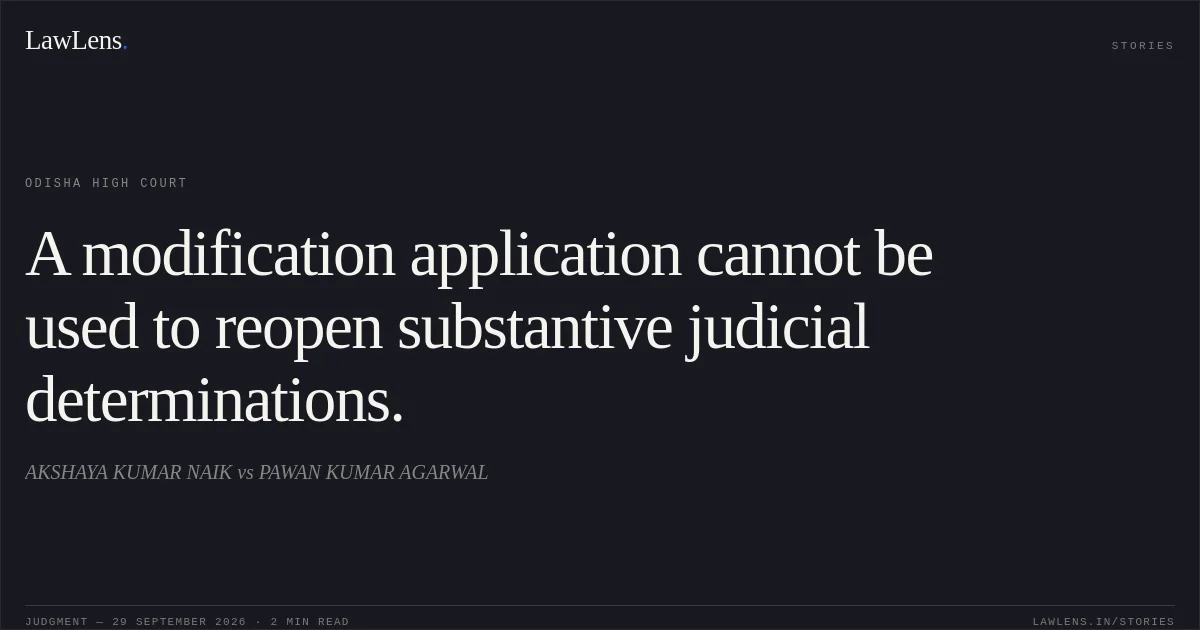
The petitioner sought modification of the judgment dated 31 July 2026, requesting corrections to several case details and factual descriptions, as well as changes to the Court’s direction on compensation and to its reference to a statutory provision.
Source reference: p.1–2The Court considered the requests against the pleadings and supporting documents in W.P.(C) Nos. 22751 of 2021 and 2903 of 2022.
Source reference: p.3–4Opposite Party No. 1 opposed the proposed alteration of the compensation direction as an impermissible substantive review.
Source reference: p.3–4Issues
Whether requested changes to case numbers, dates, and the description of a relationship could be allowed as corrections of inadvertent errors.
Source reference: p.3–4Whether the Court could, by way of modification, alter its compensation direction or change the statutory provision applied in the judgment.
Source reference: p.5Whether requested insertions of additional text into the judgment were necessary or warranted.
Source reference: p.4–5Law Applied
The Court distinguished between correcting inadvertent typographical errors and revisiting substantive judicial determinations.
Source reference: p.4–5Clerical or typographical mistakes may be corrected where the record establishes the intended text; a modification application cannot be used to re-examine or alter a conscious judicial decision.
Source reference: p.4–5The order cites no specific statute or precedent for this principle.
Source reference: no citationReasoning
The pleadings and annexures established that the judgment had misstated the impugned orders in both writ petitions and the RoR publication date; the counter-affidavit and rejoinder likewise confirmed that Opposite Party No. 1 was the son, not the grandson, of the original purchaser. The Court therefore treated those errors as typographical and allowed their correction.
Source reference: p.3–4By contrast, the proposed change to the compensation direction and the substitution of Section 4 for Section 3 concerned express judicial determinations, not accidental errors, and could not be made through modification. The proposed additions to paragraphs 3 and 15 were unnecessary because the existing text remained sufficiently clear.
Source reference: p.4–5Holding
The application was allowed in part.
The Court corrected the impugned-order details in paragraph 2, the RoR publication date in paragraph 4, and “grandfather” to “father” in paragraphs 5 and 7.
Source reference: p.5–6It rejected the requests to alter the compensation direction, change the statutory provision, and insert additional text in paragraphs 3 and 15.
Source reference: p.5–6The application was disposed of accordingly, with the Office directed to carry out the permitted corrections.
Source reference: p.6Acts & Sections Cited
2 provisions across 1 statute referred to in this judgment. Linked provisions open on LawLens.
Cooch Behar (Assimilation Of State Laws) Act, 19502
Original Court PDF
AKSHAYA KUMAR NAIKvsPAWAN KUMAR AGARWAL
Click to open original judgment
Original judgment, available to read, download and summarize on LawLens.in