Facts
In CRL.M.C. 2551/2025, the proposed accused challenged an order directing notice under Section 223 of the Bharatiya Nagarik Suraksha Sanhita, 2023 (BNSS), before the Magistrate recorded the complainant’s pre-summoning evidence.
Source reference: pp. 3–4, para. 3In CRL.M.C. 3169/2026, the proposed accused challenged a similar direction, which had been upheld in revision.
Source reference: pp. 3–4, para. 4A Single Judge referred questions concerning when cognizance is taken on a private complaint under the BNSS and when notice must be given to the proposed accused under the first proviso to Section 223(1).
Source reference: p. 2, para. 1; p. 6, para. 12Issues
Whether, under the BNSS, examination of the complainant and witnesses on oath is a step before cognizance, and whether it forms part of the process of taking cognizance.
Source reference: p. 2, para. 1; p. 50, para. 81Whether notice under the first proviso to Section 223(1) must be issued before or after that examination, and before the Magistrate formally decides to take cognizance.
Source reference: p. 2, para. 1; p. 50, para. 81Law Applied
Section 210 BNSS governs a Magistrate’s power to take cognizance; Section 223(1) requires examination on oath of the complainant and witnesses present while the Magistrate is taking cognizance, unless examination is statutorily exempted, and its first proviso bars cognizance without giving the accused an opportunity to be heard.
Source reference: pp. 24–26, paras. 48, 52–60The Court held that Section 223 changed the Cr.P.C. position: the examination is part of the cognizance process, rather than a step occurring after cognizance.
Source reference: pp. 28–32, paras. 49–59The proviso confers a mandatory right to be heard before cognizance, consistent with Kushal Kumar Agarwal v. Directorate of Enforcement and Parvinder Singh v. Directorate of Enforcement.
Source reference: pp. 39–41, paras. 72–73The Court also relied on the principle of harmonious construction and the mischief rule: statutory provisions must be read as a whole, and the remedy introduced by legislation must receive meaningful effect.
Source reference: pp. 30–31, para. 57; pp. 36–37, para. 67Reasoning
The Court treated the word “while” in Section 223 as temporal and as making the complainant’s and witnesses’ examination part of the process of taking cognizance, departing from the settled Cr.P.C. position.
Source reference: pp. 28–32, paras. 49–59Because the accused must be heard before cognizance, but has no right under Section 223 to participate in the recording of that evidence, the Court held that notice should ordinarily follow the examination, not precede it.
Source reference: pp. 35–38, paras. 63–70That sequence gives the accused a meaningful opportunity to address the complaint and recorded statements before cognizance, while avoiding premature participation in the complainant’s evidence.
Source reference: pp. 35–38, paras. 63–70The Court clarified that this does not merge cognizance with issuance of process: after hearing the accused and deciding whether to take cognizance, the Magistrate must still consider the distinct options under Sections 225–227.
Source reference: p. 38, para. 71Holding
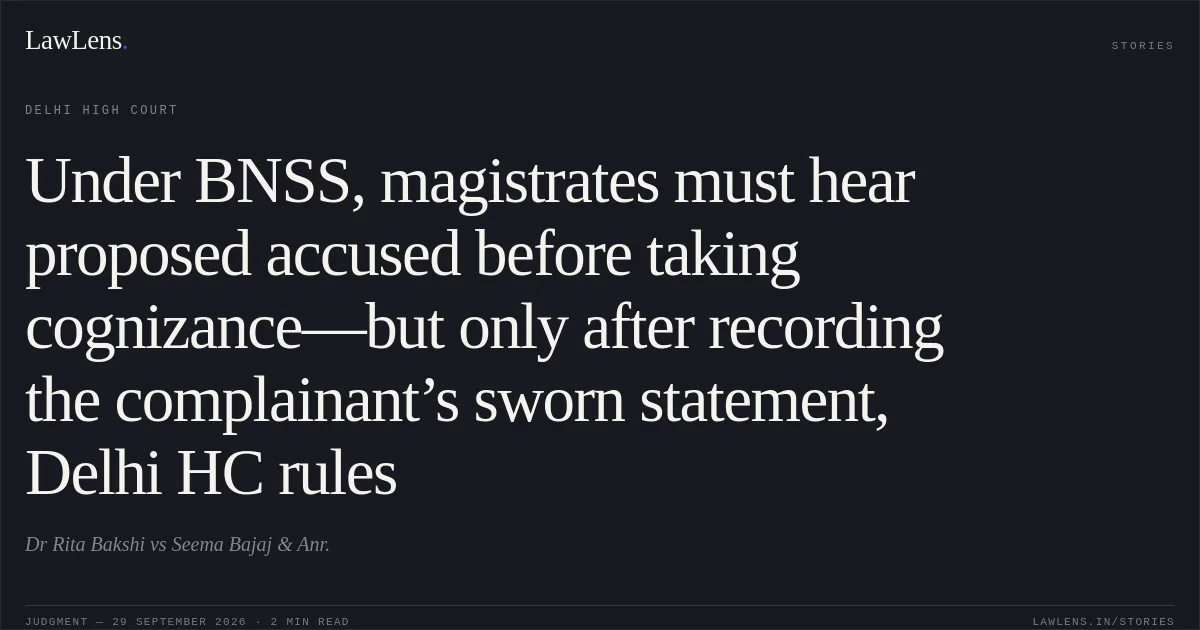
The Court answered that, unless examination is statutorily exempted, the Magistrate may take cognizance only after examining the complainant and witnesses on oath and providing the accused an opportunity to be heard.
Notice under the first proviso to Section 223(1) must be issued after that examination and after the Magistrate forms a prima facie view that the complaint should not be dismissed under Section 226, but before the formal decision to take cognizance.
Source reference: p. 50, para. 81The referred questions were answered accordingly, and the petitions were directed to be listed before the Roster Bench.
Source reference: p. 50, paras. 81–83Acts & Sections Cited
17 provisions across 3 statutes referred to in this judgment. Each provision opens on LawLens.
Bharatiya Nagarik Suraksha Sanhita, 2023
Code of Criminal Procedure, 19737
Prevention of Money-Laundering Act, 20021
Original Court PDF
Dr Rita BakshivsSeema Bajaj & Anr.
Click to open original judgment
Original judgment, available to read, download and summarize on LawLens.in