Facts
The petitioner challenged an order dated 26 September 2022 assessing provident-fund dues of ₹87,66,647 for the period from 5 April 1992 to September 2008 under Section 7A of the Employees’ Provident Funds and Miscellaneous Provisions Act, 1952 (“EPF Act”)
Source reference: para. 25The establishment had been covered under the Act from 15 February 2006, initially under the classification “Architect,” and the authorities later shifted the coverage date back to 5 April 1992 based on records including the establishment’s memorandum of association and purchase orders
Source reference: paras. 10–17After an earlier remand directing that notice and an opportunity to respond be provided, the authority passed the impugned order
Source reference: paras. 20, 24–26The petitioner maintained that it carried on interior-decoration work, not architectural or building-and-construction activity covered by the Act, and that the workers had been supplied by contractors
Source reference: paras. 22–23Issues
1. Whether the petitioner’s interior-decoration business was an establishment covered by the EPF Act under the relevant scheduled or scheme classification.
Source reference: paras. 32–482. Whether the authority’s assessment of provident-fund dues for the period from 5 April 1992 to September 2008 could stand when the alleged covered activity had not been established.
Source reference: paras. 25, 44–49Law Applied
Section 1(3)(b) of the EPF Act provides for application of the Act to establishments within the classes specified under the Act and the applicable scheme.
Source reference: no citationThe authority relied on the relevant coverage classification, including the scheme entry concerning the building-and-construction industry and the classification “Architect”.
Source reference: paras. 4, 10, 13The Court considered whether the establishment’s actual business brought it within that coverage; it treated the company’s stated objects as insufficient, by themselves, to establish that the relevant covered work was actually carried on.
Source reference: paras. 38–45Section 7A was the basis for the authority’s determination of dues.
Source reference: para. 25Reasoning
The Court found that the record did not establish that the petitioner designed buildings, constructed buildings, or otherwise carried on work falling within the relevant coverage classification.
Source reference: paras. 32–45It considered the “Architect” classification unsupported by the evidence and observed that the purchase orders appeared to relate to interior decoration rather than building construction or architectural work.
Source reference: paras. 34–40The Court also accepted that interior-decoration work may include minor civil work, but concluded that this did not, on the facts, bring the establishment within the Act.
Source reference: paras. 41, 47Accordingly, the coverage premise underlying the Section 7A assessment was not made out.
Source reference: paras. 44–49Holding
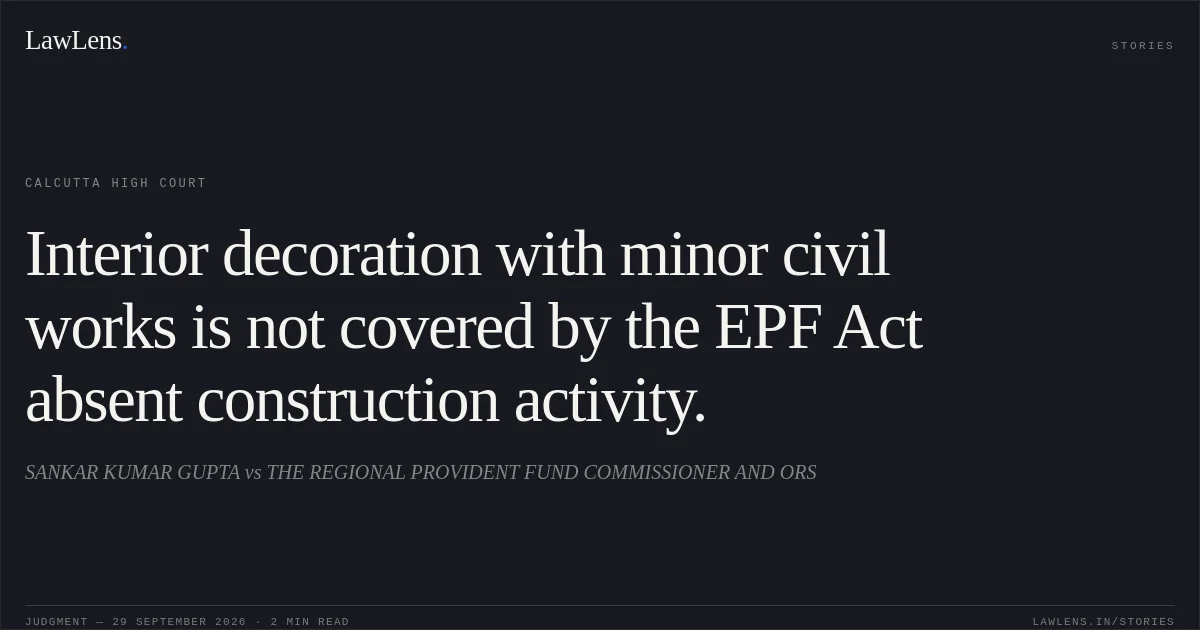
The Court held that the petitioner’s establishment was not shown to be covered by the EPF Act and that the impugned order was not in accordance with the Act.
It quashed and set aside the order dated 26 September 2022, allowed the writ petition, and disposed of any connected applications.
Source reference: paras. 49–51Acts & Sections Cited
10 provisions across 3 statutes referred to in this judgment. Linked provisions open on LawLens.
Employees’ Provident Funds And Miscellaneous Provisions Act, 19526
Building and Other Construction Workers (Regulation of Employment and Conditions of Service) Act, 19961
Factories Act, 19483
Original Court PDF
SANKAR KUMAR GUPTAvsTHE REGIONAL PROVIDENT FUND COMMISSIONER AND ORS
Click to open original judgment
Original judgment, available to read, download and summarize on LawLens.in