Facts
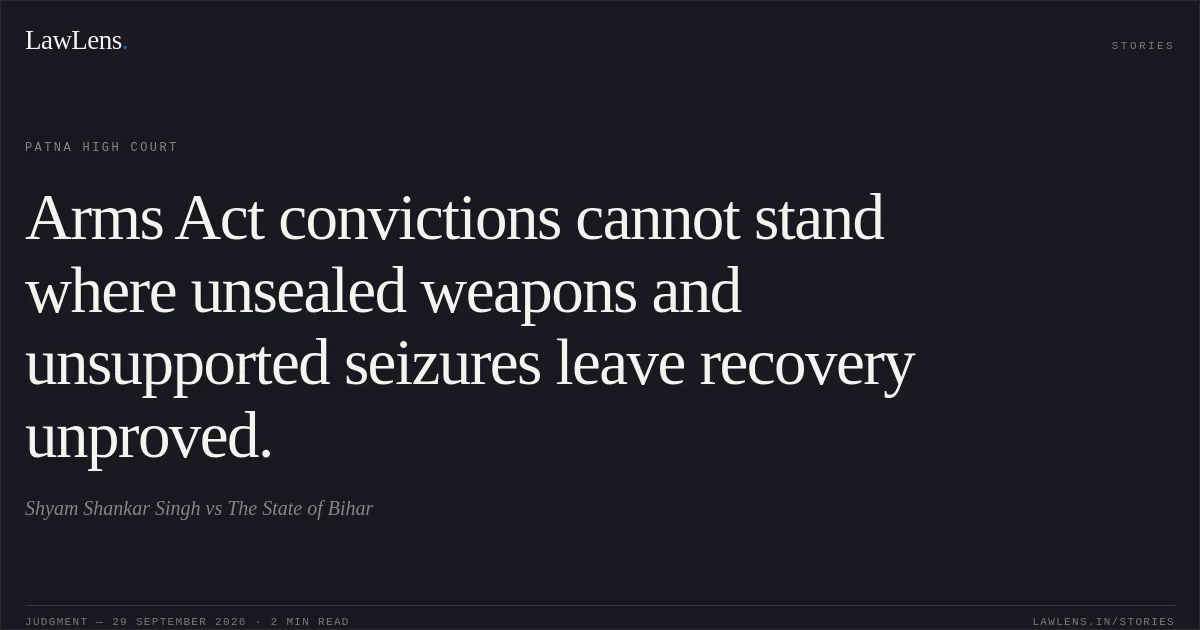
The petitioners were convicted under Sections 25(1-B)(a), 26 and 35 of the Arms Act for alleged recovery of firearms and ammunition from a jeep and its occupants.
Source reference: pp. 1–2The trial court imposed concurrent two-year terms of rigorous imprisonment and fines; the appellate court affirmed the conviction and sentence.
Source reference: pp. 1–2In revision, the petitioners challenged, among other matters, the reliability of the recovery evidence, the absence of sealing or identifying marks on the seized articles, the non-examination of a seizure-list witness and the validity of the District Magistrate’s sanction.
Source reference: pp. 3–5, 9–11The only examined seizure-list witness denied the recoveries and stated that he had signed a blank paper.
Source reference: pp. 3–5, 9–11Issues
1. Whether the concurrent findings of conviction were perverse or legally unsustainable in light of the alleged defects in proving the recoveries, including the unsealed and unidentified seized articles and the seizure-list witness’s testimony.
Source reference: pp. 7–12, 152. Whether the sanction order, which the petitioners alleged did not demonstrate application of mind to the facts of the case, could sustain the prosecution under the Arms Act.
Source reference: pp. 4–5, 10–113. Whether the challenged judgments and sentence should be set aside in the exercise of revisional jurisdiction.
Source reference: pp. 11–12, 15–18Law Applied
The prosecution was required to prove the offences charged under Sections 25(1-B)(a), 26 and 35 of the Arms Act, including the alleged possession and recovery of the relevant arms or ammunition.
Source reference: pp. 1, 5–6The Court stated that seizure evidence should be supported by independent witnesses and that seized articles should be sealed or otherwise identifiable to safeguard against tampering or false implication; it treated the failure to do so as material in the circumstances of this case.
Source reference: pp. 7–12It also stated that a sanction order must reflect the sanctioning authority’s application of mind to the facts; a bare endorsement accepting a recommendation, without relevant case particulars, was inadequate.
Source reference: pp. 4–5, 10–11In revision, the Court noted that interference with concurrent findings is not ordinarily warranted unless gross perversity is shown.
Source reference: p. 11Reasoning
The Court found material defects in the proof of recovery: the sole examined seizure-list witness did not support the prosecution and said he had signed a blank paper; the other seizure-list witness was not examined; and the evidence of the informant, the malkhana in-charge and the investigating officer indicated that the seized articles had not been sealed at recovery.
Source reference: pp. 9–12, 15The articles also lacked identifying marks or labels linking them to the petitioners, undermining proof that the items produced or examined were those allegedly recovered.
Source reference: pp. 9–12The Court further considered the sanction order defective because it merely accepted the Superintendent of Police’s recommendation and did not disclose consideration of the material facts of the alleged recovery.
Source reference: pp. 10–11It held that these material infirmities had not been addressed by the courts below and rendered their findings perverse for purposes of revision.
Source reference: pp. 11–12, 15Holding
The High Court allowed the revision, set aside the appellate judgment affirming the trial court’s conviction and sentence, and acquitted the petitioners of the charges.
It directed their release forthwith unless their custody was required in another case, disposed of any pending interlocutory applications, and directed that the trial court record be returned.
Source reference: p. 13Acts & Sections Cited
5 provisions across 2 statutes referred to in this judgment. Each provision opens on LawLens.
Arms Act, 19593
Code of Criminal Procedure, 19732
Original Court PDF
Shyam Shankar SinghvsThe State of Bihar
Click to open original judgment
Original judgment, available to read, download and summarize on LawLens.in