Facts
The appellants were convicted under Sections 302 IPC and 135 of the Bombay Police Act for their alleged roles in a group altercation in which Rajendrasinh Parmar sustained injuries and later died.
Source reference: pp. 1–5, 6–13The trial court acquitted the other accused and did not accept the charges founded on unlawful assembly, including Section 149 IPC.
Source reference: pp. 1–5, 6–13In appeal, the appellants challenged the reliability of the eyewitness account, the identification of the assailant who caused the fatal head injury, and the prosecution’s failure to explain injuries suffered by members of the appellants’ group.
Source reference: pp. 1–5, 6–13The High Court considered the evidence in the appeals and the relevance of the cross-complaint, while noting that evidence recorded in the cross-case could not itself be relied upon to decide these appeals.
Source reference: pp. 15–18Issues
1. Whether the appellants’ convictions under Section 302 IPC could stand when the prosecution had not reliably established which appellant inflicted the single head injury that caused the death.
Source reference: pp. 28–29, 67–702. Whether the circumstances—including the group clash, the unexplained injuries to the appellants’ side, and the evidence concerning the place of occurrence—created reasonable doubt about the prosecution’s account and the appellants’ individual acts.
Source reference: pp. 17–18, 42–55Law Applied
Where the trial court rejects liability under Section 149 IPC, the prosecution must establish the individual act of each accused to sustain an individual conviction.
Source reference: pp. 54–55, 64–66Exception 4 to Section 300 IPC applies where a homicide occurs without premeditation, in a sudden fight in the heat of passion upon a sudden quarrel, and without the offender taking undue advantage or acting cruelly or unusually.
Source reference: pp. 54–55, 64–66Under Section 105 of the Evidence Act, an accused raising private defence bears the burden of establishing it on a preponderance of probabilities; the plea may be assessed from the prosecution evidence, but cannot rest on speculation.
Source reference: pp. 58–61Under Lakshmi Singh v. State of Bihar, non-explanation of injuries to the accused may materially undermine the prosecution where the witnesses are interested or the defence version is probable, though it is not invariably fatal.
Source reference: pp. 17–18Medical evidence is ordinarily corroborative and displaces eyewitness testimony only where it rules out the alleged manner of injury, as stated in Solanki Chimanbhai Ukkabhai v. State of Gujarat.
Source reference: pp. 45–46The Court also referred to Sridhar Bhuyan v. State of Orissa on the requirements of Exception 4, and Stalin v. State on assessing a single injury by the circumstances of the case.
Source reference: pp. 64–67Reasoning
The Court found material weaknesses in the prosecution account: the medical evidence disclosed one incised head wound, although witnesses attributed separate head blows to both appellants; the evidence did not reliably identify which appellant caused that injury, and the medical evidence also cast doubt on the weapon attributed to the assailant.
Source reference: pp. 20–22, 28–30, 67–68The complainant’s account was further undermined by the evidence locating blood near Jagatsinh’s house, his omission to disclose that fact earlier, and the prosecution’s failure to explain injuries sustained by members of the appellants’ group.
Source reference: pp. 34–43Although the Court considered the incident a sudden group fight and did not accept the plea of private defence, the decisive deficiency was that the prosecution had not proved the specific fatal act of either appellant beyond reasonable doubt.
Source reference: pp. 54–62, 67–70Holding
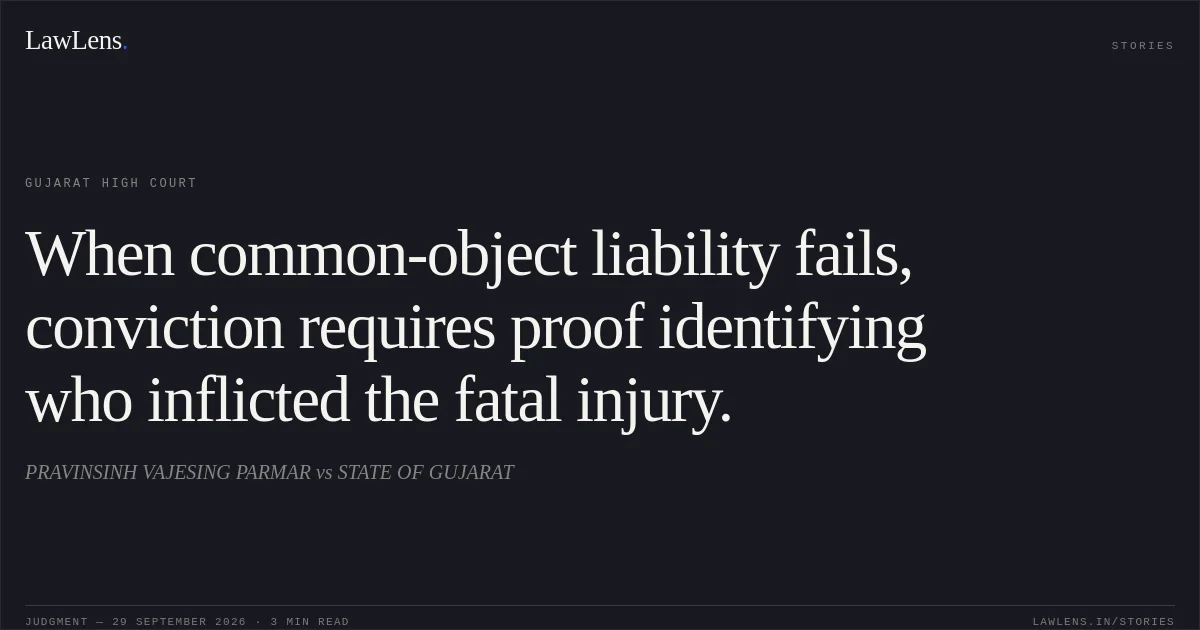
The High Court held that the Section 302 convictions were unsustainable because the prosecution failed to identify which appellant inflicted the fatal head injury and failed to prove the appellants’ individual offensive acts.
Both appeals were allowed; the convictions and sentences in Sessions Case No. 79 of 2009 were set aside, and both appellants were acquitted of all charges.
Source reference: pp. 70–71Their bail bonds were discharged and any fine paid was ordered to be refunded.
Source reference: pp. 70–71Acts & Sections Cited
34 provisions across 2 statutes referred to in this judgment. Each provision opens on LawLens.
Code of Criminal Procedure, 19733
Indian Penal Code, 1860
Original Court PDF
PRAVINSINH VAJESING PARMARvsSTATE OF GUJARAT
Click to open original judgment
Original judgment, available to read, download and summarize on LawLens.in