Facts
The respondent-workman was enrolled as a “Registered Badli” by the petitioner jute mill and was first engaged in 1990.
Source reference: paras. 3–5The petitioner contended that he was engaged only intermittently against temporary labour requirements and had never worked for 240 days in any relevant year.
Source reference: paras. 3–5The workman remained absent from January 2005; after issuing an intimation on 21 October 2005, the petitioner removed his name from the Registered Badli list with effect from 12 November 2005 under Clause 5(b)(iii) of its Certified Standing Orders.
Source reference: paras. 6–8The workman claimed that his absence was due to illness and sought resumption of work in October 2007 after producing medical and fitness certificates.
Source reference: paras. 9–12, 23–24The dispute was referred to the First Labour Court, which held that the termination was arbitrary and directed reinstatement with full back wages and consequential benefits from the date of termination until actual reinstatement.
Source reference: paras. 16–17, 27–28The employer challenged the award under Article 226 of the Constitution, principally arguing that a Badli worker had no enforceable right to employment and that the workman had not proved continuous service or absence of gainful employment.
Source reference: paras. 20–22Issues
Whether the industrial dispute raised by a Registered Badli worker was maintainable under the Industrial Disputes Act, 1947, notwithstanding his status as a Badli worker.
Source reference: paras. 20, 34Whether the workman had established “continuous service” under Sections 25B and 25D of the Industrial Disputes Act so as to attract the protection of Section 25F.
Source reference: paras. 29–40Whether the petitioner’s removal of the workman’s name from the Registered Badli list, without compliance with Section 25F, was illegal and unjustified.
Source reference: paras. 36–41Whether the Labour Court’s direction for reinstatement with full back wages and consequential benefits warranted interference in writ jurisdiction.
Source reference: paras. 20–22, 41–42Law Applied
The Court applied Section 2(s) of the Industrial Disputes Act, 1947, holding that the inclusive definition of “workman” does not, by itself, exclude a Badli worker from invoking the Act.
Source reference: para. 34Under Sections 25B and 25F, a workman who establishes the requisite continuous service, including 240 days’ service in the preceding twelve months, cannot be retrenched without compliance with the statutory conditions of notice, retrenchment compensation and notice to the appropriate Government.
Source reference: no citationSection 25D casts a duty on the employer to maintain muster rolls and permit workmen presenting themselves for work to make entries.
Source reference: paras. 31–32The Court relied on Budge Budge Jute Mills Co. Ltd. v. Workmen, 1970 (1) LLJ 222, Lalappa Lingappa v. Laxmi Vishnu Textile Mills Ltd., (1981) 2 SCC 238, Prakash Cotton Mills Pvt. Ltd. v. Rashtriya Mills Mazdoor Sangh, (1986) 3 SCC 588, Karnataka State Road Transport Corporation v. S.G. Kotturappa, (2005) 3 SCC 409, and Bangalore Metropolitan Transport Corporation v. T.V. Anandappa, (2009) 17 SCC 473, on the ordinary status of Badli workers.
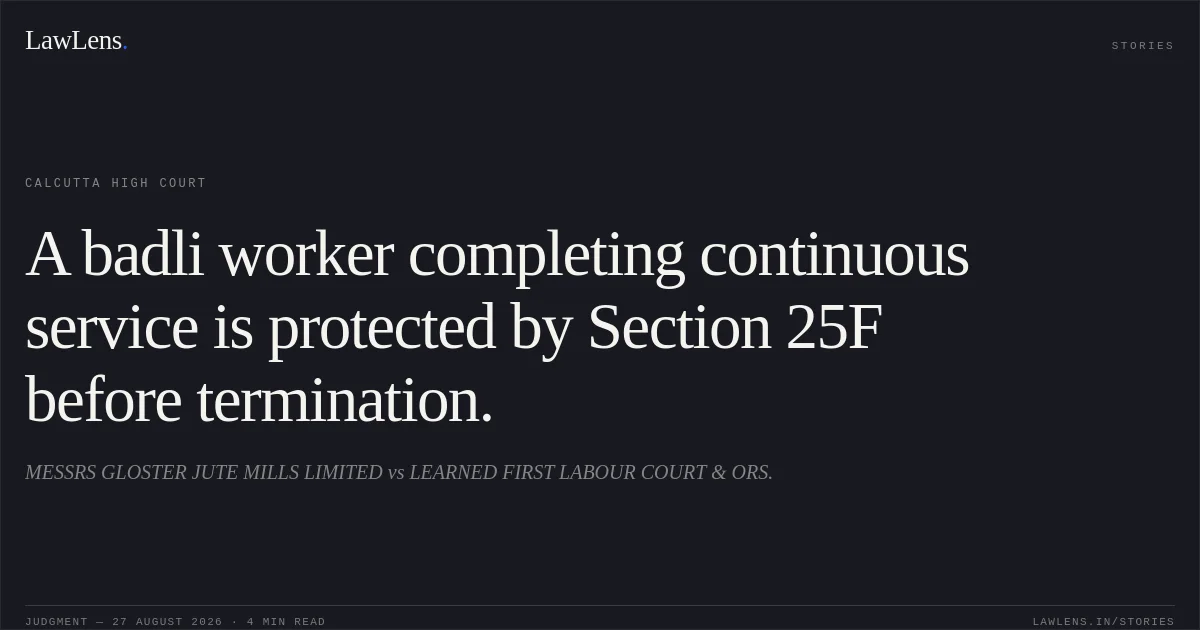
Source reference: no citationHowever, relying particularly on Gloster Ltd. v. State of West Bengal, 2013 SCC OnLine Cal 22994, it held that a Badli worker who completes the requisite continuous service ceases to be excluded from the protection of Section 25F.
Source reference: para. 37The Court also referred to Ranbir Singh v. S.K. Roy regarding the employer’s duty to maintain employment records and the permissibility of drawing an adverse inference where relevant records are withheld.
Source reference: para. 32Reasoning
The Court rejected the employer’s jurisdictional objection, distinguishing between the general status of a Badli worker and the statutory protection available upon proof of continuous service.
Source reference: no citationAlthough the petitioner asserted that the workman had worked only intermittently, the Labour Court found that continuous service from 1990 had neither been specifically denied nor disproved by employment records, and no effective cross-examination or documentary evidence was produced to establish that he had not completed 240 days in the relevant period.
Source reference: para. 36The workman’s medical records and correspondence supported his explanation for absence, while the employer’s conduct, including its subsequent communication asking him to report, was treated as consistent with the subsistence of the employment relationship.
Source reference: para. 27Applying Sections 25B and 25F and the principle in Gloster Ltd., the Court held that the workman’s continuous service brought him within the protection against retrenchment without statutory compliance.
Source reference: paras. 37–40Since the petitioner had removed him from the Badli list without complying with Section 25F, the termination was illegal.
Source reference: paras. 40–42The Court consequently found no ground to interfere with the Labour Court’s award in writ jurisdiction.
Source reference: paras. 40–42Holding
The Court held that the proceeding was maintainable because a Badli worker falls within the definition of “workman” under Section 2(s) of the Industrial Disputes Act.
It further held that the respondent had rendered continuous service sufficient to attract Sections 25B and 25F, and that his removal from the Registered Badli list without following Section 25F was illegal and unjustified.
Source reference: paras. 39–41The writ application was dismissed, and the Labour Court’s direction for immediate reinstatement with full back wages and consequential benefits from the date of termination until actual reinstatement was upheld.
Source reference: paras. 41–42Connected applications were disposed of and any interim order was vacated.
Source reference: paras. 43–44Acts & Sections Cited
6 provisions across 1 statute referred to in this judgment. Linked provisions open on LawLens.
Industrial Disputes Act, 19476
Original Court PDF
MESSRS GLOSTER JUTE MILLS LIMITEDvsLEARNED FIRST LABOUR COURT & ORS.
Click to open original judgment
Original judgment, available to read, download and summarize on LawLens.in
![Courts will not interfere with transfers absent mala fides or violation of statutory rules.. M Ramya vs EMPLOYEES STATE INSURANCE CORPORATION (ESIC). CAT - ['Chennai']. LawLens](/stories/thumbnails/courts-will-not-interfere-with-transfers-absent-mala-fides-or-violation-of-statutory-rules-a6845e9ca6f548fca284c51c8351957f.webp)
![Courts cannot direct one-time recruitment age relaxation absent authority in the governing rules or advertisement.. UT OF PUDUCHERRY vs M ANDAL. CAT - ['Chennai']. LawLens](/stories/thumbnails/courts-cannot-direct-one-time-recruitment-age-relaxation-absent-authority-in-the-governing-895d78fde47143e2a8ed0207c4b6a44f.webp)
![A review cannot correct an allegedly erroneous decision absent an error apparent on the record.. Ajit Kumar Jha vs RAILWAY BOARD. CAT - ['Delhi']. LawLens](/stories/thumbnails/a-review-cannot-correct-an-allegedly-erroneous-decision-absent-an-error-apparent-on-the-re-8ac952fd4eba470c92f7da20af72a220.webp)