Facts
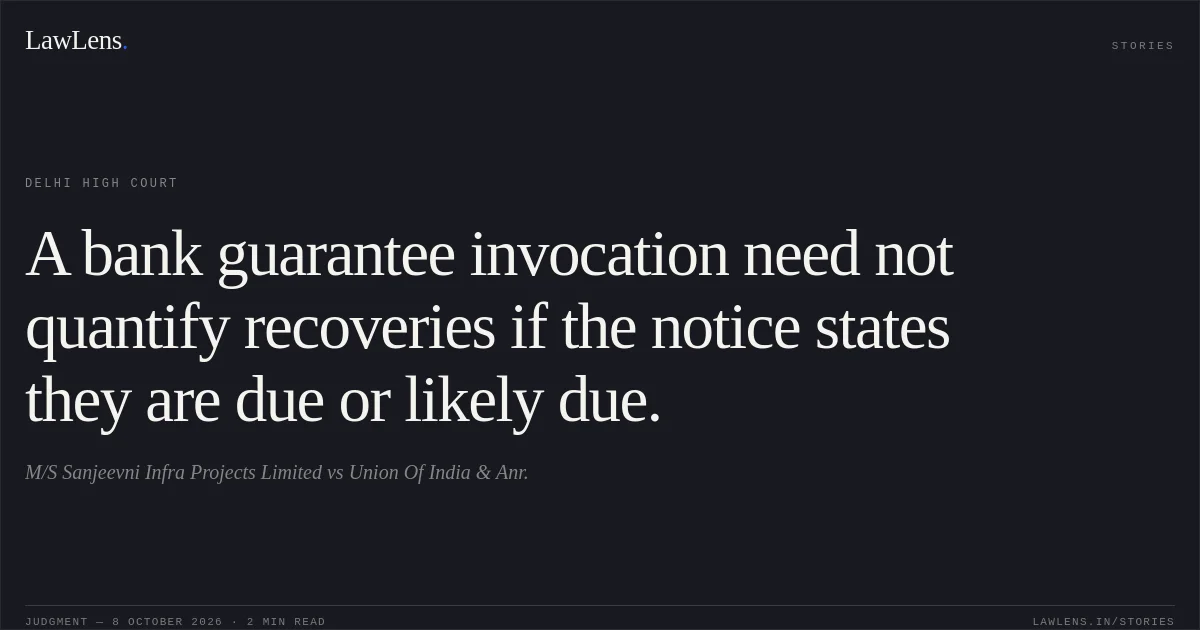
The petitioner was engaged by the Union of India to construct a Regional Centre Building in Rohini, New Delhi, and furnished an unconditional and irrevocable performance bank guarantee (PBG) for ₹1.37 crore, valid until 19 October 2026.
Source reference: p.1; p.2After the respondent determined the contract, it invoked the PBG by letter dated 1 October 2026, stating that encashment was required to meet recoveries due or likely to be due from the petitioner.
Source reference: p.3; p.4The petitioner sought an injunction restraining encashment, contending that the invocation did not identify the amount recoverable.
Source reference: p.2Its application for appointment of an arbitrator was also pending.
Source reference: p.2Issues
1. Whether the invocation notice complied with the PBG’s requirement that a demand state that the amount was required to meet recoveries due or likely to be due from the contractor.
Source reference: p.2; p.3; p.42. Whether the petitioner established grounds for an injunction restraining encashment of the PBG under Section 9 of the Arbitration and Conciliation Act, 1996.
Source reference: p.5; p.11Law Applied
Under Section 9 of the Arbitration and Conciliation Act, 1996, courts may grant interim relief but should be slow to restrain encashment of an unconditional bank guarantee.
Source reference: p.5; p.10U.P. State Sugar Corpn. v. Sumac International Ltd., (1997) 1 SCC 568, and Himadri Chemicals Industries Ltd. v. Coal Tar Refining Co., (2007) 8 SCC 110, establish that the guarantee must ordinarily be honoured according to its terms, notwithstanding disputes under the underlying contract; recognised exceptions include egregious fraud and irretrievable injustice.
Source reference: p.5; p.10The judgment also referred to M/s Garg Builders v. Hindustan Prefab Ltd., 2022 SCC OnLine Del 1264, on the independent nature of a bank guarantee and the limited grounds for interference.
Source reference: p.10; p.11Black Gold Resources Pvt. Ltd. v. International Coal Ventures Pvt. Ltd., 2025 SCC OnLine Del 9231, on the requirement that recovery of the encashed amount would be practically impossible to establish irretrievable injustice.
Source reference: p.11Reasoning
The PBG required a demand stating that the amount claimed was needed to meet recoveries due or likely to be due from the contractor.
Source reference: p.2The invocation letter stated that the guarantee was liable to be encashed “so as to meet the recoveries due or likely to be due” from the petitioner; the Court held that the notice therefore met the essential contractual requirement, even though it did not quantify or crystallise the recoverable amount.
Source reference: p.3; p.4The Court distinguished Marshal Infradevelopers India Pvt. Ltd. v. Union of India, 2022 SCC OnLine Del 936, because the invocation there was cryptic and did not meet the stipulated requirement.
Source reference: p.5The petitioner neither pleaded nor argued fraud, and did not demonstrate that it would be impossible to recover the amount if it ultimately succeeded in arbitration; financial loss or hardship alone was insufficient.
Source reference: p.10; p.11The pending contractual dispute did not, by itself, justify restraining an unconditional and irrevocable guarantee.
Source reference: p.5; p.11Holding
The Court held that the invocation complied with the PBG and that no exceptional ground for injunctive relief had been established.
It dismissed the petition and disposed of the pending application, while clarifying that its observations were tentative and would not affect the merits of any dispute before the arbitral tribunal.
Source reference: p.11; p.12Acts & Sections Cited
1 provisions across 1 statute referred to in this judgment. Each provision opens on LawLens.
Arbitration and Conciliation Act, 19961
Original Court PDF
M/S Sanjeevni Infra Projects LimitedvsUnion Of India & Anr.
Click to open original judgment
Original judgment, available to read, download and summarize on LawLens.in