Facts
The petitions challenged FIR/Case Crime No. 0227 of 2025, registered at Police Station Hari Parvat, Agra, under Sections 85, 115(2) and 352 of the Bharatiya Nyaya Sanhita, 2023 (BNS), and Sections 3 and 4 of the Dowry Prohibition Act, 1961. The FIR alleged dowry demands, cruelty, assault, attempted strangulation, retention of stridhan and a later threat; the marriage had taken place on 12 November 2024 and the wife left the matrimonial home on 3 February 2025.
Source reference: paras. 3–6The petitioners disputed the allegations and relied, among other matters, on the husband’s divorce petition filed on 3 May 2025, the FIR’s registration on 30 June 2025, and medical records which they said did not support the alleged injuries.
Source reference: paras. 7–9The High Court heard the two petitions together because they arose from the same FIR.
Source reference: para. 2Issues
1. Whether the FIR, read as a whole and taken at its highest, disclosed the ingredients of the offences under Sections 85, 115(2) and 352 of the BNS and Sections 3 and 4 of the Dowry Prohibition Act
Source reference: para. 21(i)2. Whether, in the factual and chronological context, continuation of the criminal proceedings would serve a legitimate purpose or amount to an abuse of process
Source reference: para. 21(ii)3. Whether the case fell within the exceptional categories in Bhajan Lal warranting quashing under Article 226 of the Constitution
Source reference: para. 21(iii)Law Applied
Under R.P. Kapur v. State of Punjab, State of Haryana v. Bhajan Lal and Neeharika Infrastructure Pvt. Ltd. v. State of Maharashtra, a High Court ordinarily must not assess credibility or conduct a mini-trial, but may quash an FIR where its allegations, even if accepted in full, do not disclose an offence or where proceedings are manifestly mala fide or an abuse of process.
Source reference: paras. 22–24Section 85 read with Section 86 BNS concerns specified forms of cruelty, including wilful conduct likely to cause grave injury or harassment connected with an unlawful demand; Sections 3 and 4 of the Dowry Prohibition Act respectively address giving or taking dowry and demanding dowry, which requires a connection with the marriage.
Source reference: paras. 26–27Sections 115(2) and 352 BNS require, respectively, voluntarily caused hurt and intentional insult with the requisite provocation and likelihood of breach of public peace or another offence.
Source reference: para. 28The Court also relied on Rajiv Thapar v. Madan Lal Kapoor concerning consideration of incontrovertible defence material, and on Kahkashan Kausar, Dara Lakshmi Narayana, Shobhit Kumar Mittal and Kamal v. State of Gujarat regarding specific allegations, individual attribution and the significance of chronology in matrimonial prosecutions.
Source reference: paras. 25, 32–34, 44Reasoning
The Court found that the alleged monetary demands, despite being stated as specific amounts, lacked adequate particulars identifying who made each demand, when and in what circumstances, or how the alleged harassment was connected to it; the allegations also attributed conduct collectively to the matrimonial family rather than distinguishing each petitioner’s acts.
Source reference: paras. 36–38, 48It treated the absence of earlier complaints, police intervention, PCR calls or a contemporaneous medico-legal record not as conclusive proof that no assault occurred, but as circumstances to be considered cumulatively with the short cohabitation, separation, prior divorce proceedings and delay before the FIR.
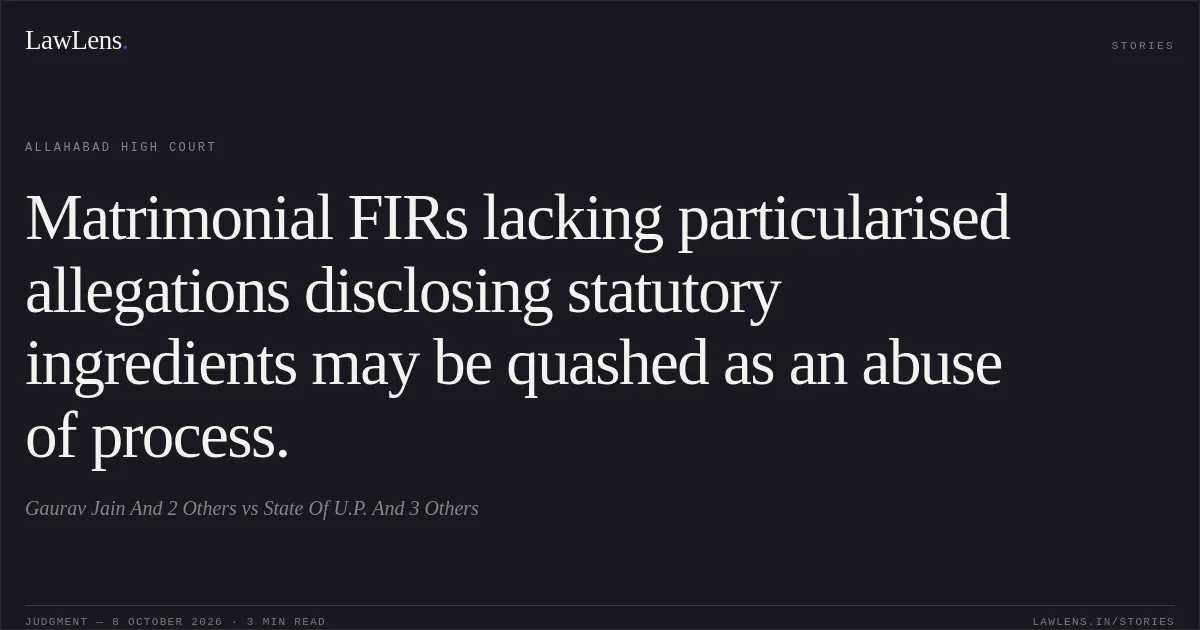
Source reference: paras. 39–46, 60Applying Bhajan Lal, the Court concluded that the allegations lacked sufficient factual particularity to disclose the invoked offences and that, in the circumstances, continuation of the prosecution would amount to abuse of process.
Source reference: paras. 59–65Holding
The High Court allowed both writ petitions and quashed FIR/Case Crime No. 0227 of 2025, together with all consequential proceedings, qua the petitioners.
It clarified that the decision did not determine the merits of the matrimonial proceedings and did not prevent the respondent wife from pursuing any otherwise maintainable independent remedy.
Source reference: paras. 69–71Acts & Sections Cited
17 provisions across 5 statutes referred to in this judgment. Each provision opens on LawLens.
Bharatiya Nyaya Sanhita, 20234
Hindu Marriage Act, 19551
Code of Criminal Procedure, 19735
Indian Penal Code, 18604
Original Court PDF
Gaurav Jain And 2 OthersvsState Of U.P. And 3 Others
Click to open original judgment
Original judgment, available to read, download and summarize on LawLens.in