Facts
The original plaintiff, since deceased and represented by her legal representatives, brought O.S. No. 238/2015 seeking a declaration of ownership and permanent injunction over three properties.
Source reference: para. 1, p. 3She relied on a partition deed dated 4 December 1963, claiming that the properties had come to her father; the defendants claimed title under registered sale deeds dated 19 September 1981 and 4 June 2001.
Source reference: paras. 1–2, p. 3The trial court initially restrained the defendants from alienating the properties or creating third-party interests. The defendants’ appeal was allowed, and that restraint was set aside.
Source reference: paras. 3–4, pp. 3–4In the petition under Article 227, the petitioners stated that the defendants had subsequently sold the property by a deed dated 17 March 2026 and sought to implead the purchaser.
Source reference: para. 5, p. 4Issues
1. Whether the First Appellate Court was justified in setting aside the trial court’s interim order restraining alienation and creation of third-party interests in the suit properties
Source reference: paras. 8–12, pp. 5–62. Whether the subsequent sale and the petitioners’ asserted interest in the properties warranted interference under Article 227
Source reference: paras. 5, 10–13, pp. 4–7Law Applied
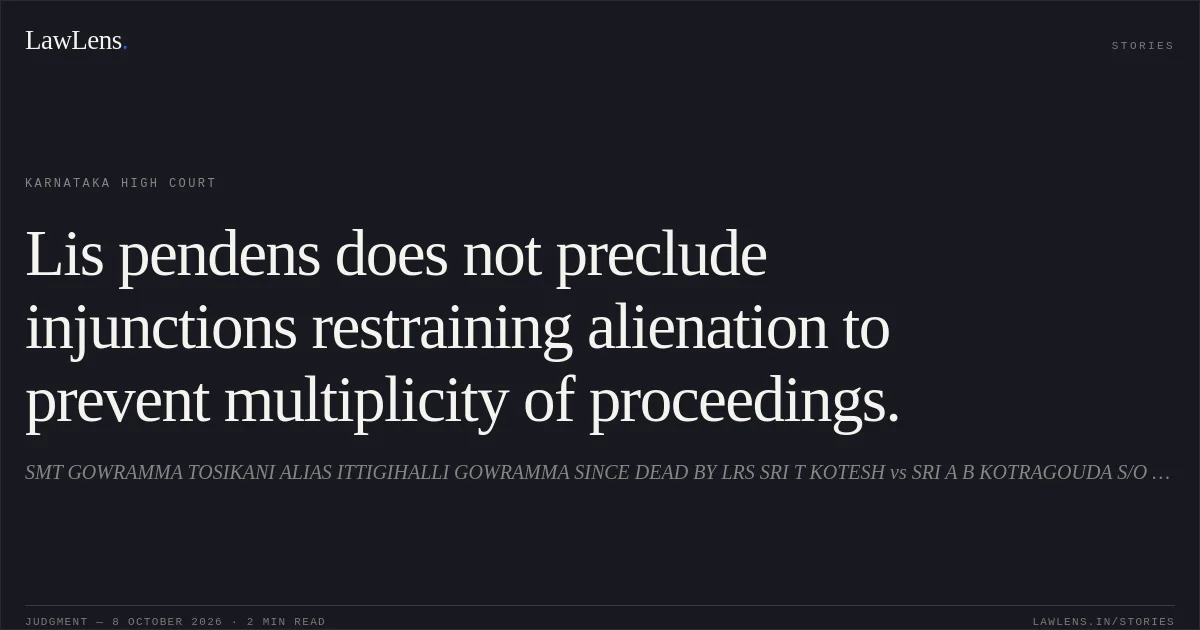
Section 52 of the Transfer of Property Act, 1882 embodies the doctrine of lis pendens: a transfer of property during the pendency of litigation is subject to the rights declared by the decree in that litigation.
Source reference: para. 8, p. 5The Court also applied the interim-protection principle that a court may preserve the subject matter of a suit pending determination of the parties’ rights; the possibility that a transferee would be bound by the eventual decree does not, by itself, make a restraint against alienation unjustified where such transfers could cause multiplicity of proceedings.
Source reference: paras. 9, 11–12, pp. 5–6Reasoning
The plaintiff’s claim that she was a Class-I heir entitled to a share in properties said to have come to her father through his ancestors remained undecided in the suit.
Source reference: para. 10, p. 6The trial court’s order merely prevented alienation or creation of third-party interests and did not restrict the defendants’ enjoyment of the properties.
Source reference: para. 9, p. 5Although the First Appellate Court relied on Section 52 and reasoned that a purchaser would be bound by the eventual decree, the High Court held that this did not adequately account for the risk of multiple proceedings or the need to preserve the properties until the parties’ rights were determined.
Source reference: paras. 8–12, pp. 5–6The subsequent sale further supported interference with the appellate order.
Source reference: para. 13, p. 6Holding
The High Court allowed the petition and set aside the First Appellate Court’s order in M.A. No. 6/2024.
It restored the trial court’s restraint against alienation or creation of third-party interests in the suit properties.
Source reference: para. 16, p. 7The petitioners were permitted to bring the purchaser on record before the trial court in accordance with law, and their impleadment application in the writ proceedings was disposed of.
Source reference: paras. 17–18, p. 7Acts & Sections Cited
1 provisions across 1 statute referred to in this judgment. Each provision opens on LawLens.
Transfer of Property Act, 18821
Original Court PDF
SMT GOWRAMMA TOSIKANI ALIAS ITTIGIHALLI GOWRAMMA SINCE DEAD BY LRS SRI T KOTESHvsSRI A B KOTRAGOUDA S/O BASAVANAGOUDA
Click to open original judgment
Original judgment, available to read, download and summarize on LawLens.in