Facts
The petitioner, who resides in Thiruvananthapuram, filed a custody petition concerning the parties’ three children before the Family Court, Ernakulam. After that court made interim custody and visitation orders, the first respondent challenged the order before the High Court; her petition was dismissed, as were subsequent applications to modify the interim order.
Source reference: p. 3Following a Government notification revising the territorial jurisdiction of Family Courts, the custody proceeding was transferred to the Family Court, Aluva, and renumbered O.P. No. 1271 of 2023.
Source reference: p. 4The petitioner sought its transfer back to Ernakulam, citing hardship and the children’s familiarity with the CLAP lawyer appointed there. The first respondent opposed the request, contending that she and the children reside within Aluva’s jurisdiction and that Aluva was more convenient for them.
Source reference: pp. 4–5Issues
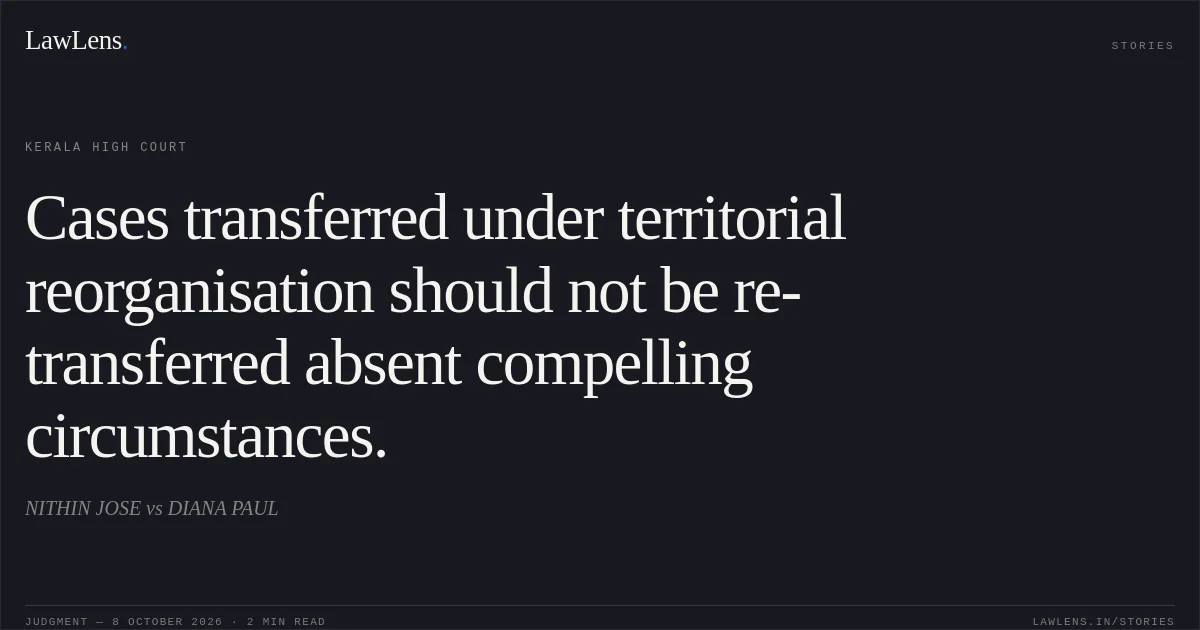
Whether the custody proceeding should be re-transferred from the Family Court, Aluva, to the Family Court, Ernakulam, despite its transfer under the revised territorial-jurisdiction arrangement.
Source reference: pp. 5–6, 9–10Whether the children’s familiarity with the CLAP lawyer appointed by the Family Court, Ernakulam, warranted re-transfer of the proceeding.
Source reference: pp. 5–6, 10–11Law Applied
Section 24 of the Code of Civil Procedure empowers the High Court to transfer proceedings in the exercise of its discretion.
Source reference: p. 3In considering transfer of matrimonial proceedings, the convenience of the woman and children is an important consideration and may, in an appropriate case, be determinative; the court must also balance the parties’ competing conveniences in light of the circumstances.
Source reference: p. 8The Court relied on Sumita Singh v. Kumar Sanjay, Vaishali Shridhar Jagtap v. Shridhar Vishwanath Jagtap, Santhini v. Vijaya Venketesh and N.C.V. Aishwarya v. A.S. Saravana Karthik Sha for those principles.
Source reference: p. 8The respondent also invoked Section 9 of the Guardians and Wards Act, 1890, concerning jurisdiction where the children ordinarily reside; the Court did not separately determine that contention.
Source reference: p. 5Reasoning
The High Court considered the transfer a consequence of the Government’s revised territorial-jurisdiction notification, issued following the Court’s administrative recommendation to address litigant convenience and distribute Family Court pendency more equitably.
Source reference: pp. 6–7It found no compelling reason to depart from that arrangement: the petitioner’s residence in Thiruvananthapuram meant that choosing between the two courts did not materially affect his convenience, while the first respondent and children lived closer to Aluva.
Source reference: p. 8The courts were less than 20 kilometres apart and well connected, and Aluva had comparatively lower pendency, making expeditious disposal more likely.
Source reference: p. 8The children’s familiarity with the CLAP lawyer did not justify re-transfer, but could be accommodated by asking the Aluva court, as far as practicable, to seek assistance from the same lawyer.
Source reference: pp. 9–11Holding
The Court dismissed the transfer petition and declined to transfer O.P. No. 1271 of 2023 from the Family Court, Aluva, to the Family Court, Ernakulam.
It directed the Family Court, Aluva, as far as practicable, to seek the assistance of the CLAP lawyer previously appointed at Ernakulam so that the children could retain the benefit of that lawyer’s familiarity and support.
Source reference: pp. 10–11Acts & Sections Cited
2 provisions across 2 statutes referred to in this judgment. Each provision opens on LawLens.
Code of Civil Procedure, 19081
Guardians and Wards Act, 18901
Original Court PDF
NITHIN JOSEvsDIANA PAUL
Click to open original judgment
Original judgment, available to read, download and summarize on LawLens.in