Facts
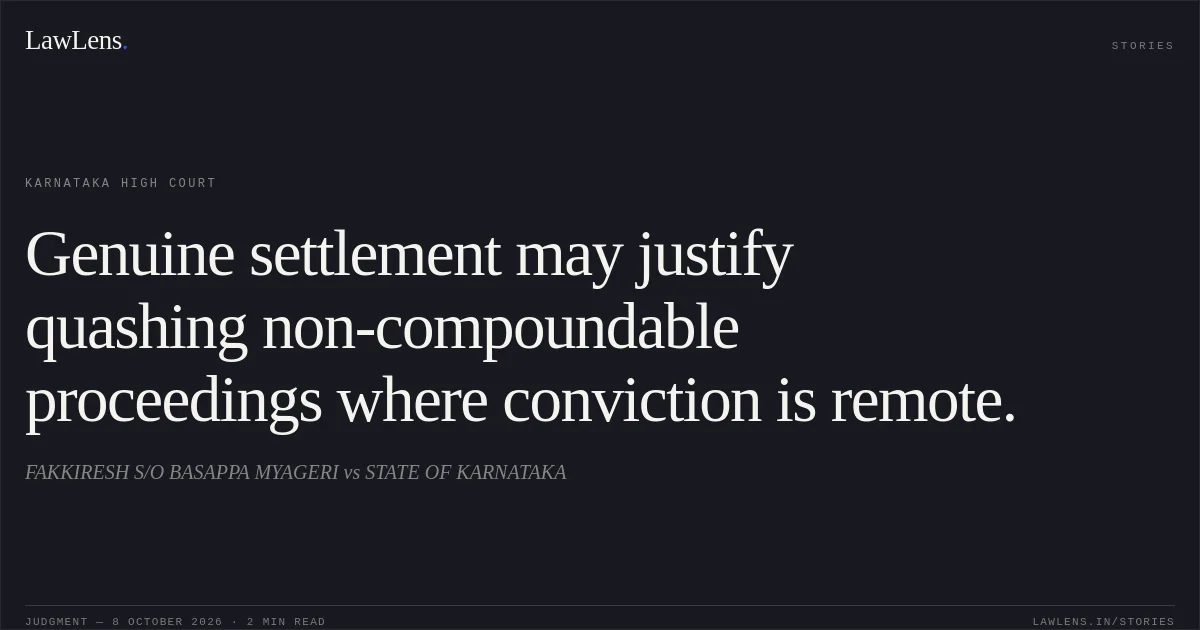
The petitioners, accused Nos. 1, 2 and 4 to 7, sought to quash proceedings in C.C. No. 815/2024 arising from Crime No. 66/2024, registered for offences under Sections 143, 147, 341, 323, 504, 506 read with Section 149 of the IPC
Source reference: p. 3The de facto complainant alleged that the petitioners wrongfully restrained and assaulted him, including with an iron rod, and threatened him
Source reference: p. 12During the petition, the parties filed a compromise application and affidavits stating that they had resolved their dispute voluntarily, without coercion, and that the complainant had no objection to quashing the proceedings
Source reference: pp. 3–7The Court considered the settlement and the circumstances of the case
Source reference: pp. 12–13Issues
1. Whether the High Court should exercise its inherent jurisdiction to quash the non-compoundable criminal proceedings in light of the parties’ compromise
Source reference: pp. 6–9, 12–132. Whether, considering the settlement and the circumstances alleged, continuation of the prosecution would serve the interests of justice or instead amount to an abuse of process
Source reference: pp. 12–13Law Applied
Section 482 of the Code of Criminal Procedure (corresponding to Section 528 of the Bharatiya Nagarik Suraksha Sanhita, 2023) preserves the High Court’s inherent power to quash criminal proceedings, including in appropriate cases involving non-compoundable offences; that power is distinct from statutory compounding under Section 320 CrPC (Section 359 BNSS) and must be exercised sparingly to secure the ends of justice or prevent abuse of process
Source reference: pp. 7–8Relying on Narinder Singh v. State of Punjab, (2014) 6 SCC 466, the Court noted that relevant considerations include the nature and seriousness of the offence, whether the dispute is predominantly private, the likelihood of conviction, prejudice from continuing the prosecution, and the stage of proceedings
Source reference: pp. 7–11Reasoning
The Court found that the dispute had been settled voluntarily with the intervention of village elders, and that the parties were residents of the same village and close neighbours
Source reference: pp. 12–13Although the complaint alleged an assault causing a bleeding head injury, the Court considered the settlement and the limited prospect of witnesses supporting the prosecution, concluding that the chances of conviction were remote and continuation of the proceedings would be unnecessary
Source reference: pp. 12–13Applying the principles in Narinder Singh, it held that quashing would be appropriate in the circumstances
Source reference: pp. 7–11, 12–13Holding
The Court allowed the petition and quashed the proceedings in C.C. No. 815/2024, arising from Crime No. 66/2024, insofar as they concerned petitioners/accused Nos. 1, 2 and 4 to 7
The compromise application was allowed, and pending applications were disposed of
Source reference: p. 14Acts & Sections Cited
14 provisions across 3 statutes referred to in this judgment. Each provision opens on LawLens.
Code of Criminal Procedure, 19732
Bharatiya Nagarik Suraksha Sanhita, 20232
Original Court PDF
FAKKIRESH S/O BASAPPA MYAGERIvsSTATE OF KARNATAKA
Click to open original judgment
Original judgment, available to read, download and summarize on LawLens.in