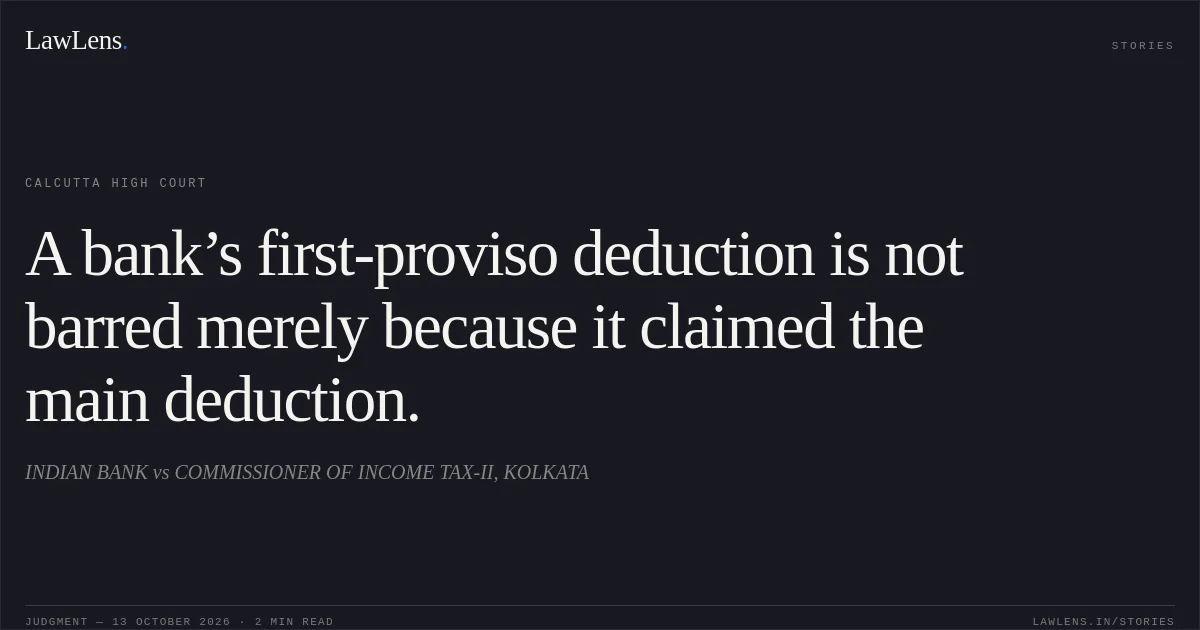
Facts
For assessment year 2004–05, Indian Bank claimed a deduction under Section 36(1)(viia)(a) of the Income-tax Act, 1961, for provision for bad and doubtful debts, and a further deduction of Rs. 96,65,00,000 under the first and applicable succeeding provisos for assets classified by the Reserve Bank of India as doubtful or loss assets.
Source reference: pp. 2–3The Assessing Officer disallowed the further claim, reasoning that the proviso could not be invoked separately after a deduction under the main provision had been allowed.
Source reference: pp. 2–3The Commissioner of Income-tax (Appeals) and the Income-tax Appellate Tribunal upheld that view.
Source reference: pp. 2–3The Bank appealed under Section 260A
Source reference: pp. 2–3Issues
1. Whether, under Section 36(1)(viia)(a) and its first proviso, the proviso deduction was alternative to the main-clause deduction and therefore unavailable where a deduction had already been allowed under the main clause
Source reference: p. 2, para. 2Law Applied
Section 36(1)(viia)(a) allows a deduction for qualifying provisions for bad and doubtful debts, subject to statutory limits; its first proviso concerns specified assets classified by the RBI as doubtful or loss assets, and the applicable succeeding proviso modifies the relevant percentage or quantum.
Source reference: p. 3, para. 7The effect of a proviso must be determined from its text, context, and legislative purpose; the words “at its option” must be given operative meaning and vest the statutory choice in the qualifying assessee.
Source reference: pp. 4–5, paras. 8–10The Court relied on *CIT v. Tamil Nadu Industrial Investment Corporation Ltd.*, [2019] 112 taxmann.com 386 (Madras), whose reasoning on the expression “at its option” it found persuasive, and on *Indian Bank v. Commissioner of Income-tax*, [2023] 151 taxmann.com 205 (Calcutta), which rejected the contention that the first-proviso deduction was necessarily alternative to the main-clause deduction.
Source reference: p. 5, para. 11; p. 6, para. 12Reasoning
The Court held that treating the first proviso as an alternative benefit automatically exhausted by allowance under the main clause would deprive “at its option” of meaningful effect and transfer the statutory choice from the Bank to the tax authorities.
Source reference: pp. 4–5, paras. 8–9In light of the provision’s text and purpose, the proviso claim could not be rejected solely because the main-clause deduction had also been allowed.
Source reference: pp. 5–6, paras. 10–14The claim nevertheless remained subject to the statutory conditions, relevant RBI classification, and applicable ceiling.
Source reference: pp. 5–6, paras. 10–14Holding
The Court answered the substantial question of law in the affirmative, in favour of the Bank and against the Revenue.
It allowed the appeal and set aside the Tribunal’s order insofar as it rejected the Rs. 96,65,00,000 claim on the ground that the proviso deduction was alternative to the main-clause deduction.
Source reference: p. 7, paras. 16–17The Assessing Officer was directed to give effect to the judgment by verifying the statutory conditions and limits, without reconsidering the legal issue decided.
Source reference: p. 7, paras. 16–17Acts & Sections Cited
2 provisions across 1 statute referred to in this judgment. Linked provisions open on LawLens.
Income Tax Act, 19612
Original Court PDF
INDIAN BANKvsCOMMISSIONER OF INCOME TAX-II, KOLKATA
Click to open original judgment
Original judgment, available to read, download and summarize on LawLens.in
![Authorities must individually assess similarly situated employees’ eligibility for benefits under an affirmed precedent.. Swapan Das vs POSTS. CAT - ['Kolkata']. LawLens](/stories/thumbnails/authorities-must-individually-assess-similarly-situated-employees-eligibility-for-benefits-79605d4f38f347acb73daa832fe2a358.webp)
![Competent authority must reconsider the compassionate allowance claim, including limitation, by a reasoned order.. VINAY KUMAR vs DEPTT OF POSTS. CAT - ['Allahabad']. LawLens](/stories/thumbnails/competent-authority-must-reconsider-the-compassionate-allowance-claim-including-limitation-ca3eb833b95c48bba16e267d27ef2dca.webp)