Facts
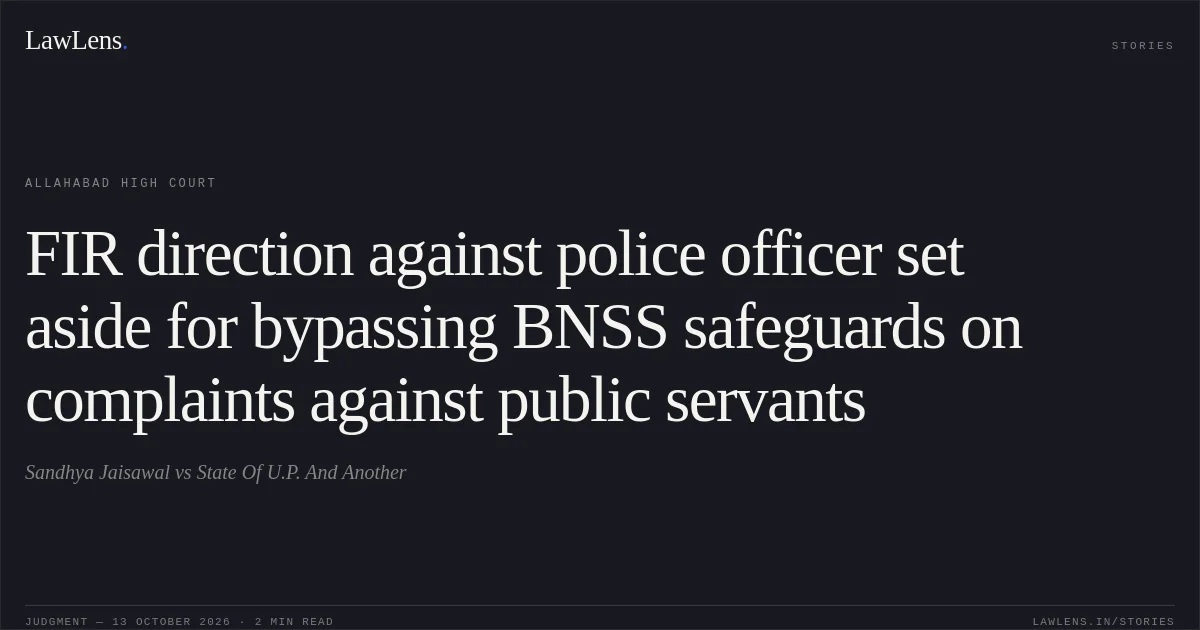
Sushila Devi applied under Section 173(4) BNSS, alleging that Sub-Inspector Sandhya Jaiswal and other police personnel entered her home, used caste-related abuse, and illegally detained her son.
Source reference: paras. 3, 5She sought registration of an FIR and investigation; the Special Judge allowed the application and directed registration and investigation by an independent gazetted officer.
Source reference: paras. 3, 5Jaiswal appealed, relying on a police report and contemporaneous records, including a supurdginama, and arguing that the alleged events arose from police action in a case in which she was the Investigating Officer.
Source reference: paras. 4, 27–30Issues
Whether the Special Judge could direct registration of an FIR on an application under Section 173(4) BNSS without demonstrating compliance with the requirements of Section 175(3) BNSS.
Source reference: paras. 12, 23–25, 32Whether, given that the allegations concerned police personnel and allegedly arose during official police action, the Special Judge was required to follow the safeguards in Section 175(4) BNSS before ordering investigation.
Source reference: paras. 13, 20–22, 26, 31Law Applied
Section 173(4) BNSS provides a route to the Magistrate after refusal by the police to record information; the power to order investigation is exercised under Section 175(3), which requires consideration of an affidavit-supported application, such inquiry as the Magistrate considers necessary, and the police officer’s submissions.
Source reference: paras. 15–16, 17, 23–25Where a complaint against a public servant alleges conduct arising in the course of official duties, Section 175(4) adds safeguards: the Magistrate must receive a report from an officer superior to the public servant and consider the public servant’s assertions about the circumstances of the incident.
Source reference: paras. 16–18Om Prakash Ambadkar v. State of Maharashtra explains these statutory requirements, while XXX v. State of Kerala holds that Section 175(4) applies where the alleged act has a prima facie connection to official duty, with the Magistrate retaining discretion to reject untenable allegations for valid reasons.
Source reference: paras. 17–18The Court also relied on Anil Kumar, Priyanka Srivastava, Ramdev Food Products and Babu Venkatesh for the broader principle that an order directing investigation requires judicial application of mind and cannot be made mechanically.
Source reference: paras. 8–11Reasoning
The complaint named police personnel and concerned events occurring against the background of an investigation in which Jaiswal was the Investigating Officer.
Source reference: paras. 26–31The record also included a police report, an existing criminal case involving the complainant’s family, and a supurdginama concerning the son’s custody—all material requiring assessment before directing an investigation.
Source reference: paras. 26–31Although the Special Judge had called for a police report, the order did not show meaningful consideration of that report, the police submissions, the need for inquiry, or the Section 175(4) safeguards.
Source reference: paras. 27, 32, 34The High Court did not determine the truth of the allegations or conclusively find that the conduct was within official duty; it held that the statutory requirements and the possible nexus to official action had to be judicially examined before an investigation was ordered.
Source reference: paras. 19–22, 31Holding
The High Court held that the Special Judge’s order failed to demonstrate compliance with Sections 175(3) and 175(4) BNSS and suffered from material non-application of mind.
It allowed the appeal, set aside the order dated 2 September 2026, and directed that any consequential proceedings arising from that order also stand quashed.
Source reference: paras. 37–39Acts & Sections Cited
15 provisions across 4 statutes referred to in this judgment. Each provision opens on LawLens.
Bharatiya Nagarik Suraksha Sanhita, 20233
Bharatiya Nyaya Sanhita, 20233
Code of Criminal Procedure, 19738
Scheduled Castes and the Scheduled Tribes (Prevention of Atrocities) Act, 19891
Original Court PDF
Sandhya JaisawalvsState Of U.P. And Another
Click to open original judgment
Original judgment, available to read, download and summarize on LawLens.in