Facts
The prosecution alleged that on 30 June 1982 the appellant forcibly raped the informant’s approximately 12-year-old daughter while she was taking water to her father in the fields.
Source reference: para. 2The prosecutrix testified that the appellant dragged her into a ditch, removed her clothing and penetrated her; her father and Ram Dutt said they arrived after hearing her cries and saw the appellant on her.
Source reference: paras. 4–8A medical examination the next day recorded a fresh hymenal tear, bleeding and tenderness; the doctor assessed her age at about 15, with a possible variation of two years.
Source reference: paras. 2, 4–8The Sessions Court convicted the appellant under Section 376 IPC and imposed five years’ rigorous imprisonment.
Source reference: paras. 1, 10–18He appealed under Section 374(2) CrPC, disputing the witnesses’ credibility, the prosecutrix’s age and lack of consent, proof of penetration, and the significance of medical and other evidence.
Source reference: paras. 1, 10–18Issues
1. Whether the prosecutrix’s testimony, considered with the eyewitness and medical evidence, proved the appellant’s guilt under Section 376 IPC beyond reasonable doubt
Source reference: paras. 23–28, 332. Whether the alleged inconsistencies, suggested motive for false implication, disputed age and consent, and objections concerning penetration and forensic examination created reasonable doubt
Source reference: paras. 11–18, 29–323. Whether the conviction or sentence required appellate interference
Source reference: paras. 33–36Law Applied
Section 376 IPC governs the offence of rape, and Section 374(2) CrPC provides for an appeal from a conviction by a Sessions Court.
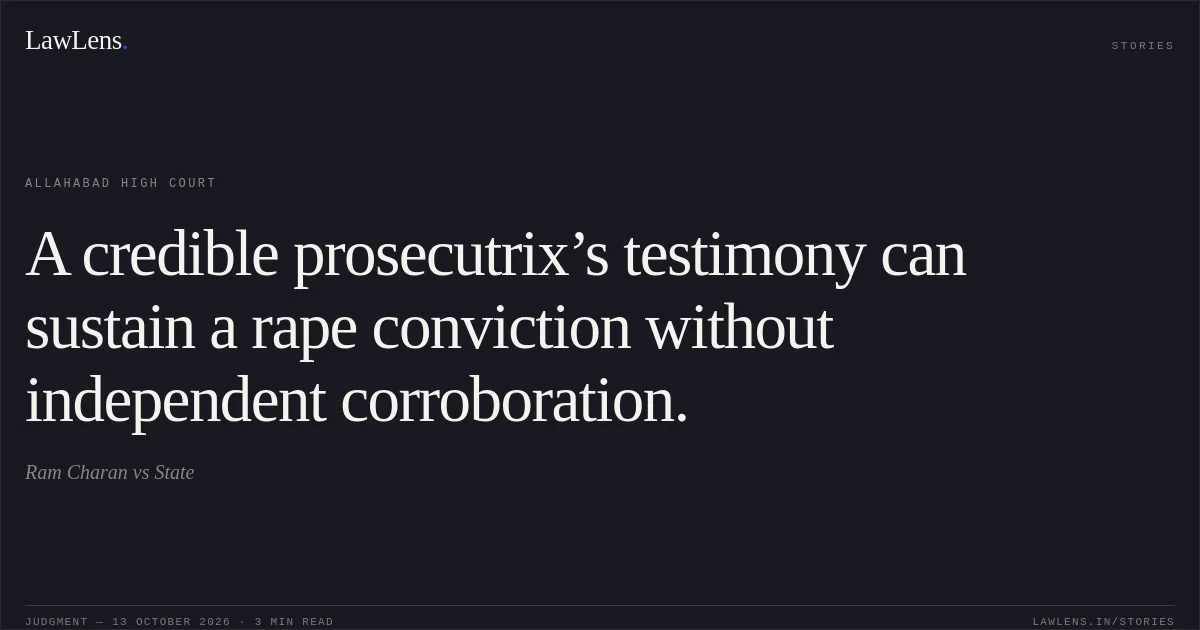
Source reference: para. 1Under Sections 118 and 134 of the Evidence Act, 1872, a prosecutrix is a competent witness and the prosecution need not produce a particular number of witnesses; her credible testimony may sustain a conviction without corroboration as a strict rule of law, though the court must evaluate it with appropriate care.
Source reference: para. 31The Court relied on State of Maharashtra v. Chandraprakash Kewalchand Jain and Vijay v. State of M.P. for the principles governing assessment of a prosecutrix’s evidence, and on Pruthiviraj Jayantibhai Vanol v. Dinesh Dayabhai Vala for the principle that medical evidence ordinarily does not displace credible ocular evidence unless a gross contradiction makes the ocular account impossible.
Source reference: paras. 27, 31It also applied the principle that minor discrepancies which do not undermine the core of the prosecution case do not, by themselves, warrant acquittal.
Source reference: para. 30Reasoning
The Court found the prosecutrix’s account consistent and unshaken, and considered Ram Dutt’s evidence corroborative of her cries, the appellant’s presence on her and his flight.
Source reference: paras. 24–26The fresh hymenal tear, bleeding and tenderness supported the allegation of sexual assault; the absence of spermatozoa did not, in the Court’s assessment, create a contradiction sufficient to discredit the ocular evidence.
Source reference: paras. 7, 27–28Differences about clothing and other details were treated as peripheral, while the defence theories of consent, a rival dispute and a homosexual encounter were unsupported by evidence.
Source reference: paras. 29–32The Court therefore concluded that the prosecution had proved the offence beyond reasonable doubt.
Source reference: para. 33Holding
The Court dismissed the appeal and confirmed the conviction under Section 376 IPC and the sentence of five years’ rigorous imprisonment.
It directed that, if the appellant was on bail, his bail bonds be cancelled and he be taken into custody to serve the remaining sentence; the trial court record and judgment were ordered transmitted for compliance.
Source reference: paras. 37–38Acts & Sections Cited
4 provisions across 2 statutes referred to in this judgment. Each provision opens on LawLens.
Code of Criminal Procedure, 19732
Indian Penal Code, 18602
Original Court PDF
Ram CharanvsState
Click to open original judgment
Original judgment, available to read, download and summarize on LawLens.in