Facts
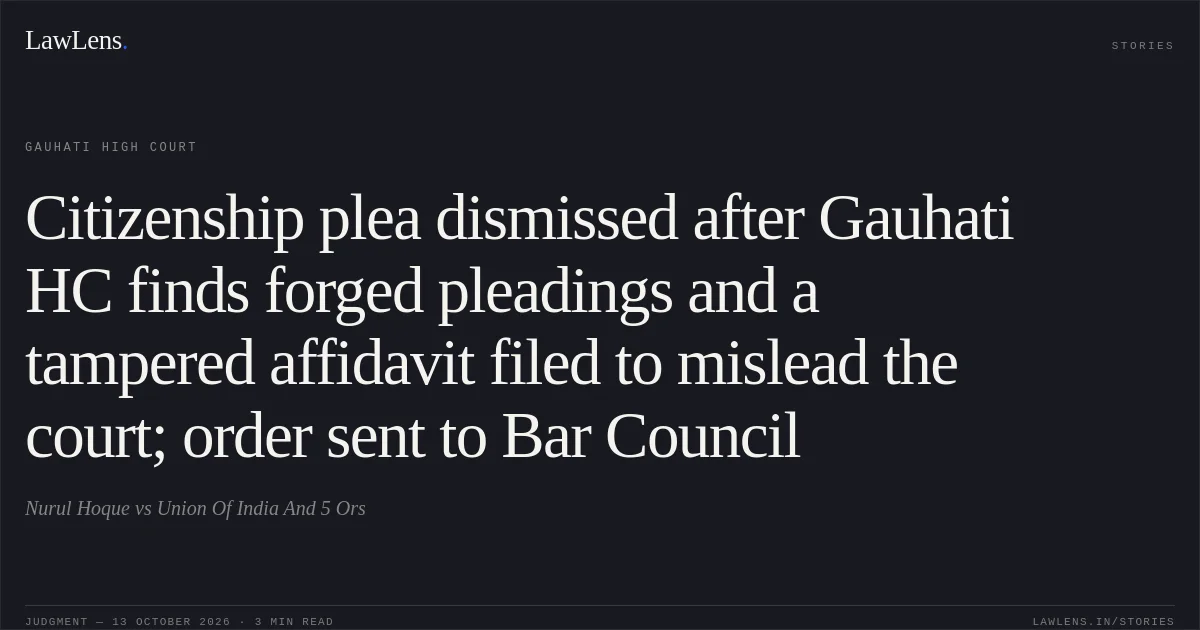
The petitioner challenged a Foreigners Tribunal opinion dated 10 October 2018 declaring him a foreigner who had entered India after 25 March 1971.
Source reference: p. 2Before the Tribunal, he relied principally on voter lists spanning 1965 to 2017 to establish his lineage and citizenship.
Source reference: pp. 2–6, 16–18On examining the Tribunal record against the copies filed with the writ petition, the High Court found material discrepancies in the written statement and evidence-on-affidavit, including a different stated place of birth and differences in the documents referred to.
Source reference: pp. 2–6, 16–18The Tribunal had rejected the petitioner’s evidence, finding discrepancies in names and relationships across the voter lists, and had also rejected other documents, including a Gaonburah certificate and an Aadhaar card.
Source reference: pp. 27–30Issues
Whether the Tribunal’s finding that the petitioner failed to establish Indian citizenship, and its consequent opinion declaring him a foreigner, was legally or factually unsustainable.
Source reference: pp. 29–31, 33Whether the discrepancies between the documents filed in the writ petition and those in the Tribunal record, including the alleged alteration of the affidavit, affected the petitioner’s challenge.
Source reference: pp. 4–6, 31–33Law Applied
Under Section 9 of the Foreigners Act, 1946, the burden of proving that a person is not a foreigner rests on that person; Section 2(a) defines a foreigner.
Source reference: pp. 2–3, 33–34The Court relied on Basiron Nessa v. Union of India, 2018 (4) GLT 692, for the principle that documentary evidence must be proved from records and not solely by oral testimony where citizenship is in question.
Source reference: p. 30It also applied Basiron Bibi v. Union of India, 2018 (1) GLT 372, that a party relying on a voter list must have the document considered as a whole, including entries adverse to that party.
Source reference: p. 31The Court noted Sirajul Hoque v. State of Assam, (2019) 5 SCC 534, which held that a discrepancy in a grandfather’s name alone does not justify declaring a person a foreigner where the identities of the family members, including the person concerned, are established.
Source reference: p. 31It further treated an unauthorised alteration of a sworn affidavit as discrediting its evidentiary validity.
Source reference: p. 32Reasoning
The Court found that the petitioner had not adequately pleaded or established his relationship to the various voters appearing in the exhibited lists, while the records contained inconsistencies in names, ages, and family relationships.
Source reference: pp. 27–31It held that the petitioner could not rely only on favourable entries while disregarding adverse entries in the same voter lists.
Source reference: p. 31The Court distinguished the principle in Sirajul Hoque because, in its assessment, the relevant family identities and relationships had not been established here.
Source reference: pp. 31–32It also found that the writ-petition copies materially differed from the Tribunal record and that the Tribunal-record affidavit showed signs of erasure and overwriting; it considered the filed copies ex facie unreliable and the alleged alteration serious.
Source reference: pp. 31–33On the evidence as a whole, the Court found no basis to disturb the Tribunal’s assessment.
Source reference: pp. 32–33Holding
The Court held that the petitioner failed to discharge the burden imposed by Section 9 of the Foreigners Act and that the Tribunal’s opinion was sustainable on the evidence and in law.
The writ petition was dismissed; the interim bail order was recalled and revoked, and the consequences of the Tribunal’s opinion were to follow.
Source reference: pp. 33–34The Registry was directed to return the Tribunal record, preserve copies of the disputed documents, and send a copy of the judgment and the vakalatnama to the Bar Council.
Source reference: p. 34Acts & Sections Cited
2 provisions across 1 statute referred to in this judgment. Linked provisions open on LawLens.
Foreigners Act, 19462
Original Court PDF
Nurul HoquevsUnion Of India And 5 Ors
Click to open original judgment
Original judgment, available to read, download and summarize on LawLens.in