Facts
Police alleged that the petitioner, accused No. 2, was involved in collecting money from the public for “O.C. Matka” gambling.
Source reference: p. 2During a raid, police seized cash, a chit, a pen and pieces of paper; the petitioner’s name was disclosed in accused No. 1’s statement, but no incriminating article was recovered from him and no mahazar was drawn in his presence.
Source reference: pp. 2–3, 8The petitioner sought to quash the proceedings under Section 78(3) of the Karnataka Police Act, contending that the offence was non-cognizable and the mandatory procedure for investigation had not been followed.
Source reference: pp. 3–4, 7–8The Magistrate’s permission to investigate was recorded only as “Permitted” on the police requisition.
Source reference: pp. 3–4, 7–8Issues
1. Whether investigation into the alleged non-cognizable offence under Section 78(3) of the Karnataka Police Act could proceed without compliance with Sections 155(1) and 155(2) of the Cr.P.C.
Source reference: pp. 4–62. Whether the Magistrate’s bare endorsement “Permitted” on the police requisition constituted a valid order authorising investigation.
Source reference: pp. 7–83. Whether the proceedings against the petitioner were liable to be quashed in light of the defective authorisation and the absence of material recovered from him.
Source reference: p. 8Law Applied
Section 78(3) of the Karnataka Police Act was treated as creating a non-cognizable offence.
Source reference: p. 4Under Sections 155(1) and 155(2) of the Cr.P.C., the police must enter the substance of information about a non-cognizable offence in the prescribed book, refer the informant to the Magistrate, and obtain the Magistrate’s order before investigating.
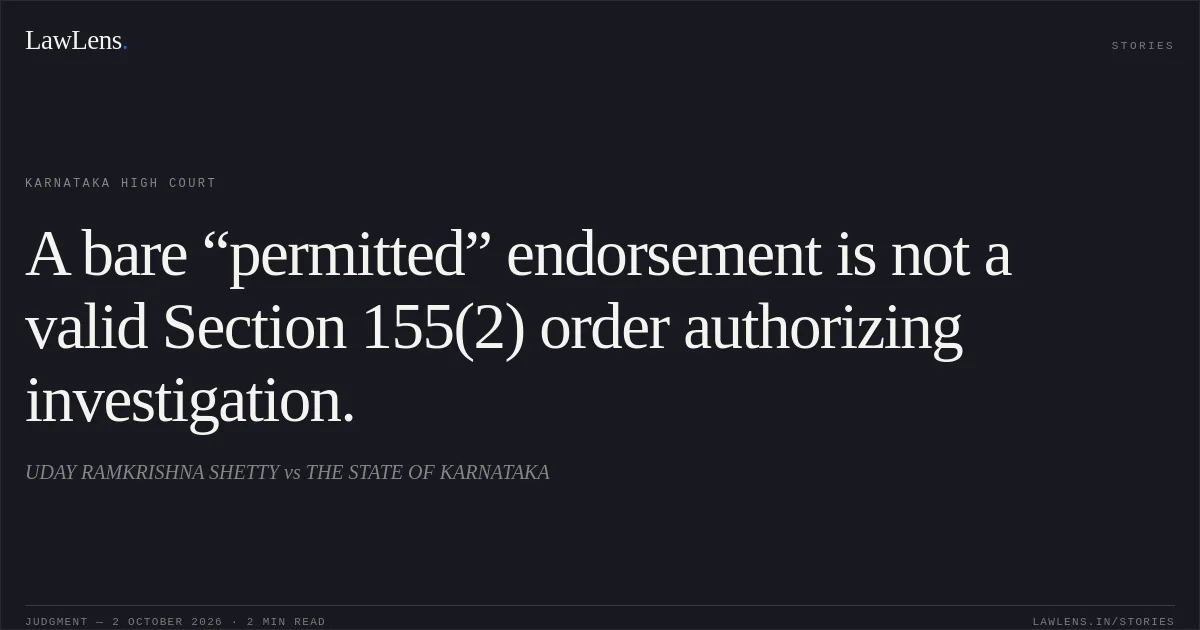
Source reference: pp. 4–6Relying on Vaggeppa Gurulinga Jangaligi v. State of Karnataka, ILR 2020 KAR 630, and the Karnataka Criminal Rules of Practice, the Court stated that permission must follow judicial consideration and be recorded in a separate, reasoned order; a mere “permitted” endorsement on the requisition is insufficient.
Source reference: pp. 5–7Reasoning
The Court found that the Magistrate had only endorsed “Permitted” on the police requisition, without a separate order demonstrating application of judicial mind.
Source reference: pp. 6–8Under Sections 155(1) and 155(2), and the guidance in Vaggeppa, that endorsement did not validly authorise investigation of the non-cognizable offence.
Source reference: pp. 6–8The Court also noted that the petitioner’s name emerged from accused No. 1’s statement, with no incriminating article recovered from the petitioner and no mahazar drawn.
Source reference: p. 8It therefore held that the proceedings against the petitioner could not be sustained.
Source reference: p. 8Holding
The Court allowed the petition and quashed the proceedings against accused No. 2 in C.C. No. 516/2026, arising from Crime No. 148/2026, for the offence under Section 78(3) of the Karnataka Police Act, pending before the Civil Judge and JMFC, Siddapura.
Pending applications, if any, were disposed of as not surviving for consideration.
Source reference: p. 9Acts & Sections Cited
4 provisions across 3 statutes referred to in this judgment. Each provision opens on LawLens.
Code of Criminal Procedure, 19732
Bharatiya Nagarik Suraksha Sanhita, 20231
KARNATAKA POLICE ACT, 1963.1
Original Court PDF
UDAY RAMKRISHNA SHETTYvsTHE STATE OF KARNATAKA
Click to open original judgment
Original judgment, available to read, download and summarize on LawLens.in