Facts
The petitioners challenged GST show-cause notices and adjudication orders, principally on the ground that the PDFs available on the GST common portal did not display a physical or digital signature and were therefore invalid.
Source reference: para. 1The writ petitions were referred to a Full Bench for an authoritative ruling on that question in light of differing decisions of coordinate Benches, including Bigleap Technologies and Solutions Private Limited.
Source reference: paras. 1–2, 34–38GSTN was impleaded and explained, including by live demonstration, how officers’ DSCs are used to authenticate notices and orders in the system before they are uploaded and made available to taxpayers.
Source reference: paras. 6–8, 89–94Issues
Whether GST notices and adjudication orders under Chapter XVIII of the CGST Rules are invalid or nullities because the PDFs available to taxpayers do not display a physical or digital signature.
Source reference: paras. 2, 50Whether making a notice or order available on the GST common portal constitutes valid service under Section 169(1)(d) of the CGST Act, and when the period for taking further steps begins.
Source reference: paras. 49, 121Whether the absence of a DIN or RFN renders a notice or order invalid.
Source reference: paras. 125–128Law Applied
Sections 73 and 74 of the CGST Act provide for determination of tax and service of a show-cause notice; Section 146 authorises the common portal, and Section 169(1)(d) permits service by making a communication available on that portal. Section 160 protects proceedings that are, in substance and effect, in conformity with the Act.
Source reference: paras. 77–80, 121Rule 142 of the CGST Rules governs electronic notices, summaries and orders in demand proceedings; Rule 26(3), which prescribes authentication methods for notices, certificates and orders under Chapter III, does not govern proceedings under Chapter XVIII.
Source reference: paras. 77–80, 121Sections 3, 3A and 5 of the Information Technology Act, 2000 recognise electronic authentication, including digital signatures, while its Second Schedule and the applicable digital-signature rules prescribe authentication methods.
Source reference: paras. 95–108Forms are subordinate to the Rules and cannot add a requirement not imposed by the governing Rules.
Source reference: paras. 86–88The Court applied the principle in Usha Kumar v. State of Bihar that a Bench differing from a coordinate Bench should refer the matter to a larger Bench.
Source reference: paras. 38–39It distinguished M.M. Rubber and Company Ltd. v. Deputy Director and Kilasho Devi Burman v. Commissioner of Income Tax on the basis that the GST documents at issue were electronically authenticated through the prescribed system.
Source reference: paras. 146, 150Reasoning
The Court accepted GSTN’s explanation that the proper officer must be onboarded and authorised in the system using a DSC; the officer then uses the DSC to authenticate the electronic record, which the system stores with an associated hash and audit trail before generating the taxpayer-facing PDF.
Source reference: paras. 96–109Since the notices and orders were electronically authenticated through the common portal, the absence of a signature visibly reproduced on the PDF did not make them unsigned or invalid.
Source reference: paras. 96–109The Court held that Rule 26(3) was confined to Chapter III and that the signature fields in forms under Chapter XVIII could not, by themselves, impose a mandatory visible-signature requirement.
Source reference: paras. 79, 116–118It further held that service is effected when the notice or order is made available on the portal under Section 169(1)(d), and the relevant period runs from the date of upload.
Source reference: para. 121A document must, however, bear either a DIN or an RFN; without either identifier, it is not a valid communication.
Source reference: paras. 125–128, 154Other grounds—such as audit procedure, jurisdiction, alleged non-application of mind, and certain service issues concerning the “Additional Notices” tab—were left for appropriate proceedings.
Source reference: paras. 131–141Holding
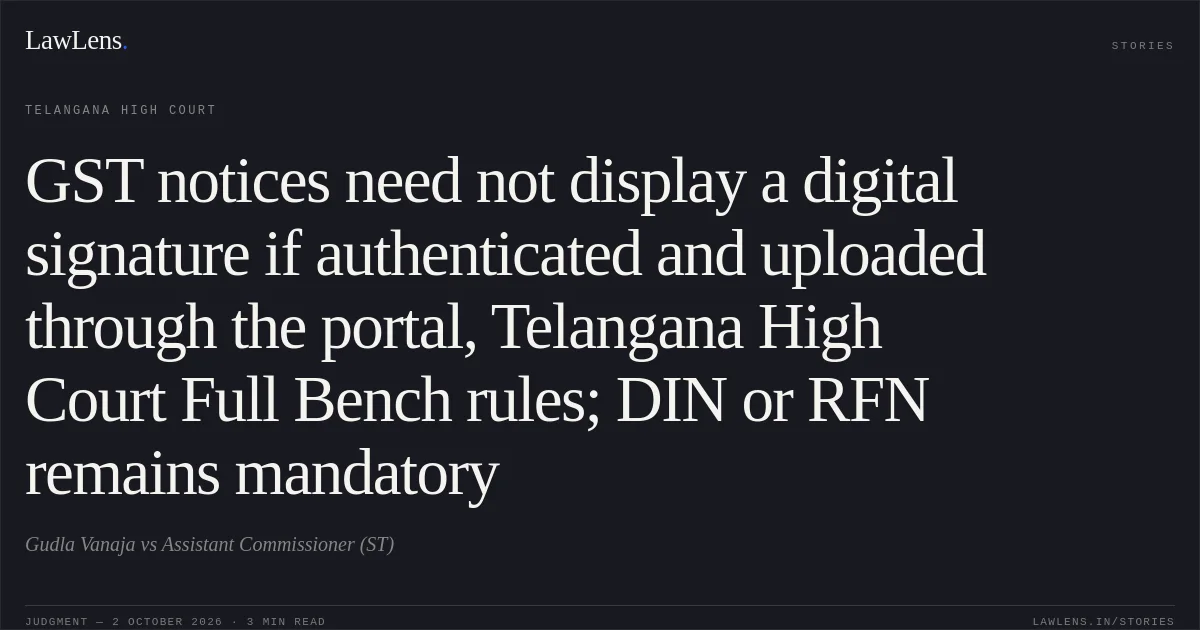
The Full Bench held that a GST notice or order under Chapter XVIII is not invalid merely because its PDF does not display a physical or digital signature, provided it has been electronically authenticated by the proper officer and uploaded on the common portal.
Portal availability constitutes valid service under Section 169(1)(d), and limitation runs from the date of upload.
Source reference: para. 154Absence of both a DIN and an RFN renders the communication invalid.
Source reference: para. 154The contrary view in Bigleap Technologies was held not to state the correct law.
Source reference: para. 154The petitions were disposed of, with liberty to the petitioners to pursue statutory appeals within two weeks and raise other available grounds in those proceedings; no costs were ordered.
Source reference: paras. 155–157Acts & Sections Cited
138 provisions across 5 statutes referred to in this judgment. Each provision opens on LawLens.
Central Goods and Services Tax Act, 2017
Integrated Goods and Services Tax Act, 20171
Information Technology Act, 2000
Bharatiya Sakshya Adhiniyam, 20237
Customs Act,19621
Original Court PDF
Gudla VanajavsAssistant Commissioner (ST)
Click to open original judgment
Original judgment, available to read, download and summarize on LawLens.in