Facts
The prosecution alleged that, on 8 April 2022, police raided a location near Shirur Park, Hubballi, following information that people were gambling and collecting money.
Source reference: p. 2The raid resulted in the seizure of ₹1,300, OC matka chits and a ball pen.
Source reference: p. 2The petitioner sought to quash the proceedings in C.C. No. 7411/2025, arising from Vidyanagar Police Station Crime No. 48/2025, for an alleged offence under Section 78(3) of the Karnataka Police Act, 1963.
Source reference: pp. 2–4He argued that the offence was non-cognizable and that the mandatory procedure under Sections 155(1) and 155(2) of the Code of Criminal Procedure, 1973 (Cr.P.C.) had not been followed.
Source reference: pp. 2–4The State opposed the petition, asserting that the investigation complied with the required procedure.
Source reference: p. 4Issues
1. Whether the police could investigate the alleged non-cognizable offence without a valid order of the jurisdictional Magistrate under Section 155(2) Cr.P.C.
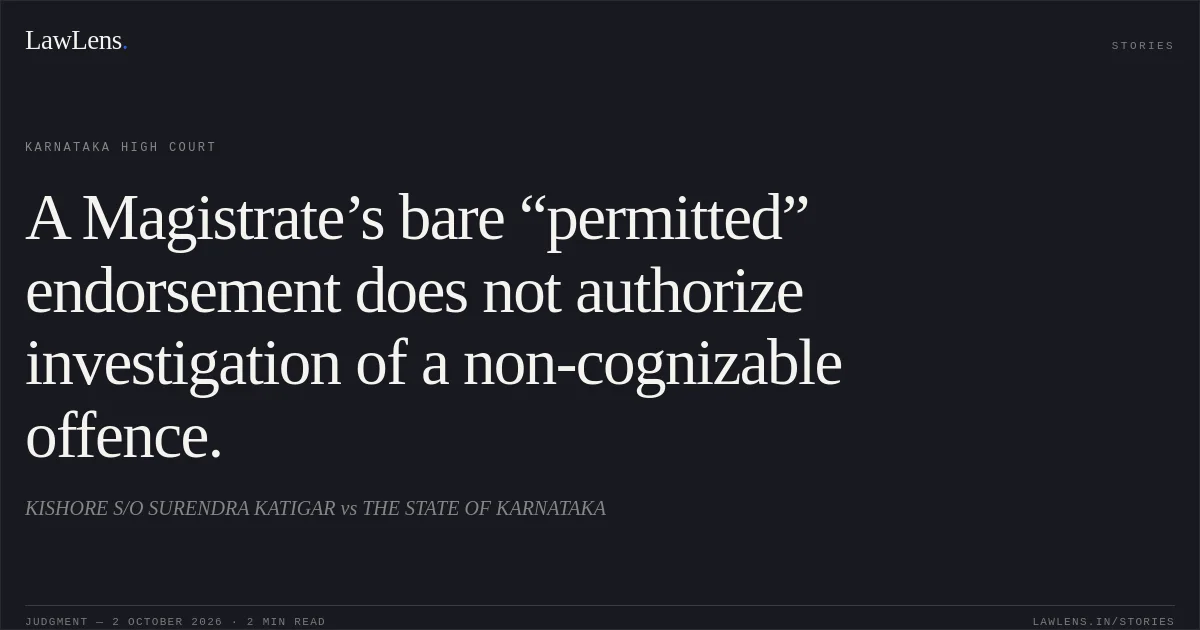
Source reference: pp. 3–62. Whether the Magistrate’s endorsement “Permitted” on the police requisition constituted a valid order authorising investigation.
Source reference: pp. 7–83. Whether the proceedings against the petitioner were liable to be quashed.
Source reference: p. 8Law Applied
Sections 155(1) and 155(2) Cr.P.C. require the officer in charge, upon receiving information concerning a non-cognizable offence, to record its substance and refer the informant to the Magistrate; a police officer may not investigate such an offence without an order from a Magistrate empowered to try or commit the case.
Source reference: pp. 4–6In Vaggeppa Gurulinga Jangaligi v. State of Karnataka, ILR 2020 KAR 630, the Karnataka High Court held that the Magistrate must apply judicial mind to the requisition, record a reasoned finding that investigation is warranted, and specify the rank and designation of the investigating officer; a bare endorsement such as “Permitted” on the requisition is not a valid order under Section 155(2) Cr.P.C.
Source reference: pp. 5–7Reasoning
The Court accepted that the alleged offence under Section 78(3) of the Karnataka Police Act was non-cognizable and therefore required compliance with Sections 155(1) and 155(2) Cr.P.C.
Source reference: p. 5The Magistrate had made only the endorsement “Permitted” on the police requisition.
Source reference: pp. 7–8Applying Vaggeppa, the Court found that this did not demonstrate judicial application of mind or constitute a valid order authorising investigation.
Source reference: pp. 7–8The Court also noted that no incriminating articles had been recovered from the petitioner.
Source reference: p. 8In these circumstances, the police lacked authority to investigate and file the final report.
Source reference: p. 8Holding
The Court allowed the petition and quashed the proceedings against the petitioner, accused No. 1, in C.C. No. 7411/2025, arising from Crime No. 48/2025 of Vidyanagar Police Station, for the offence under Section 78(3) of the Karnataka Police Act.
Acts & Sections Cited
4 provisions across 3 statutes referred to in this judgment. Each provision opens on LawLens.
Bharatiya Nagarik Suraksha Sanhita, 20231
Code of Criminal Procedure, 19732
KARNATAKA POLICE ACT, 1963.1
Original Court PDF
KISHORE S/O SURENDRA KATIGARvsTHE STATE OF KARNATAKA
Click to open original judgment
Original judgment, available to read, download and summarize on LawLens.in