Facts
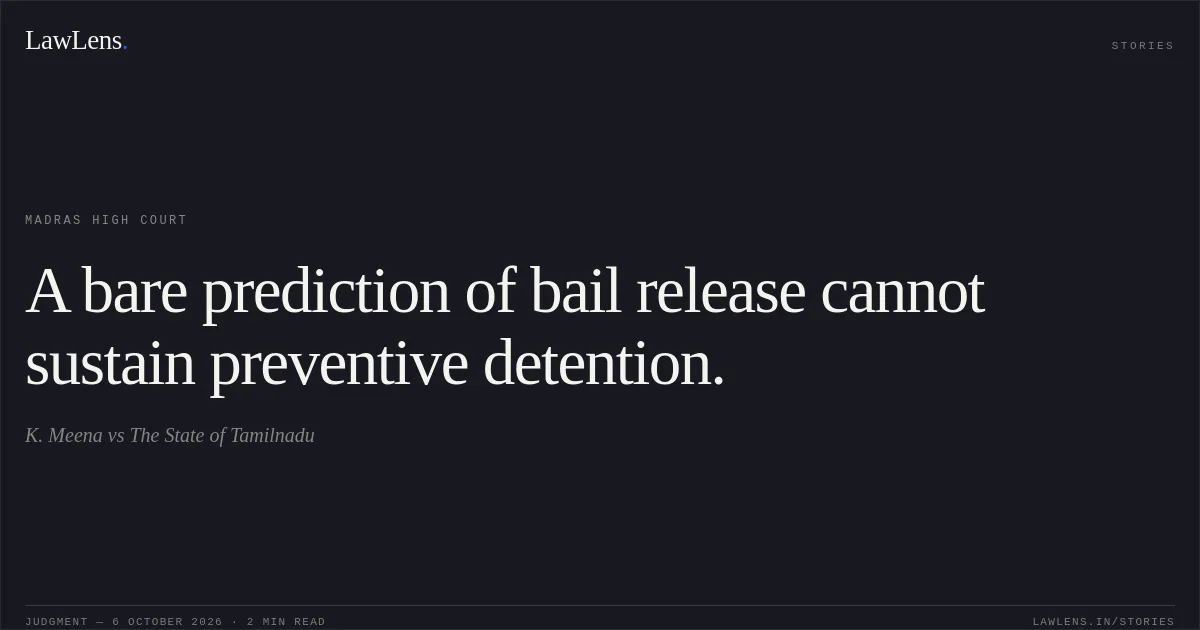
The petitioner, the mother of Chandru, challenged his preventive detention as a “Goonda” under Section 2(f) of the Tamil Nadu Act 14 of 1982.
Source reference: p. 1–2The District Collector and District Magistrate made the detention order on 1 June 2026.
Source reference: p. 1–2The petitioner contended that Chandru had not applied for bail, yet the detaining authority inferred that he was likely to be released by relying on another case.
Source reference: p. 1–2The High Court considered whether that inference was supported by cogent material.
Source reference: p. 1–2Issues
1. Whether the detaining authority could validly conclude that the detenu was likely to be released on bail when he had filed no bail application.
Source reference: p. 2–32. Whether reliance on another bail case, without disclosing facts demonstrating that it was materially similar, provided cogent material for that conclusion.
Source reference: p. 3Law Applied
Article 226 of the Constitution empowers the High Court to examine the legality of detention.
Source reference: p. 3–8Under Section 2(f) of the Tamil Nadu Act 14 of 1982, a person may be classified as a “Goonda,” but preventive detention must satisfy the applicable legal requirements.
Source reference: p. 3–8Where a person is already in custody, a detention order based on the anticipated likelihood of release on bail requires reliable material supporting that likelihood.
Source reference: p. 3–8As reiterated in *Alagu v. State of Tamil Nadu*, drawing on *Rekha v. State of Tamil Nadu* and *Huidrom Konungjao Singh*, a pending bail application may support such an inference; absent one, a relevant exception may arise where a similarly situated co-accused in the same case has been granted bail.
Source reference: p. 3–8The authority must disclose sufficient details of the comparable bail case; a bare assertion is ipse dixit and cannot sustain detention.
Source reference: p. 3–8Reasoning
Chandru had filed no bail application, and the detaining authority relied on another case without disclosing facts showing that it involved a similarly situated co-accused or otherwise provided a sound basis to expect his release.
Source reference: p. 2–3, 7–8The Court found no cogent material supporting the authority’s subjective satisfaction that bail was likely.
Source reference: p. 2–3, 7–8Applying the principles discussed in *Alagu* and the authorities quoted therein, it held that the conclusion was a mere ipse dixit and that the detention order was therefore unsustainable.
Source reference: p. 2–3, 7–8Holding
The Court answered the issues against the State, allowed the Habeas Corpus Petition, and set aside the detention order dated 1 June 2026 in Cr.M.P. No. 38/Goonda/2026.
It directed Chandru’s release forthwith, unless his detention was required in connection with another case.
Source reference: p. 8Acts & Sections Cited
1 provisions across 1 statute referred to in this judgment. Linked provisions open on LawLens.
Tamil Nadu Act 14 of 1982 (alias, unresolved)1
Original Court PDF
K. MeenavsThe State of Tamilnadu
Click to open original judgment
Original judgment, available to read, download and summarize on LawLens.in