01Facts
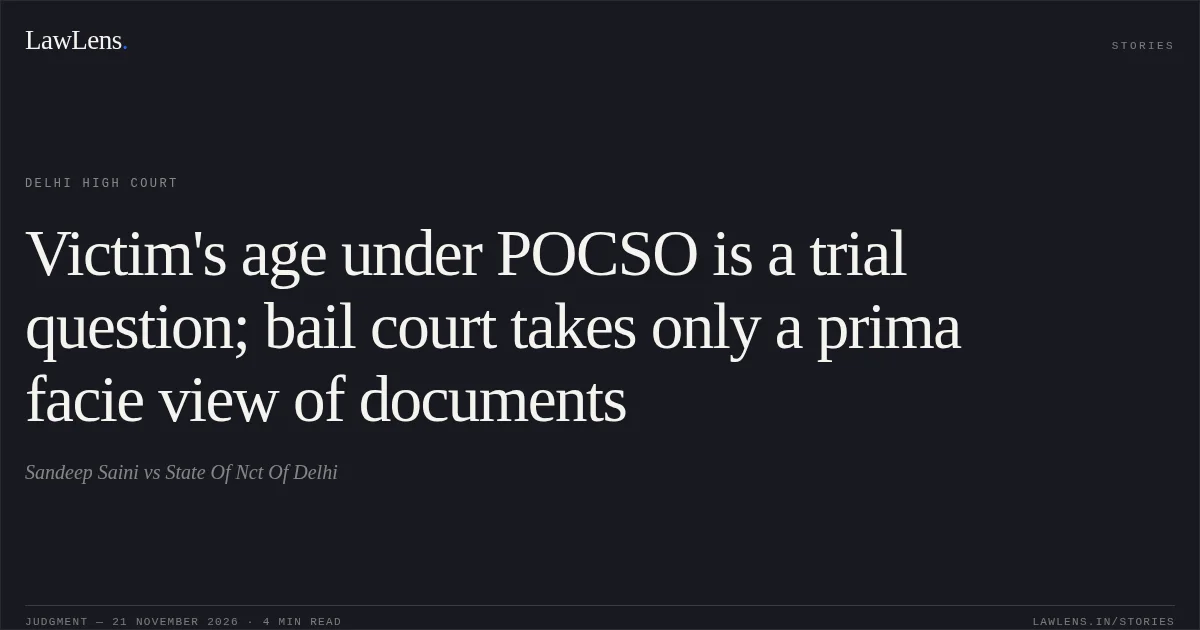
The applicant sought regular bail under Section 483 of the Bharatiya Nagarik Suraksha Sanhita, 2023 (“BNSS”), in a case arising from FIR No. 381/2023 registered under Sections 363, 368, 376, 328 and 34 of the Indian Penal Code, 1860, and Sections 6 and 21 of the Protection of Children from Sexual Offences Act, 2012 (“POCSO Act”)
p. 1 · ¶ 1The victim, aged 14 years and 8 months at the time, initially stated that she had left home voluntarily and had no complaint against anyone; she later alleged that the applicant had sexually assaulted her
pp. 2–4 · ¶ 3.3–3.6The applicant was aged 20 years and 4 months at the time of the incident
p. 6 · ¶ 15.3The prosecution evidence was underway: the victim and her father had completed their examination-in-chief, while 19 prosecution witnesses were listed.
p. 4, 6, 11 · ¶ 6, 15.4, 22The applicant had been in custody for approximately three years and two months, had no criminal antecedents, and the trial was expected to take time.
p. 4, 6, 11 · ¶ 6, 15.4, 2202Issues
i.1. Whether the applicant should be granted regular bail, notwithstanding the gravity of the alleged offences under the IPC and POCSO Act
pp. 5–6 · ¶ 12–15ii.2. Whether the circumstances relied upon by the applicant—including the parties’ alleged romantic relationship, the victim’s initial statement, the applicant’s period in custody, and the anticipated duration of trial—tilted the balance in favour of bail
pp. 7–8, 16–20 · p. 11 · ¶ 2203Law Applied
Section 483 BNSS empowers the High Court to grant bail.
p. 1 · ¶ 1The court considered the nature and seriousness of the POCSO allegations, while applying the approach in Dharmender Singh v. State (Govt. of NCT), which identifies real-life factors relevant to post-charge bail in POCSO cases, including the ages of the victim and accused, their comparative ages, the alleged use of threats or violence, the accused’s conduct and access to the victim, and other circumstances bearing on the alleged offence and risk to the trial.
pp. 8–10 · ¶ 21It also relied on Praduman v. State (Govt. of NCT of Delhi) and Another, where the Court treated a pre-existing romantic relationship, the parties’ ages, and inconsistencies in statements as relevant mitigating considerations in deciding bail.
pp. 8–11 · ¶ 21These considerations inform the bail decision; they do not determine the merits of the charges.
Provisions in the judgment · 11 · Linked ones open on LawLens
Bharatiya Nagarik Suraksha Sanhita, 2023 Section 483
Indian Penal Code, 1860 Section 363Section 368Section 376Section 328Section 34
Protection of Children from Sexual Offences Act, 2012 Section 6Section 21Section 29
Code of Criminal Procedure, 1973 Section 161Section 164
04Reasoning
The Court noted the victim’s differing accounts, including her initial statement that she had left home of her own accord and had no complaint, alongside the later allegation of sexual assault.
p. 7 · ¶ 16–17It also considered material indicating a romantic relationship, the parties’ ages, the applicant’s lengthy custody, absence of criminal antecedents, and the fact that only two of 19 prosecution witnesses had been examined.
pp. 7–8 · ¶ 18–20 · p. 11 · ¶ 22Weighing these circumstances against the seriousness of the allegations, the Court treated them as mitigating factors supporting release on bail, while expressly reserving the merits for trial.
pp. 7–8 · ¶ 20 · p. 12 · ¶ 2505Holding
The Court allowed the bail application and directed the applicant’s release on a personal bond of ₹30,000 with one surety for the like amount, subject to conditions including attendance at every hearing, disclosure of residential address and mobile number, reporting to the jurisdictional police station every Monday at 9:00 a.m., and non-interference with witnesses or evidence.
pp. 11–12 · ¶ 23–24The Court clarified that its observations were solely for deciding bail and would not affect the trial.
p. 12 · ¶ 25Original Court PDF
Vicky @ VikkyvsState (Govt. Of Nct Of Delhi) & Anr.
Click to open original judgment
Original judgment, available to read, download and summarize on LawLens.in