01Facts
The petitioner sought quashing under Section 528 of the Bharatiya Nagarik Suraksha Sanhita, 2023 (BNSS) of FIR No. 626/2021 dated 30 January 2021, registered at PS Hari Nagar, West District, Delhi, under Sections 376/406/506 IPC, and all consequential proceedings, on the basis of settlement.
¶ 1The parties executed a Settlement Agreement dated 2 September 2026.
¶ 4The agreed consideration was Rs. 15,50,000, of which Rs. 10,00,000 had been paid earlier and Rs. 5,50,000 was paid on the date of hearing by Demand Draft dated 17 November 2026, which respondent no. 2 accepted.
¶ 5–6Respondent no. 2 stated she married another person on 8 December 2024 and does not wish to pursue the matter.
¶ 7–8On the Court's query, she stated that she herself uploaded her bio-data to Jeevansathi.com, that her parents were not involved, that she contacted the petitioner through her account, and that they were in a relationship for some time.
¶ 9–10She further stated she wishes to move on with her life.
¶ 11The learned APP stated the State had no serious objection.
¶ 13The FIR had been pending since 2021 and the State machinery had been engaged over a prolonged period.
¶ 2002Issues
i.1. Whether the High Court, under Section 528 BNSS, can quash an FIR registered under Section 376 IPC (a non-compoundable offence) on the basis of a settlement between the parties.
¶ 14–15ii.2. Whether, on the facts, quashing the FIR would secure the ends of justice and prevent abuse of process, notwithstanding the gravity of the offence and the pendency of proceedings since 2021.
¶ 14, 18, 2003Law Applied
Section 528 BNSS and the inherent power of the High Court to secure the ends of justice and prevent abuse of process, which may be exercised to quash proceedings even for non-compoundable offences where parties have settled and no overriding public interest is adversely affected.
¶ 15Gian Singh v. State of Punjab, (2012) 10 SCC 303, which holds that serious offences such as rape or murder cannot be quashed on settlement, whereas offences of predominantly civil flavour, including those arising from matrimony or family disputes, may be quashed where continuation would be futile.
¶ 16Parbatbhai Aahir v. State of Gujarat, (2017) 9 SCC 641, which holds that the power under Section 482 CrPC (now Section 528 BNSS) is distinct from compounding under Section 320 CrPC, may be exercised for non-compoundable offences, must weigh the nature and gravity of the offence, and may be exercised for offences with a predominantly civil character where the possibility of conviction is remote.
¶ 17Madhukar v. State of Maharashtra, 2025 SCC OnLine SC 1415, which holds that although Section 376 IPC offences are grave, FIRs under it may be quashed to secure the ends of justice depending on the facts of each case.
¶ 19Provisions in the judgment · 7 · Linked ones open on LawLens
Bharatiya Nagarik Suraksha Sanhita, 2023 Section 528
Indian Penal Code, 1860 Section 376Section 406Section 506Section 407
Code of Criminal Procedure, 1973 Section 320Section 482
04Reasoning
The Court first recognised that Section 376 IPC is a grave offence, so settlement-based quashing is ordinarily discouraged, but held that the inherent power is not constrained by a rigid formula and must be assessed on the facts.
¶ 18–19On the facts, the Court relied on respondent no. 2's categorical statement, made in the Court's presence, that the relationship arose from a consensual association initiated through an online matrimonial platform, that she has since married another person, and that she does not wish to continue the prosecution.
¶ 9–11Her consent, the completed payment of Rs. 15,50,000, and the State's lack of serious objection indicated that the dispute is predominantly personal and that continuation of the trial was unlikely to produce a conviction, which supported quashing under the Gian Singh and Parbatbhai framework.
¶ 13, 15–16The Court also treated the FIR's pendency since 2021 and the prolonged use of State machinery as an adverse factor, which justified a monetary cost to be paid to the Bar Council of Delhi Indigent and Disabled Lawyers Fund.
¶ 20–21The judgment does not expressly analyse the nature of the offence in depth beyond citing the governing principles, and it does not address the public-interest element separately from the State's non-objection.
¶ 13, 18–2005Holding
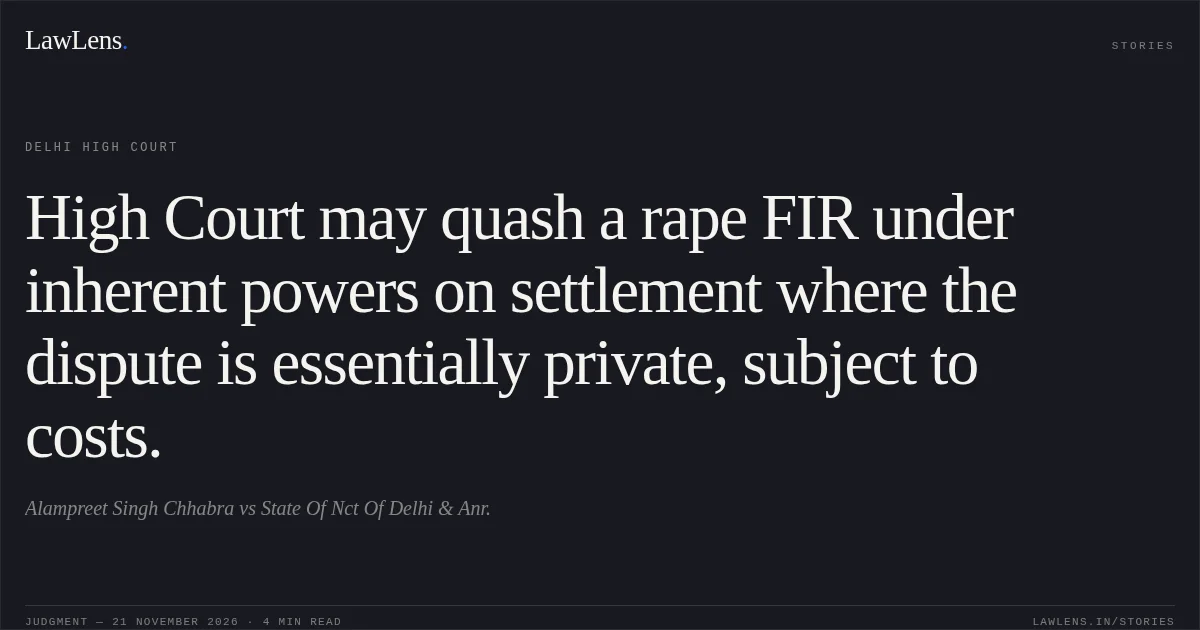
An FIR under Section 376 IPC (along with Sections 406/506 IPC) may be quashed under Section 528 BNSS on settlement where the circumstances justify it, and the Court found no impediment to doing so here.
¶ 14–15, 20The petition was allowed and FIR No. 626/2021 (PS Hari Nagar) and all consequential proceedings were quashed, subject to the petitioner paying costs of Rs. 20,000 to the Bar Council of Delhi Indigent and Disabled Lawyers Fund within two weeks.
¶ 21–24The petition was disposed of accordingly.
¶ 25Original Court PDF
Alampreet Singh ChhabravsState Of Nct Of Delhi & Anr.
Click to open original judgment
Original judgment, available to read, download and summarize on LawLens.in