01Facts
The appellants, Sandeep @ Kuldeep (husband), Ram Poojan Yadav (father-in-law) and Smt. Urmila (mother-in-law), were convicted under Sections 304-B/34 and 498-A/34 IPC by the Additional Sessions Judge (Outer District, Rohini) in Sessions Case No. 69/2008 and sentenced to seven years' simple imprisonment under Section 304-B/34, with no separate sentence under Section 498-A.
¶ 1The deceased, Anjana, married Sandeep on 20.04.2008.
¶ 2 · ¶ 12The prosecution alleged that the appellants demanded a motorcycle, which was not provided at the wedding, and later Rs. 1.5 lakh, and harassed her for non-fulfilment.
¶ 2She visited her parental home from 27.04.2008 to 18.05.2008 and complained of the demands; after her return she said she was not permitted to make calls freely.
¶ 2On 17.06.2008 she telephoned her brother PW-4 weeping about the demands, and a further conversation took place that evening.
¶ 2–3On 21.06.2008, 62 days after marriage, she was found hanged in the upper-floor room of the matrimonial home, with the room reportedly bolted from inside.
¶ 3, 12, 21The post-mortem attributed death to asphyxia from ante-mortem hanging.
¶ 12Viscera showed 55.5 mg/100 ml ethyl alcohol.
¶ 9 · ¶ 29The defence case was suicide, with the deceased described as reserved and silent, and neighbours and a maternal uncle (DW-3) testified that no dowry demand existed.
¶ 5, 9, 21–2302Issues
i.1. Whether the death of the deceased occurred "otherwise than under normal circumstances" within seven years of marriage, satisfying the first two ingredients of Section 304-B IPC.
¶ 11 · ¶ 12ii.2. Whether the deceased was subjected to cruelty or harassment by the appellants in connection with a dowry demand, and whether such cruelty was inflicted "soon before her death."
¶ 13 · ¶ 24 · ¶ 31iii.3. Whether the reliability of the principal prosecution witnesses (PW-1, PW-2, PW-4) and the neutral/defence witnesses (PW-13, DW-1 to DW-3) is undermined by earlier omissions and inconsistencies.
¶ 15–23iv.4. Whether the unexplained presence of alcohol in the deceased's viscera shifts an additional burden onto the inmates of the house.
¶ 29v.5. Whether the presumption under Section 113-B of the Indian Evidence Act, 1872 stands attracted and has been rebutted by the appellants.
¶ 32 · ¶ 3303Law Applied
Section 304-B IPC requires five ingredients: death by burns, bodily injury or otherwise than under normal circumstances; occurrence within seven years of marriage; cruelty or harassment by the husband or relative; such cruelty being connected with a dowry demand; and cruelty "soon before her death."
¶ 11Section 113-B of the Evidence Act, under which the court must presume dowry death once the ingredients are established unless rebutted by cogent evidence.
¶ 32Section 498-A IPC, with no separate sentence following Shanti v. State of Haryana, (1991) 1 SCC 371.
¶ 1Bharwada Bhoginbhai Hirjibhai v. State of Gujarat, (1983) 3 SCC 217, under which a witness is not a "human tape-recorder" and minor lapses of memory do not destroy core testimony.
¶ 15Section 162 CrPC, under which a Section 161 statement is not substantive evidence and can only be used to contradict.
¶ 27Hans Raj Sharma v. State NCT of Delhi, 2010 SCC OnLine Del 920, on persistent demands causing mental agony.
¶ 25Kans Raj v. State of Punjab, (2000) 5 SCC 207, requiring specific proof of overt acts against non-husband relatives.
¶ 26Satbir Singh v. State of Haryana, (2021) 6 SCC 1, on a live and proximate link between demand and death.
¶ 26The principle that "soon before death" is not synonymous with "immediately before" and requires a live link.
¶ 31Section 106 of the Evidence Act, Trimukh Maroti Kirkan v. State of Maharashtra, 2006 AIR SCW 5300, and State of Rajasthan v. Jaggu Ram, 2008 Cri LJ 1039 (SC), for unexplained circumstances within the home.
¶ 29Provisions in the judgment · 8 · Linked ones open on LawLens
Code of Criminal Procedure, 1973 Section 374Section 428Section 176Section 313Section 161Section 162Section 293
Indian Penal Code, 1860 Section 34
04Reasoning
The Court held the first two ingredients established, since a suicidal hanging within two months of marriage is "otherwise than under normal circumstances."
¶ 12PW-1's omission of the motorcycle demand in the hurried SDM statement (Ex.PW1/A) was attributed to shock and was not treated as a material omission, since the demand appeared in his same-day Section 161 statement and was consistent thereafter.
¶ 15PW-2's claim of a direct telephone conversation with the deceased was not accepted, as it was absent from his earlier statement, but his testimony was relied on to the extent corroborated.
¶ 16PW-4's confusion over whether he had been examined by the SDM or the police did not undermine his account, and the SIM registered to a third party did not cast doubt on his user of it.
¶ 18The call detail records (Ex.PW14/B, Ex.PW16/B) independently corroborated a call on 17.06.2008 between the deceased's family and the appellants' phone, which the appellants admitted.
¶ 19, 31PW-13's testimony was given limited weight, as he was a neighbour who had attended the marriage on the accused side and intervened to close the matter, showing partiality.
¶ 20DW-1 and DW-2 proved only the physical circumstances of discovery, and their claim that the deceased looked "happy" conflicted with the appellants' own Section 313 statements that she was silent and withdrawn.
¶ 21–22DW-3's testimony was discounted in light of his family ties to the accused and the admission that Appellant No. 3 had described the deceased as "mum."
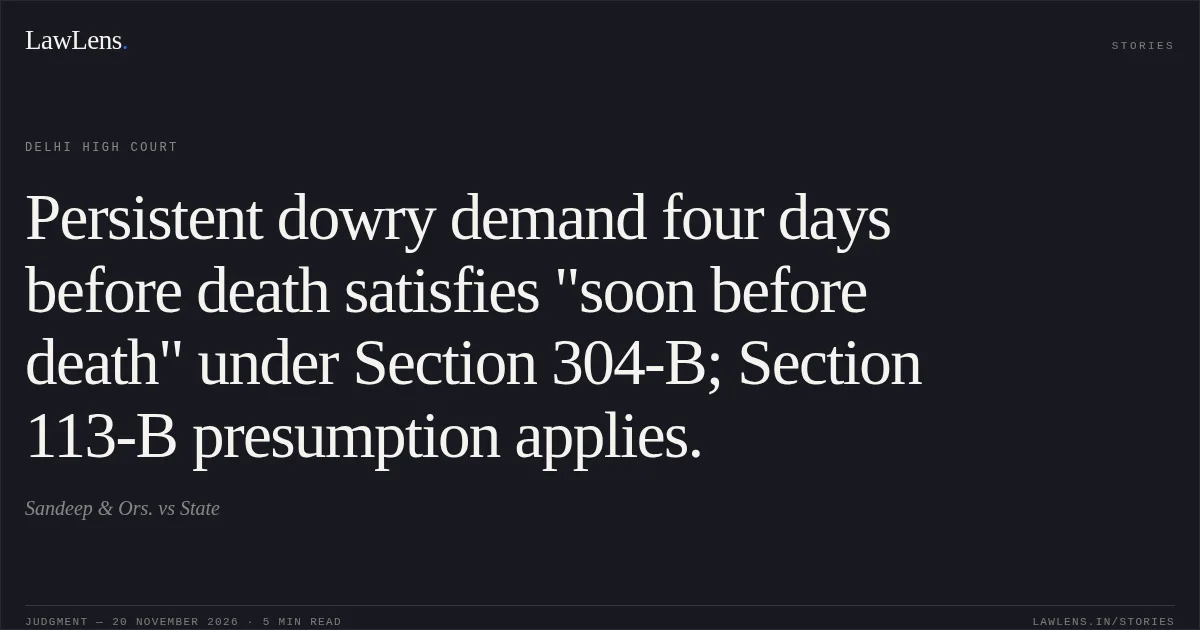
¶ 23The Court found a persistent demand from the first week of marriage, repeated after 18.05.2008 and pressed four days before death.
¶ 24The demand for a motorcycle and Rs. 1.5 lakh, attributed to all three appellants and corroborated by call records, distinguished Kans Raj.
¶ 27The "taunt" about poverty recorded only in Section 161 statements was not treated as proved under Section 162 CrPC.
¶ 27The alcohol finding was not treated as insignificant. Because it lay within the knowledge of the inmates, Section 106 imposed a duty of explanation, and its absence was an additional link.
¶ 29The "factory" purpose of the demand did not take it outside the definition of dowry.
¶ 30The proximity requirement was met because the last complaint was made four days before death and corroborated by records.
¶ 31The appellants' defence did not rebut the presumption under Section 113-B.
¶ 3305Holding
The Court answered all issues in favour of the prosecution. The five ingredients of Section 304-B IPC were established beyond reasonable doubt.
¶ 12, 24–31The Section 113-B presumption stood un-rebutted.
¶ 32–33The Court held that the appellants had subjected the deceased to continuing harassment for a motorcycle and Rs. 1.5 lakh in connection with dowry, and that the harassment persisted up to a point proximate to death.
¶ 30–31The appeal was dismissed, and the judgment dated 19.09.2009 and order on sentence dated 30.09.2009 were upheld. The appellants were directed to surrender before the Trial Court within two weeks to undergo the remaining sentence, with set-off under Section 428 CrPC. The Trial Court record was ordered returned.
¶ 34–37Original Court PDF
Sandeep & Ors.vsState
Click to open original judgment
Original judgment, available to read, download and summarize on LawLens.in